
Key Point | Details |
Intended Audience | Operators of Theme Park and businesses planning related goods, services or brand development. |
Primary Classes | Class 41, Class 43, Class 35 |
Extension Classes | Class 9, Class 25, Class 28, Class 35, Class 39, Class 41 |
Analysis Premise
In trademark legal practice and market operations, a Theme Park is defined as a comprehensive service model that operates physical amusement venues. The core of this business lies in providing mechanical rides, various performances, and themed exhibitions, while simultaneously operating catering services and souvenir retail within the park. This analysis is based on this typical physical park operation model and does not cover pure digital game development or single-purpose exhibition activities.
Primary Classes
For theme park operators, the foundation of trademark protection must cover the operation of physical facilities, consumer services within the park, and overall brand commercial operations. The following are the three most critical categories for theme parks:
Class | Application Scenario / | Examples of Goods/Service Descriptions |
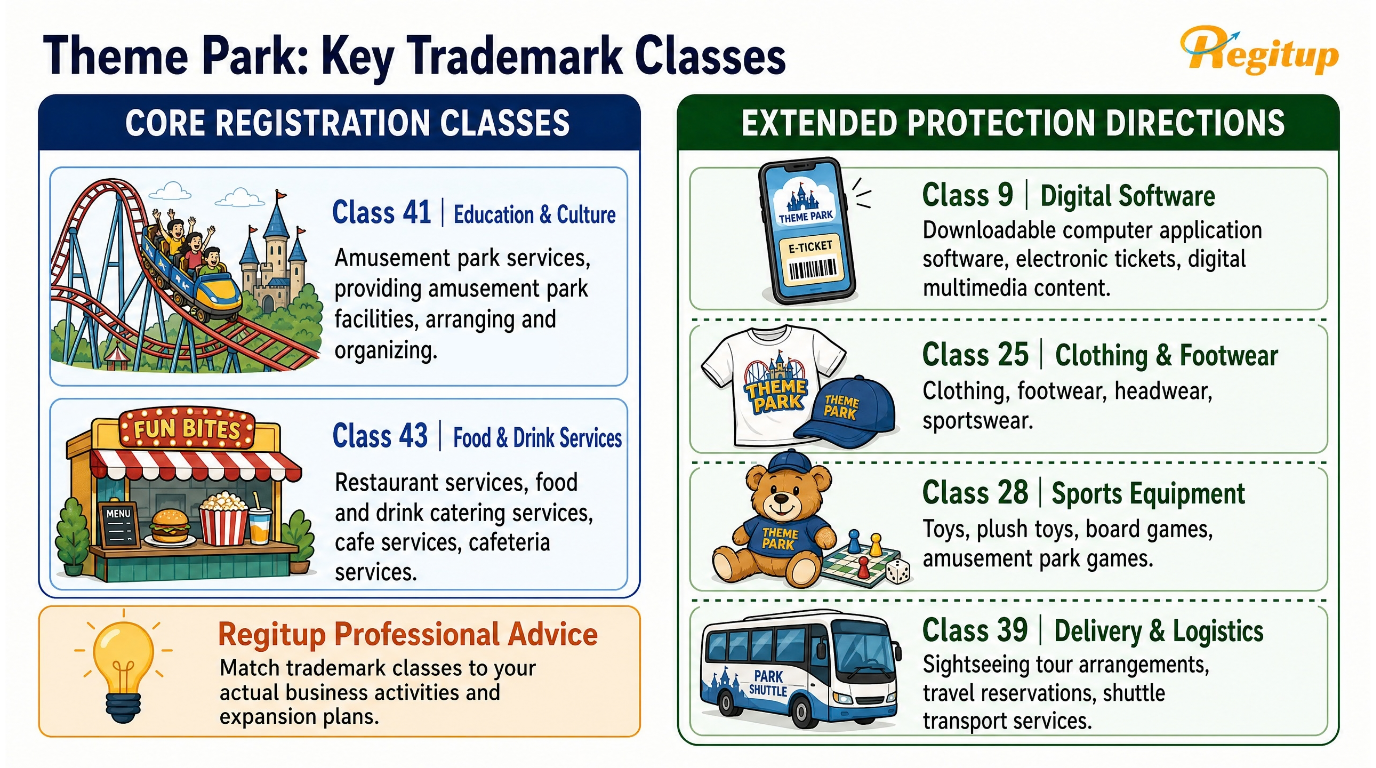
Class 41 | The core business of a theme park, covering all entertainment and cultural activities provided to visitors. | Amusement park services, providing amusement park facilities, arranging and organizing themed exhibitions, live performance services. |
Class 43 | Theme parks typically house numerous restaurants, cafes, or snack stalls; catering revenue is a significant source of income. | Restaurant services, food and drink catering services, cafe services, cafeteria services. |
Class 35 | Theme parks are highly branded industries involving extensive advertising, loyalty programs, and retail displays of merchandise within the park. | Presentation of goods on communication media for retail purposes, advertising and marketing, business management consultancy. |
Explanation of Class Boundaries
Class 41 primarily protects the "activity itself" and the "provision of facilities," such as the operation of roller coasters or theatrical performances. Class 43 focuses on the "provision of space and food," ensuring that the catering brands within the park are not misappropriated by others. The importance of Class 35 lies in protecting the park's rights as a "business entity," particularly in promoting park activities, operating official stores, and managing large member databases. Omitting Class 35 could allow competitors to use similar names in marketing services or retail channels, leading to consumer confusion.
Extension Classes Based on Business Models
As a theme park brand grows, its commercial footprint often extends to peripheral merchandise, digital interaction, and cross-industry licensing. The following extension classes are recommended based on specific business expansion directions:
Class | Application Scenario | Potential Scope of Services |
Class 9 | If developing a park guide app, electronic ticketing system, or interactive AR/VR software. | Downloadable computer application software, electronic tickets, digital multimedia content. |
Class 25 | If producing and selling apparel, hats, and other merchandise featuring the park logo or characters. | Clothing, footwear, headwear, sportswear. |
Class 28 | If developing exclusive plush toys, models, or gaming equipment for the theme park. | Toys, plush toys, board games, amusement park games. |
Class 39 | If providing shuttle transportation services, park sightseeing arrangements, or tour planning. | Sightseeing tour arrangements, travel reservations, shuttle transport services. |
Class 45 | If licensing the park's character IP or brand to other manufacturers for commercial development. | Intellectual property licensing, copyright management, trademark licensing services. |
Strategic Significance of Extension Classes
These extension classes are not necessarily required for all operators in the early stages but should be selected based on the specific path of brand monetization. For instance, if your theme park possesses strong character IP (Intellectual Property), Class 45 licensing services and Class 28 toy merchandise will be key to defending against infringement. If the park emphasizes a digital experience, software protection under Class 9 should not be overlooked.
Conclusion
In summary, the trademark layout for operating a theme park should center on the Golden Triangle of Class 41 (Entertainment), Class 43 (Dining), and Class 35 (Brand Management). Building on this foundation, operators should flexibly extend into Classes 9, 25, 28, 39, and 45 according to their needs for peripheral merchandise development, digitalization, and IP licensing.
It is important to note that the recommendations provided in this article are based on an analysis of general business models. During the actual application process, the description of specific goods or services, the final arrangement of classes, and the actual scope of trademark protection may vary depending on the trademark examination guidelines of different countries or regions and the specific business content of the enterprise. Before formally submitting an application, it is recommended to consult with a professional institution to ensure the accuracy of the protection strategy.
Complete Your Trademark Application with Regitup
Trademark registration is a professional undertaking involving precise classification and legal judgment. The Regitup team possesses deep industry knowledge and practical experience to help you verify complex classification data, prepare professional application documents, and submit applications to official authorities on your behalf, ensuring your theme park brand gains solid legal protection in a competitive market.
Start Your Trademark Registration
Frequently Asked Questions
Q1 : Is registering Class 41 alone enough for a theme park?
Usually, it is not enough. While Class 41 covers core amusement facilities and performance services, theme park revenue often comes from on-site restaurants and merchandise sales. Failing to register Class 43 (Dining) and Class 35 (Brand Retail Management) simultaneously could allow others to use your brand name in similar commercial settings, causing consumer confusion and damaging your brand interests.
Q2 : If I develop a park-specific app, do I need to add Class 9?
Yes. If the app you provide features electronic ticketing, park map navigation, or interactive games, it falls under the category of digital products. Class 41 only protects the provision of physical facilities and cannot effectively prevent others from publishing similar software in app stores. Registering Class 9 ensures the exclusivity of your digital services on mobile platforms.
Q3 : Do gift shops in the park need separate registration?
This depends on your business model. If you are managing overall brand marketing and retail channels, Class 35 is essential. However, if you sell highly recognizable exclusive character merchandise, it is recommended to register for the products themselves, such as Class 28 for toys or Class 25 for apparel, to prevent counterfeit goods from circulating in the market.
Q4 : Which class does character IP licensing to other manufacturers belong to?
This falls under Class 45 for intellectual property licensing services. When your theme park brand or character IP holds market value and you plan to allow third parties to produce co-branded products or conduct commercial promotions through licensing agreements, registering Class 45 provides a clear legal basis for your licensing business and strengthens control over brand value.