
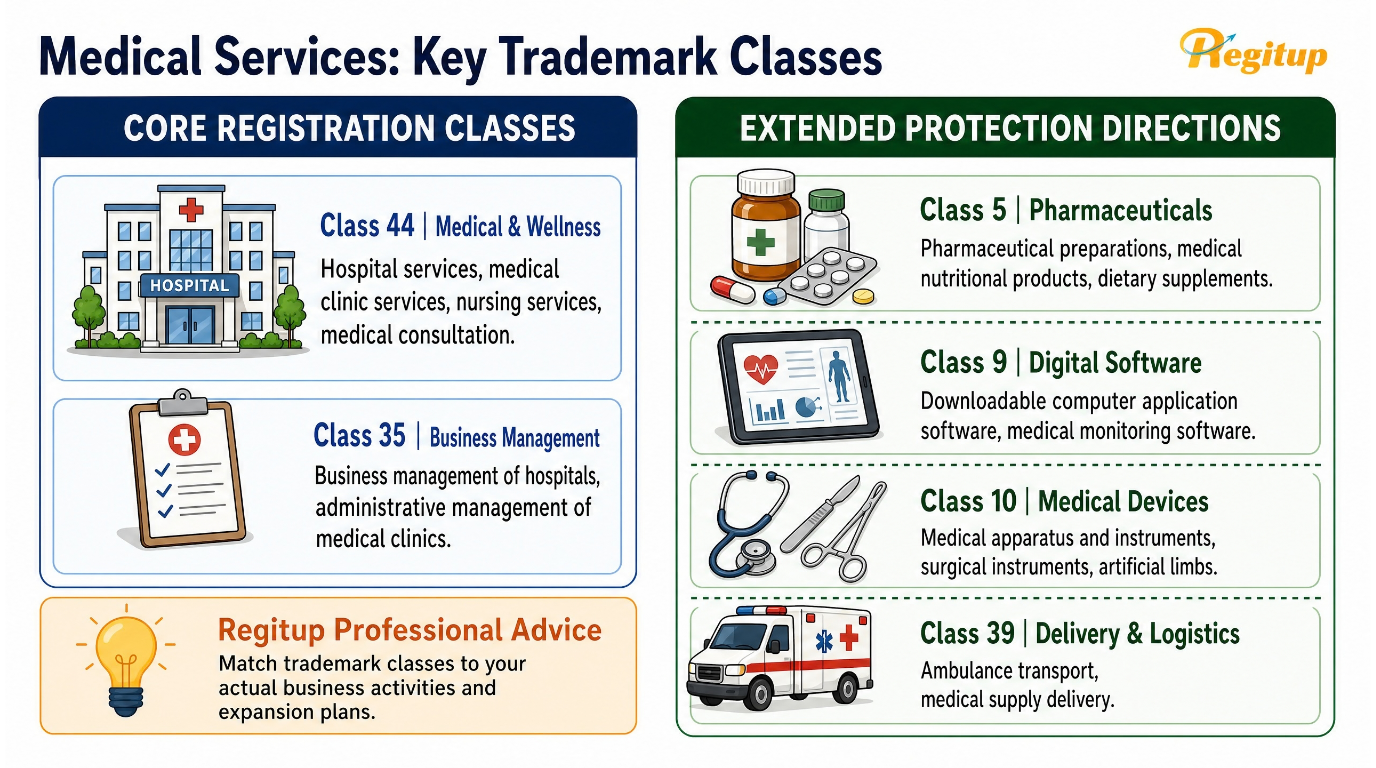
Key Point | Details |
Intended Audience | Operators of Medical Services and businesses planning related goods, services or brand development. |
Primary Classes | Class 44, Class 35 |
Extension Classes | Class 5, Class 9, Class 10, Class 35, Class 39, Class 42 |
Analysis Premise
In this article, medical services center on medical institutions such as hospitals and clinics. These services involve professional medical care provided by licensed physicians and nursing staff, including clinical diagnosis, medication, surgery, and post-operative care, covering both outpatient and inpatient models. The brand value of such services is built on medical expertise and trust; therefore, the trademark layout must precisely cover actual medical activities and the scope of institutional management.
Primary Classes
For most medical institutions, the following two classes constitute the most fundamental line of trademark defense:
Class | Applicable Scenario / | Examples of Goods/Service Descriptions |
Class 44 | Providing direct medical, diagnostic, and nursing services to individuals; this is the foundation of rights for hospitals and clinics. | Hospital services, medical clinic services, nursing services, medical consultation. |
Class 35 | Involves the administrative management and commercial operation of medical institutions, ensuring the brand's exclusive rights at the management level. | Business management of hospitals, administrative management of medical clinics. |
Class 44 protects the practice of "medicine," preventing others from using the same trademark in similar diagnostics. Class 35 focuses on "operations," which is particularly important for medical chains or large groups to prevent confusion in management consultancy services. Both classes must be registered in tandem to fully protect a medical brand.
Extension Classes Based on Business Models
Operators should consider the following extension classes based on their actual activities, with each class corresponding to specific commercial behaviors:
Class | Applicable Scenario | Scope of Services to Consider |
Class 5 | Providing in-house private-label pharmaceuticals or nutritional supplements. | Pharmaceutical preparations, medical nutritional products, dietary supplements. |
Class 9 | Providing independent applications for patient appointments or medical record queries. | Downloadable computer application software, medical monitoring software. |
Class 10 | Developing or selling private-label medical devices or prosthetics. | Medical apparatus and instruments, surgical instruments, artificial limbs. |
Class 39 | Providing patient referral or emergency transportation services. | Ambulance transport, medical supply delivery. |
Class 42 | Engaging in clinical medical research or scientific laboratory services. | Medical research, scientific laboratory services, clinical trials. |
Extension classes should be judged conservatively, targeting only clearly relevant items. For example, if there are no plans to develop an app, registering in Class 9 is unnecessary.
Conclusion
The trademark layout for medical services should center on Class 44, incorporating Class 35 for operational management and other functional extension classes as needed. The actual designated goods or services, class arrangements, and scope of rights will still vary based on local regulations and specific business models. Before applying, it is recommended to conduct a professional class review to ensure there are no gaps in the brand protection network.
Assistance from Regitup for Trademark Applications
Trademark classification involves professional legal judgment. The Regitup team can assist you in verifying information, preparing application documents, and submitting them on your behalf, ensuring your medical brand receives the most appropriate legal protection.
Start Your Trademark Registration
Frequently Asked Questions
Q1 : Does a clinic focusing only on self-paid aesthetic medicine count as Class 44?
Yes, as long as it involves diagnostic or therapeutic actions provided by medical professionals, it falls under the medical services category of Class 44.
Q2 : Do health supplements sold by a hospital need separate registration?
Yes. Health supplements are physical goods and should be registered in Class 5. Class 44 only protects "services" and cannot be extended to cover specific physical products.
Q3 : Is a trademark registration still necessary if I already have a medical license?
A medical license is a government "operating permit," while a trademark protects the exclusive right to the "brand name." Without a registered trademark, others may use the same name to operate their business, leading to brand loss.
Q4 :Which class does a digital medical record system belong to?
If the system is provided to patients as a downloadable app, the core class is Class 9. If it involves technical maintenance, it may also involve Class 42.