
Key Point | Details |
Intended Audience | Operators of E-commerce and businesses planning related goods, services or brand development. |
Primary Classes | Class 35 |
Extension Classes | Class 9, Class 35, Class 36, Class 38, Class 39, Class 42 |
Analysis Premise
In this discussion, "E-commerce" is defined as a business model that displays products, processes orders, and facilitates transactions through internet platforms. This includes retail services connecting suppliers and consumers, whether operating a brand's own shopping website or providing an online marketplace for third-party sellers. This analysis focuses on e-commerce operating entities with digital transaction processing capabilities and does not cover simple physical retail or display-only websites.
Primary Classes
The core value of e-commerce lies in the "platform services" and "retail environment" it provides. Under international classification standards, these activities are clearly categorized into classes related to business management and retail services.
Class | Scenario / Why it is a Primary Class | Example Product/Service Descriptions |
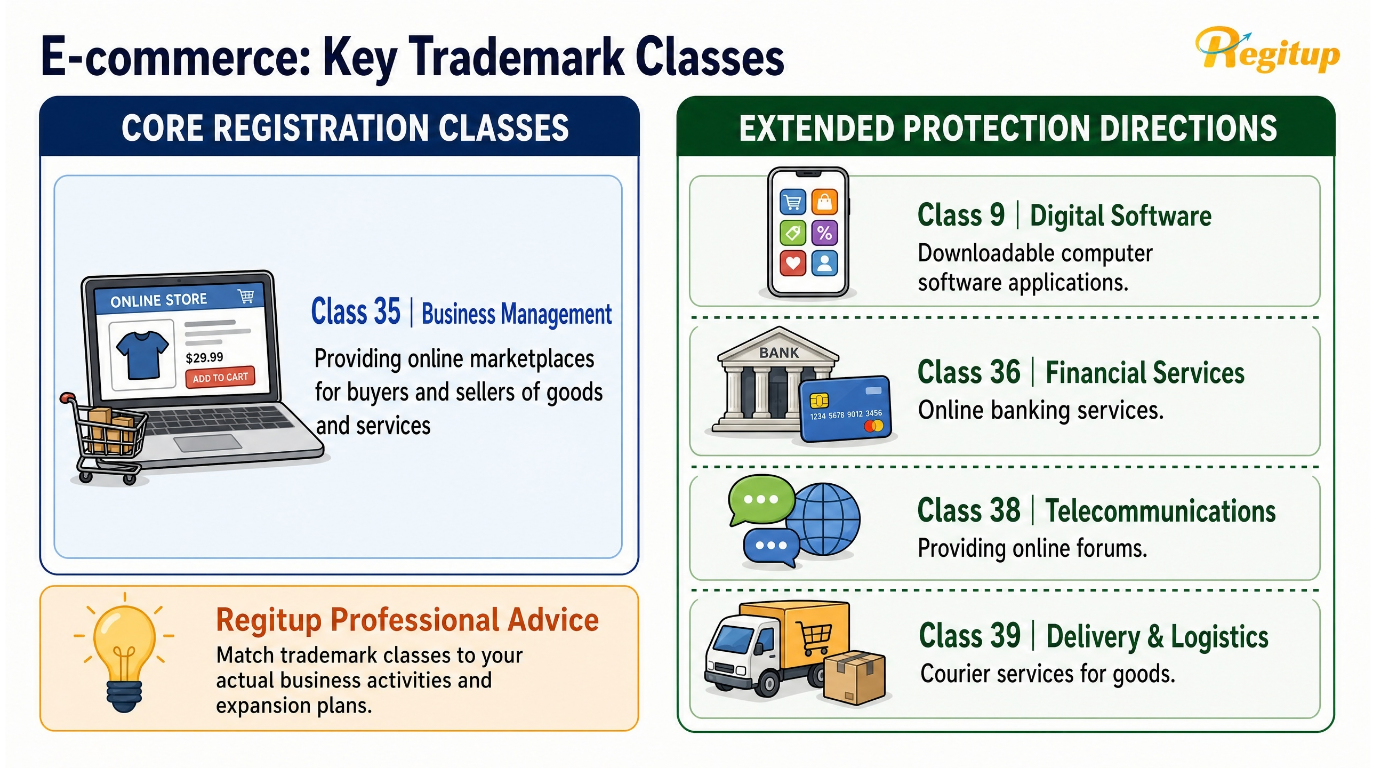
Class 35 | The core retail service model, providing online marketplaces for buyers and sellers, operating retail websites, or handling business management affairs. | Providing online marketplaces for buyers and sellers of goods and services; retail services provided via electronic media; presentation of goods on communication media for retail purposes. |
The essence of Class 35 is "providing convenience." For an e-commerce platform, as long as it provides a digital environment for consumers to search, compare prices, and complete purchases, the brand must be protected in this class. Even when selling own products on a proprietary website, registering in Class 35 has become an industry standard to protect overall business operations and prevent competitive misleading.
Extension Classes Based on Business Models
As business models diversify, e-commerce operators often expand into technology development, logistics, or financial payments. The following are recommended extension classes based on specific activities:
Class | Applicable Scenario | Potential Scope of Services |
Class 9 | Providing a downloadable mobile shopping app for users to install. | Downloadable computer software applications; downloadable e-wallet software. |
Class 36 | Involving online payment processing, e-wallets, or financial intermediary services. | Online banking services; electronic funds transfer; financial processing services. |
Class 38 | Providing built-in forums, communities, or instant messaging features within the platform. | Providing online forums; electronic bulletin board services; digital file transmission. |
Class 39 | Having a proprietary logistics system or being deeply involved in product packaging and delivery. | Courier services for goods; packaging of goods; transport brokerage. |
Class 42 | Providing cloud technology platforms, SaaS, or non-downloadable online software. | Providing online non-downloadable computer software; hosting digital content; cloud computing services. |
The choice of extension classes should be based on "actual operations" and "future plans." For instance, if only third-party payment gateways are used, the need for Class 36 is lower; however, if there are plans to launch a proprietary digital wallet, then Classes 36 and 9 become critical.
Conclusion
In summary, e-commerce trademark registration centers on Class 35 and extends based on technical architecture (Classes 9 and 42), the logistics chain (Class 39), and payment functions (Class 36).
The scope of trademark protection is not static. The actual designated product or service descriptions, class arrangements, and the final scope of rights will vary depending on the examination criteria of the filing jurisdiction and the specific business. Before submitting an application, it is recommended to conduct a comprehensive review of the revenue structure and future blueprint to ensure that brand assets are granted the most appropriate legal shield.
Assistance from Regitup for Trademark Applications
The subtle nuances of trademark classification often determine the success or failure of brand protection. The Regitup team has extensive experience in cross-border trademark practice and can help you verify official terminology, precisely plan class distribution, and complete the submission process on your behalf. Through professional advice, you can avoid common classification pitfalls and ensure your e-commerce business has a solid legal foundation in the digital market.
Start Your Trademark Registration
Frequently Asked Questions
Q1 : I only sell things online; why do I need to register in Class 35?
Class 35 protects "retail services." In an e-commerce environment, your brand name usually serves as the sign for the shopping environment. Registering in Class 35 prevents others from opening online stores with the same name, which is crucial for brand recognition.
Q2 : My e-commerce site has a mobile version; do I need to register in Class 9?
If users access the mobile version of the site via a browser, it is generally not necessary. However, if you have listed an app in an app store for users to download and install, it is strongly recommended to register in Class 9 to protect the software name from being misappropriated.
Q3 : If I also help sellers deliver goods, is Class 39 mandatory?
If logistics and delivery are a significant part of your business and you provide this service under your own brand, Class 39 provides necessary protection to prevent other logistics companies from using similar names and causing consumer confusion.
Q4 : What is the difference between Class 42 and Class 9 regarding software?
Class 9 is for "downloadable physical files," while Class 42 is for "technical services running in the cloud." Modern e-commerce businesses often utilize both, so both classes are usually considered during planning.
Q5 : After registering in these classes, is my trademark valid worldwide?
Trademark rights are territorial, and their effectiveness is limited to that specific jurisdiction. Although e-commerce transcends borders, legal protection must still follow the procedures of each individual country. It is recommended to arrange trademark layouts for each major operating market separately.