
Key Point | Details |
Intended Audience | Operators of EdTech and businesses planning related goods, services or brand development. |
Primary Classes | Class 41, Class 42, Class 9 |
Extension Classes | Class 9, Class 16, Class 35, Class 38, Class 41, Class 42 |
Analysis Premise
In the modern business environment, EdTech (Educational Technology) refers to a business model that utilizes digital platforms, mobile applications, or online systems to provide knowledge transfer and skill training. Its core encompasses computer information skills training, language instruction courses, and coaching programs designed for professional certifications.
Specifically, the scope of this article focuses on service providers that combine "educational content" with "technological tools." This includes companies operating online teaching platforms, teams developing interactive learning software, and educational institutions providing professional instruction through digital media. The value of this model stems not only from the course content itself but also from a stable and interactive technical platform required to achieve learning objectives.
Primary Classes
For most enterprises engaged in EdTech, brand competitiveness lies in the professionalism of the teaching content and the convenience of the platform. Trademark applications should revolve around the essence of the service (teaching) and the means of implementation (software and platforms). The following are the primary classes that must be prioritized:
Class | Application Scenario / Why it is a Primary Class | Examples of Goods/Service Descriptions |
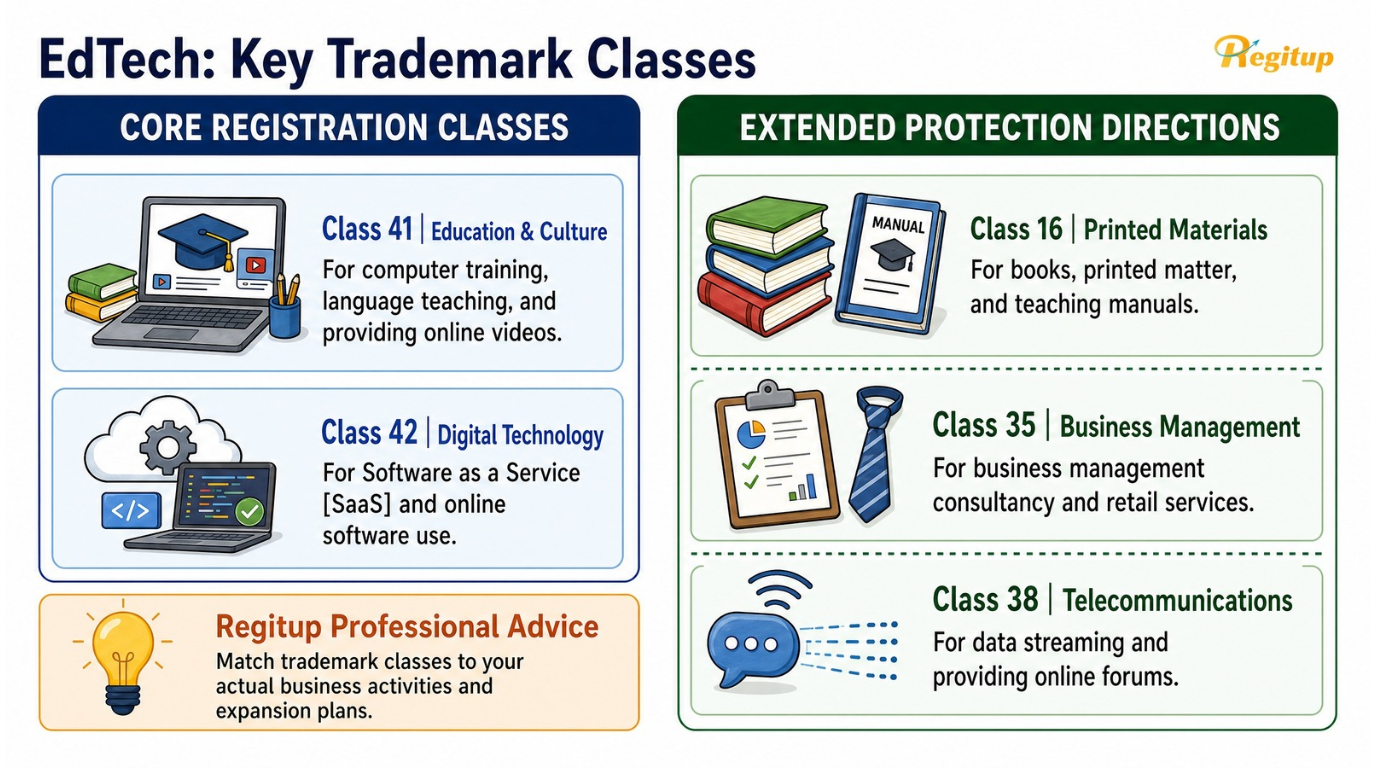
Class 41 | Core Education Services: This is the foundation for teaching institutions, covering actual instruction and training activities. | Computer training, language teaching, providing online non-downloadable videos. |
Class 42 | Platform Technical Services (SaaS): If providing a cloud-based learning platform or web-based system, this class protects the technical architecture. | Software as a Service [SaaS], providing temporary use of non-downloadable online software. |
Class 9 | Digital Products and Applications: For teaching apps or offline learning software downloadable to mobile phones or computers. | Downloadable computer software applications, teaching apparatus, downloadable e-books. |
Regarding class boundaries, Class 41 protects the "act of education," namely course curriculum and teaching methods. Class 42 emphasizes "platform provision," ensuring that competitors cannot operate online systems under the same name. Class 9 targets the "digital goods" themselves, which is particularly important when software is installed on terminal devices. Applying for a combination of these three classes effectively prevents brand infringement across different technical levels.
Extension Classes Based on Business Models
Beyond core teaching and platforms, enterprises often extend their business into other areas based on operational strategies. The following extension classes are recommended based on various business activities:
Class | Application Scenario | Scope of Services to Consider |
Class 16 | Providing physical printed teaching materials and books | Books, printed matter, teaching manuals. |
Class 35 | Educational institutions operating franchises or retail of materials | Business management and organization consultancy, retail and wholesale services for teaching materials. |
Class 38 | Providing live streaming for online courses | Data streaming, providing online forums. |
The choice of extension classes should depend on actual operations. If teaching relies heavily on live broadcasts, the communication service protection of Class 38 will be a necessary supplement. If physical handouts are sent in addition to digital content, the printed matter classification of Class 16 should not be overlooked.
Conclusion
The trademark layout for EdTech should be anchored by Classes 41, 42, and 9, with flexible extensions to Classes 38, 16, or 35 depending on whether the business involves live transmission, physical publishing, or franchise management. Through a well-structured, multi-layered strategy, companies can build a solid brand defense system in the EdTech market.
It must be emphasized that the actual designated items, the order of class arrangements, and the scope of rights for a trademark will vary according to the laws of the filing jurisdiction and the specific business model. Before submitting an application, a detailed search and evaluation should be conducted based on the market environment.
Complete Your Trademark Application with Regitup
Trademark registration is not just about filling out forms; it is a strategic layout for your brand. The Regitup team possesses extensive cross-border practical experience and can assist you in accurately verifying classification standards, preparing detailed documentation, and submitting applications on behalf of your business. We are dedicated to simplifying the process so you can focus on innovation in educational technology.
Start Your Trademark Registration
FAQ
Q1 : If a digital education platform only provides video viewing, does it still need to register in Class 42?
If the platform involves account management or learning progress tracking, registration is still recommended. Class 42 protects the technical provision of "Software as a Service," preventing others from operating similar technical platforms under the same name.
Q2 : Is registering in Class 9 enough for a downloadable teaching app?
No, it is not. Class 9 only protects the software product. If your core business is teaching, a competitor could register the same name in Class 41 to provide educational services. Therefore, Class 41 is an indispensable line of defense.
Q3 : I plan to open franchises in the future; should I register in Class 35 now?
It is recommended to establish your layout as early as possible. Class 35 covers business management and franchise consultancy, protecting your rights when operating educational systems and brand licensing, and preventing third parties from misappropriating your trademark.
Q4 : What is the difference in classification between physical teaching materials and e-books?
Physical printed teaching materials belong to Class 16, while downloadable e-books are categorized under Class 9. If your teaching plan includes both, it is recommended to obtain protection in both classes.
Q5 : Does online interactive teaching require registration in Class 38?
If the core of your service includes real-time data streaming or discussion forum functions, Class 38 can provide specific protection for "communication transmission," which is an important link in strengthening brand protection.