
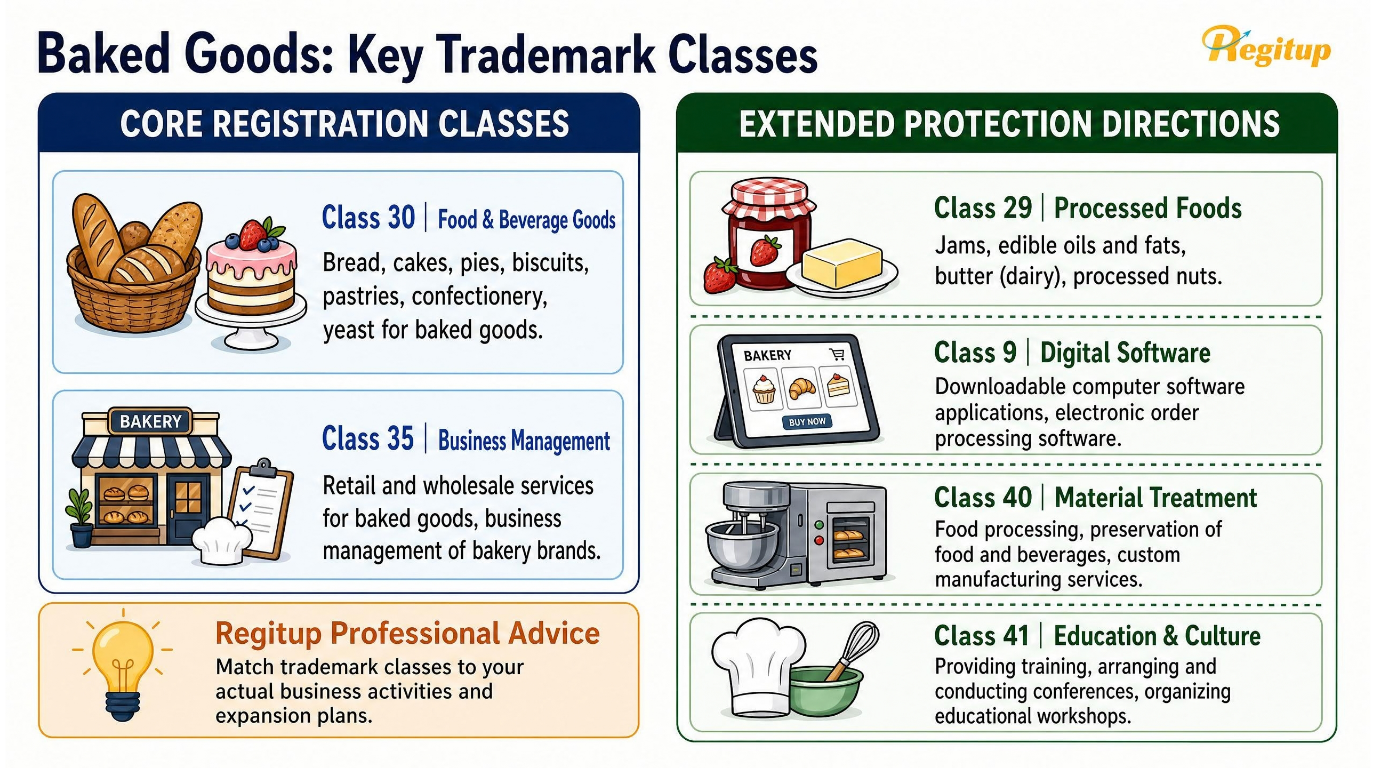
Key Point | Details |
Intended Audience | Operators of Baked Goods and businesses planning related goods, services or brand development. |
Primary Classes | Class 30, Class 35, Class 43 |
Extension Classes | Class 9, Class 29, Class 30, Class 35, Class 40, Class 41 |
Analysis Premise
In this article, "Baked Goods" refers to a business model that produces and sells bread, cakes, pastries, and various snacks under its own brand. This type of business typically involves brand management, product packaging and sales, and the operation of physical or online retail stores. This analysis is primarily intended for bakery operators with independent brand identities, providing brand owners with comprehensive category planning recommendations.
Primary Classes
For bakery operators, the core of protection lies in the products themselves and the corresponding business services, covering both "what is sold" and "where it is sold."
Class | Application Scenario / Why it is a Primary Class | Examples of Goods/Services Descriptions |
Class 30 | The most fundamental category for the bakery industry, protecting physical products under the brand and preventing others from selling similar food items. | Bread, cakes, pies, biscuits, pastries, confectionery, yeast for baked goods. |
Class 35 | Modern brands rely heavily on store operations and franchising; protects retail rights, advertising, marketing, and business management. | Retail and wholesale services for baked goods, business management of bakery brands, franchise business management, advertising and promotion. |
Class 43 | Provides direct protection for the store name and catering services if operating a physical location for customer selection or dine-in. | Bakeries, pastry shops, services for providing food and drink, catering services, cafes. |
Operators must understand the boundary between Class 30 and Class 43. Class 30 protects the "goods"—the bread or cake that customers take away—while Class 43 protects the "service"—the operation of a bakery under that brand name. Additionally, Class 35 ensures the brand's right to operate in the market, especially when developing franchise systems or selling on e-commerce platforms, providing specific protection for "retail services" to prevent competitors from using the same marks in similar channels.
Extension Classes Based on Business Models
As a bakery brand diversifies, it may venture into teaching, contract manufacturing, or digital services. Categories should be selected based on specific activities.
Class | Application Scenario | Potential Scope of Services |
Class 9 | Developing a proprietary online ordering app or membership points management software. | Downloadable computer software applications, electronic order processing software, electronic publications. |
Class 29 | Selling self-made jams, butter, dairy products, or processed fruit auxiliary products. | Jams, edible oils and fats, butter (dairy), processed nuts. |
Class 40 | Providing Original Equipment Manufacturing (OEM) or customized baking services for other companies. | Food processing, preservation of food and beverages, custom manufacturing services. |
Class 41 | Operating baking classrooms, hosting cooking training courses, or technical seminars. | Providing training, arranging and conducting conferences, organizing educational or entertainment competitions. |
Class 42 | Providing an independent baking technology platform or SaaS (Software as a Service). | Software hosting, Software as a Service (SaaS), computer software design and development. |
Extension classes should follow a conditional strategy. For example, Class 41 only holds value if you actually offer paid "baking courses" to the public. If you only provide a simple form on your website, you do not need to register in Class 9 or Class 42; these technology categories only become a focus of protection when resources are invested in developing an independent app or exporting technical solutions to others.
Conclusion
For the baked goods industry, the most secure path to protection is "products and services in parallel." Primary categories should target Class 30 (Products), Class 35 (Retail Management), and Class 43 (Storefront Services). Classes 29, 40, 41, or technology-related classes depend on whether the brand has corresponding side businesses or digital assets.
The final scope of rights and category arrangement for trademark registration still varies by filing jurisdiction, official guidelines, and specific business operation details. Before formal submission, it is recommended to consult a professional organization to confirm the accuracy of descriptions.
Complete Your Trademark Application with Regitup
Selecting trademark categories is only the first step; precise terminology and rigorous procedures are the keys to approval. The Regitup team has extensive international practical experience and can assist you in verifying data, preparing professional documents, and submitting on your behalf, ensuring your bakery brand receives solid legal protection during its expansion.
Start Your Trademark Registration
Frequently Asked Questions
Q1 : If I only sell cakes online, do I still need to register in Class 43?
If you have no physical storefront and do not provide on-site catering, Class 43 is less important. However, if you plan to open pop-up shops or a studio in the future, pre-registration is still a wise choice. In a pure e-commerce model, Class 30 and Class 35 are absolutely necessary.
Q2 : Is Class 35 necessary even for small bakery studios?
Yes. Class 35 protects "retail services" and "brand management." Even for a small studio, as long as you market and sell products under a brand name, Class 35 prevents others from using your name in similar channels, maintaining brand uniqueness.
Q3 : My products include jams and spreads; do these belong in Class 30?
Not necessarily. While bread belongs to Class 30, jams, butter, and most processed fruit products belong to Class 29. If these side products are a significant source of revenue for your brand, it is recommended to include Class 29 in your extension protection scope.
Q4 : Why register in Class 9 for developing an ordering app?
Class 9 covers "downloadable computer software." When customers download and use an app, the software itself is the carrier. To prevent others from developing malicious software or competing apps with the same name, registering in Class 9 provides direct protection for digital assets.
Q5 : Is the registration valid globally once the primary classes are registered?
Trademark rights are territorial. While the Nice classification framework is used in most countries, applications must still be filed separately in each target market. Classification is a standard, not a guarantee of automatic global protection.