
Key Point | Details |
Intended Audience | Operators of Stone Engineering and businesses planning related goods, services or brand development. |
Primary Classes | Class 19, Class 37, Class 40 |
Extension Classes | Class 1, Class 6, Class 8, Class 19, Class 35, Class 37 |
Analysis Premise
In this article, "Stone Engineering" refers to a business model centered on construction and decorative stone, such as marble, granite, and artificial stone. This industry typically covers the supply of stone, precision factory processing (such as cutting, polishing, and carving), and on-site installation and construction in buildings or interior spaces. The primary clients are building contractors, interior design firms, and landscape engineering units. This discussion does not cover simple stone quarrying (mining) or pure artistic sculpture that does not involve architectural installation.
Primary Classes
For enterprises engaged in stone engineering, protecting the brand's core involves securing rights for material supply, processing technology, and on-site construction services. The following are the most critical primary Nice classes for this industry:
Class | Application Context / Why it is a Primary Class | Examples of Goods/Services Descriptions |
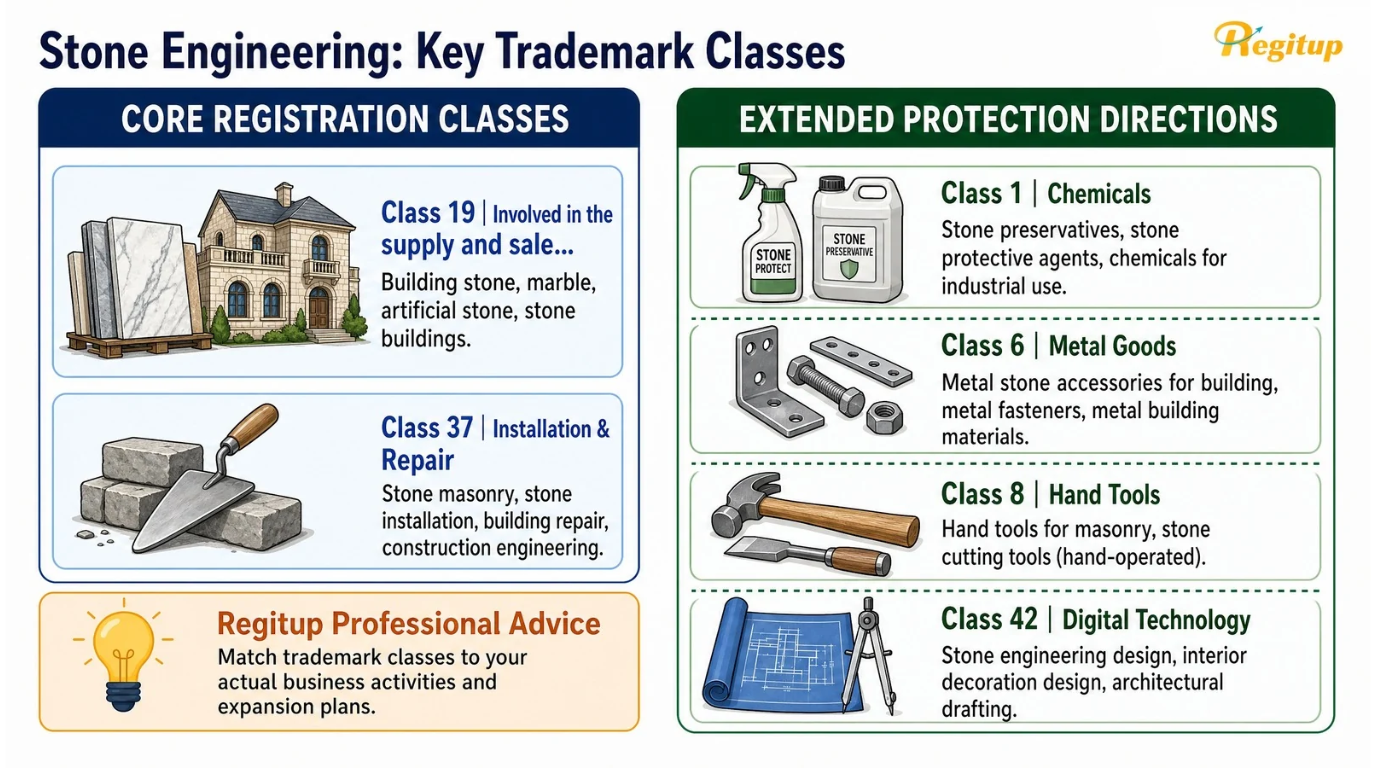
Class 19 | Involved in the supply and sale of stone products, particularly non-metallic building materials. | Building stone, marble, artificial stone, stone buildings. |
Class 37 | Providing on-site stone installation, masonry construction, and subsequent building maintenance services. | Stone masonry, stone installation, building repair, construction engineering. |
Class 40 | Involved in physical or chemical processing procedures performed on raw stone materials. | Stone processing, stone polishing, stone carving, information on material treatment. |
Class 35 | Operating stone trade, wholesale/retail, or maintaining physical stone showrooms. | Stone retail, wholesale of building materials, rental of exhibition stands (for commercial purposes). |
In the stone engineering industry, Class 19 protects the "goods"—the stone products themselves; Class 37 and Class 40 protect "labor," corresponding to on-site installation and factory processing, respectively. For most stone engineering providers with a complete supply chain, these three are indispensable. Furthermore, as modern stone engineering often involves branded showrooms and trading operations, Class 35 commercial management and retail services have become a primary registration choice for many leading companies.
Extension Classes Based on Business Models
Beyond core materials and construction, stone engineering providers may selectively add the following extension classes based on their specific value-added services or peripheral product lines:
Class | Application Context | Scope of Services |
Class 1 | Producing or selling chemical protection and maintenance products specifically for stone surfaces. | Stone preservatives, stone protective agents, chemicals for industrial use. |
Class 6 | Providing metal support frames, hooks, and other accessories required for stone dry-hanging engineering. | Metal stone accessories for building, metal fasteners, metal building materials. |
Class 8 | Manufacturing or selling specific hand tools required for professional stone masonry. | Hand tools for masonry, stone cutting tools (hand-operated). |
Class 42 | Providing customized stone application design, drafting, or engineering technical consultation. | Stone engineering design, interior decoration design, architectural drafting. |
The choice of these extension classes should depend on the actual business expansion of the enterprise. For example, if your company has a professional design team planning marble inlay patterns for clients, Class 42 becomes particularly important. If you develop and sell patented stone protective fluids, you must consider Class 1.
Conclusion
In summary, the trademark layout for stone engineering should be built upon the core foundation of Class 19, Class 37, and Class 40. If branded commercial operations or professional design services are involved, Class 35 and Class 42 are essential for reinforced protection. As for Class 1, Class 8, and Class 6, these depend on whether the enterprise is involved in the related chemicals, tools, or metal accessories business.
Please note that the actual designated goods or service items, class arrangements, and the final scope of rights for trademark registration may vary based on local jurisdictional regulations and specific business details. Before formally submitting an application, it is recommended to consult a professional organization to ensure the integrity of the protection plan.
Assist Your Trademark Application with Regitup
The choice of trademark classification directly affects the breadth and strength of brand protection. The Regitup team has extensive experience in international trademark practice and can assist you in accurately verifying the business details of your stone engineering operations, preparing professional application documents, and submitting them on your behalf. We are committed to simplifying tedious administrative processes, ensuring your brand receives the most robust legal protection under professional planning.
Start Your Trademark Registration
FAQ
Q1 : If I have registered marble in Class 19, does it mean I can stop others from providing stone installation services on construction sites?
Not necessarily. Class 19 primarily protects the stone products themselves. If others use the same brand name to provide "installation services" rather than "selling stone," it may be legally viewed as a different category. Therefore, it is recommended to simultaneously register in Class 37 to ensure exclusive brand rights for construction services.
Q2 : Our company provides design drawings for stone engineering. Does this require additional registration?
Yes. If the design services you provide have independent value, or if you wish to protect your brand's reputation in the field of "engineering design," it is recommended to add Class 42. This prevents other design firms from using your brand name to mislead clients.
Q3 : Is there a difference between artificial stone and natural stone in trademark classification?
In the Nice Classification, building stone (Class 19) typically covers both natural and artificial stone. However, when drafting the description of goods for your application, it is recommended to clearly list the items you primarily deal with to obtain more precise protection.
Q4 : If I only operate stone engineering in a specific region, do I need to consider global classification?
The Nice Classification is an internationally recognized framework used by most jurisdictions worldwide. While trademark rights are territorial, adopting the standard Nice Classification helps maintain a consistent brand protection strategy if you need to expand into other markets in the future.
Q5 : Why are stone preservatives classified in Class 1 instead of Class 19?
Class 19 is limited to non-metallic building materials. Stone preservatives are chemical preparations and are classified under Class 1 for industrial chemicals in the Nice Classification. If your business includes selling your own branded cleaning or protective products, this is an important supplementary class.