
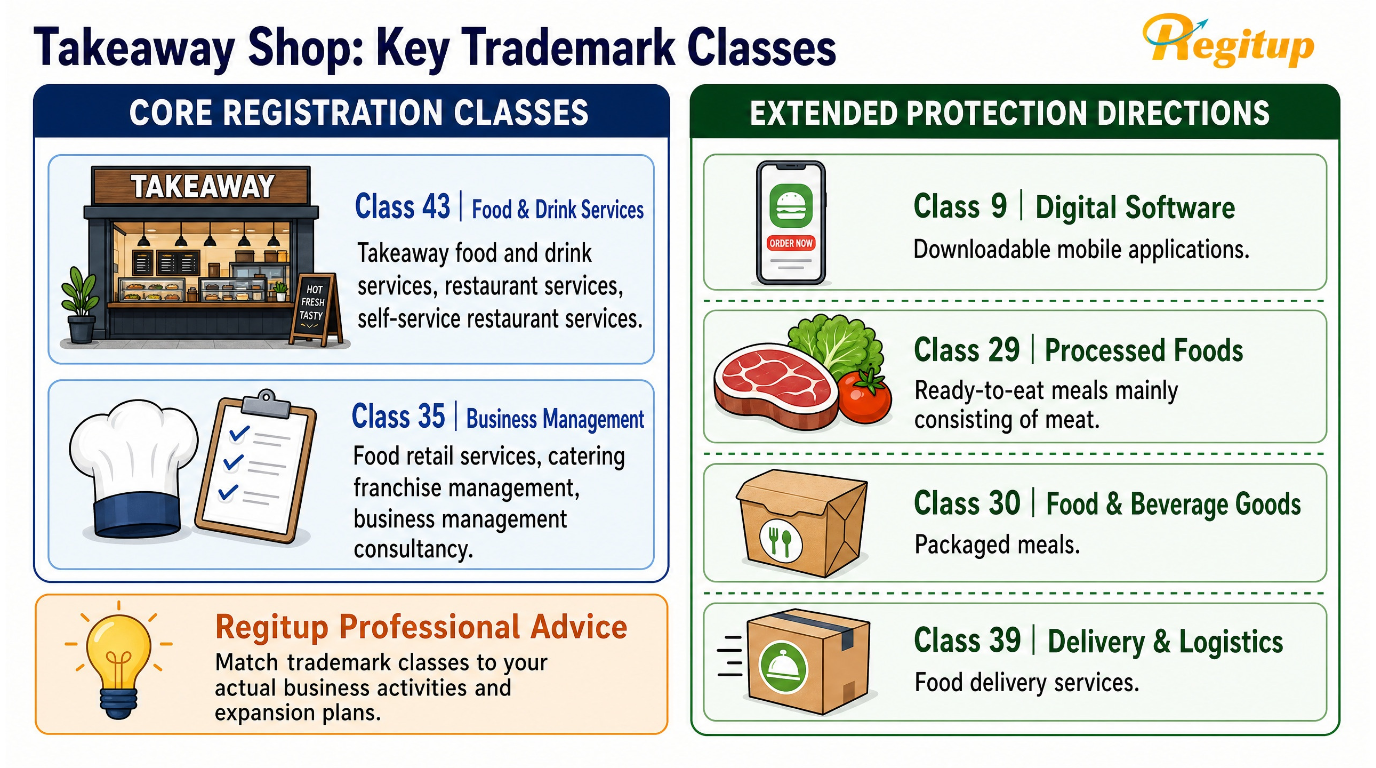
Key Point | Details |
Intended Audience | Operators of Takeaway Shop and businesses planning related goods, services or brand development. |
Primary Classes | Class 43, Class 35 |
Extension Classes | Class 9, Class 29, Class 30, Class 35, Class 39, Class 42 |
Analysis Premise
In trademark legal practice and commercial strategy, a "takeaway shop" refers to a catering outlet whose core business is the preparation of ready-to-eat meals and beverages. The main characteristic of such establishments is that their service model primarily relies on customers taking orders away from the premises or using third-party delivery platforms. Unlike traditional restaurants, takeaway shops typically do not provide indoor dining space, or they offer only a very limited and informal seating area.
The brand value of this business model is highly dependent on name recognition and reputation. Therefore, when choosing trademark categories, it is essential to accurately cover two major aspects: "meal preparation" and "brand operation." Clearly defining the scope of a takeaway shop helps businesses avoid wasting resources on unnecessary categories while ensuring the most comprehensive legal protection for their core operations.
Primary Classes
The trademark strategy for a takeaway shop should prioritize securing the rights to the catering brand. The table below summarizes the two most critical categories, which are the priority considerations for most operators in the early stages of their business.
Class | Scenario / Why it is a Primary Class | Examples of Goods/Service Descriptions |
Class 43 | Protects the core of the catering brand, covering the preparation and supply of food and drinks. | Takeaway food and drink services, restaurant services, self-service restaurant services. |
Class 35 | Applicable to chain brand operations, franchise management, and food retail business. | Food retail services, catering franchise management, business management consultancy. |
Class Boundary Explanation
Class 43 is the lifeblood of all catering operators; it protects the "services for providing food and drink." For takeaway shops—whether they are bubble tea shops, light meal box providers, or fried chicken outlets—as long as they involve on-site preparation and delivery to customers for consumption, Class 43 is an indispensable line of defense.
However, modern takeaway shops are often more than just a single store; many evolve toward chain operations. This is where the importance of Class 35 becomes evident. It protects "business management" and "retail services." If you plan to recruit franchisees or sell branded merchandise and pre-packaged foods at the counter in addition to freshly prepared meals, Class 35 provides more comprehensive brand management protection, preventing others from misappropriating your brand name at the commercial operation level.
Extension Classes Based on Business Models
As the scope of business expands, a takeaway shop may involve logistics, e-commerce, or food processing. The following table outlines recommended extension classes based on specific conditional business activities.
Class | Scenario | Recommended Scope of Service |
Class 9 | If the enterprise develops and operates a dedicated mobile application (APP) for member ordering. | Downloadable mobile applications. |
Class 29 | If selling frozen prepared meals or ready-to-eat cooked products primarily consisting of meat or vegetables. | Ready-to-eat meals mainly consisting of meat. |
Class 30 | If the operator develops self-produced packaged foods, such as branded sauces, sealed snacks, or ambient meal kits. | Packaged meals. |
Class 39 | If the operator has its own delivery fleet or provides delivery services to specified locations. | Food delivery services. |
Class 42 | If involved in the development of technical ordering platforms or food science and technology research. | Software as a Service (SaaS). |
Why You Can't Choose Categories Based on Industry Name Alone
Many operators mistakenly believe that registering under a "catering" category is sufficient. However, in trademark practice, choosing categories is far more complex than just matching an industry name. Taking takeaway shops as an example, a common point of confusion is the boundary between "goods" and "services."
For instance, preparing a cup of coffee on-site belongs to the services of Class 43. But if you package those coffee beans, print your trademark on them, and sell them, this involves the goods category of Class 30. If you are not registered in Class 30, it may be difficult to directly assert rights against others selling coffee beans under the same name in supermarkets based solely on your Class 43 trademark.
Furthermore, with the prevalence of digital transformation, many takeaway shops develop dedicated apps. In such cases, trademark protection must extend to the software field of Class 9. Relying only on the industry name "takeaway shop" makes it easy to overlook these hidden legal risks, leading to defensive gaps as the brand diversifies its operations.
Conclusion
Trademark registration for a takeaway shop is not a single-choice question but a strategic combination of moves. The core layout should firmly secure Class 43 and Class 35 to ensure the legality of the brand in catering supply and commercial operations. Simultaneously, operators should flexibly choose extension classes such as Class 39, Class 30, or Class 9 based on whether they involve self-delivery services, packaged food sales, or digital platform development.
It is important to note that the actual scope of trademark protection, the specific descriptions of designated goods or services, and the final arrangement of categories will vary depending on the regulatory requirements of the filing jurisdiction and specific business details. The information provided in this guide is intended to help operators establish an initial framework; actual applications should be based on professional legal assessments.
Get Assistance with Your Trademark Application from Regitup
The Regitup team is deeply rooted in the professional field of trademarks, dedicated to providing precise brand protection solutions for various catering entrepreneurs. Our expert team can help you select the categories from the complex Nice classification that best fit your current business status. We handle data verification, application document preparation, and formal submission procedures, allowing you to focus on store operations and delicious research and development.
Start Your Trademark Registration
Frequently Asked Questions
Q1 : If my takeaway shop only serves through delivery platforms, do I still need to register Class 43?
Yes. Class 43 protects "services for providing food and drink." Whether customers pick up their meals in person or receive them through a delivery platform, the core act of preparing the food under your brand still falls under Class 43. Without registration in this class, your brand name will lack basic protection in the catering market.
Q2 : If I sell branded merchandise (such as mugs), do I need to add more categories?
Yes. Catering service trademarks typically do not automatically cover physical goods. If you plan to sell mugs printed with your brand logo, you should consider registering Class 21 (household or kitchen utensils and containers). Trademark protection is specific to individual items; you should evaluate the corresponding categories for whatever goods you sell.
Q3 : Why does my takeaway shop need to consider Class 35?
Class 35 primarily covers business operations and retail management. For operators aspiring to develop a franchise, manage multiple branches, or provide food retail in addition to catering, Class 35 protects the brand's exclusive rights at the "business administration" level, preventing others from opening management consultancies or retail channels under the same name.
Q4 : I developed an ordering app; does it belong to the catering category?
No. An app itself is considered "downloadable software" in trademark classification, which belongs to Class 9. Although the app exists for catering services, its legal attribute is a software product. To prevent others from listing counterfeit software with the same name on app stores, registration in Class 9 is necessary.
Q5 : Are trademark classification standards updated regularly?
Trademark classification standards evolve continuously with the global business environment and emerging technologies to reflect new service types such as delivery platforms or digital payments. While completed registrations typically remain valid during their term, it is recommended to refer to the latest classification guidelines when planning new trademark layouts or business expansions to ensure that the service descriptions used comply with current examination standards.