
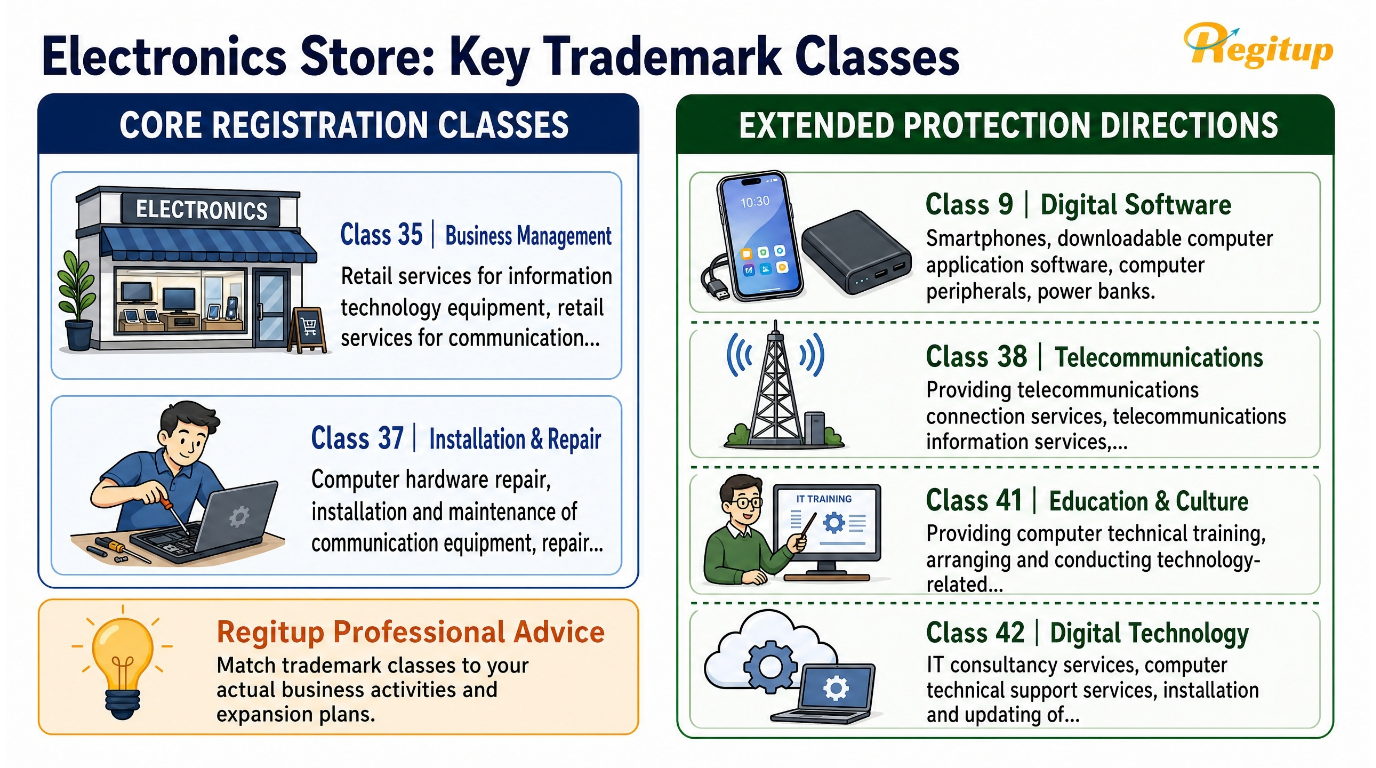
Key Point | Details |
Intended Audience | Operators of Electronics Store and businesses planning related goods, services or brand development. |
Primary Classes | Class 35, Class 37 |
Extension Classes | Class 9, Class 35, Class 37, Class 38, Class 41, Class 42 |
Analysis Premise
In this context, an Electronics Store refers to a business entity operating physical stores or online platforms engaged in the retail and wholesale of computers, communication devices, and consumer electronics (3C products), along with their peripherals and accessories. These enterprises often provide technical consultation, hardware installation, and repair services in addition to product sales.
Defining this scope is crucial because "selling goods" and "providing repairs" fall under different categories in trademark classification. This article analyzes the positioning within the Nice Classification based on this core business model.
Primary Classes
For most electronics stores, the primary task in protecting brand identity is securing exclusive rights for retail channels and legal branding for after-sales repairs. The following two classes are the most essential for this industry:
Class | Application Scenario / | Examples of Goods/Service Descriptions |
Class 35 | Core Retail Services: This is the most critical class for specialty stores, used to protect the store name as a retail channel identifier. | Retail services for information technology equipment, retail services for communication equipment, wholesale and retail of computer peripherals, centralized sales of electronic products. |
Class 37 | Hardware Repair and Installation: Essential if the store provides computer assembly, mobile phone repairs, or hardware upgrades. | Computer hardware repair, installation and maintenance of communication equipment, repair of electronic office equipment, mobile phone maintenance services. |
Class Boundary Clarification
The core value of Class 35 lies in protecting the "channel brand." When consumers see your store name, they identify it as a service platform offering a variety of product choices. Registering in Class 35 prevents others from using the same or similar store names in the electronics retail sector.
Class 37 focuses on "labor activities." Electronics stores often have a repair department providing services like screen replacements or PC assembly. Without Class 37 protection, competitors might use your brand name in the repair service field, leading to consumer confusion.
Extension Classes Based on Business Models
As the industry diversifies, many specialty stores expand into software applications or telecommunications services. The following extension classes are recommended for consideration:
Class | Application Scenario | Recommended Scope of Services |
Class 9 | Own-Brand Products: If the store launches its own branded charging cables, headphones, or phone cases. | Smartphones, downloadable computer application software, computer peripherals, power banks. |
Class 38 | Telecommunications Agency: Providing intermediary services such as mobile number registration or internet plan processing for major carriers. | Providing telecommunications connection services, telecommunications information services, mobile communication transmission services. |
Class 41 | Education and Training: Regularly holding courses on tech product usage or software operation seminars. | Providing computer technical training, arranging and conducting technology-related seminars, promotion of technology knowledge. |
Class 42 | Technical Support and Software Services: Providing non-hardware services such as software installation, system tuning, or cloud consultation. | IT consultancy services, computer technical support services, installation and updating of computer software, data backup services. |
Conclusion
Trademark strategy is the cornerstone of long-term operations for an electronics store. Businesses should use Class 35 and Class 37 as their defensive core and build a protection network based on whether they involve own-brand development, software technical support, or telecommunications agency services.
The actual designated goods or services, class arrangements, and final scope of rights for a trademark will vary depending on the regulations of the filing jurisdiction and specific business details. It is recommended to consult a professional before formal submission to ensure the accuracy of the application.
Assist Your Trademark Application with Regitup
Trademark registration involves complex legal judgments, and a small oversight could lead to application rejection. The Regitup team has extensive experience in cross-border trademark practice and can provide precise class verification, document preparation, and representation services for your electronics store. We are committed to simplifying the process, allowing you to focus on business expansion while we safeguard your brand.
Start Your Trademark Registration
Frequently Asked Questions
Q1 : I only sell electronic products online. Do I still need to register in Class 37?
If you operate purely as an e-commerce business and do not provide any product installation or repair labor, Class 37 is not necessary. You should prioritize protecting retail services in Class 35 and evaluate whether Class 9 product protection is needed.
Q2 : Does registering in Class 35 mean others cannot sell the same products as I do?
No. Trademark Class 35 protects your "store name" from being used by others for similar retail services. It prevents others from operating businesses with the same or similar store names in the market, avoiding customer confusion.
Q3 : If my store helps customers install software, which class should I choose?
Installing software is a technical service categorized under Class 42. If this is just a free service during the sales process, it may be less important than Class 35. However, if you offer it as a paid professional service, it is recommended to include Class 42 in your strategy.
Q4 : Why must own-brand products be registered in Class 9?
Class 9 covers most physical electronic products. When your brand is printed on product packaging and enters the market, the law treats it as a "good." Without a Class 9 registration, even if you have Class 35 rights, others could still use your brand on similar products.