
Key Point | Details |
Intended Audience | Operators of Video Rental and businesses planning related goods, services or brand development. |
Primary Classes | Class 41, Class 35 |
Extension Classes | Class 9, Class 35, Class 38, Class 39, Class 40, Class 41 |
Analysis Premise
In this article, the "Video Rental" industry is defined by the business model of providing membership-based rental, return, and related store operations for audio-visual content on physical media (such as DVDs, Blu-ray discs, and videotapes) or their digital equivalents. This includes traditional video rental stores as well as services integrated through automated rental kiosks or retail brands. The focus of the analysis is on the "rental service" itself and "brand franchise management," excluding pure cinema screenings or the manufacturing of audio-visual equipment.
Primary Classes
For video rental operators, protecting core services and brand image is the top priority. The following are the primary classes that must be considered first:
Class | Application Scenario / Why it's a Primary Class | Examples of Goods/Services Descriptions |
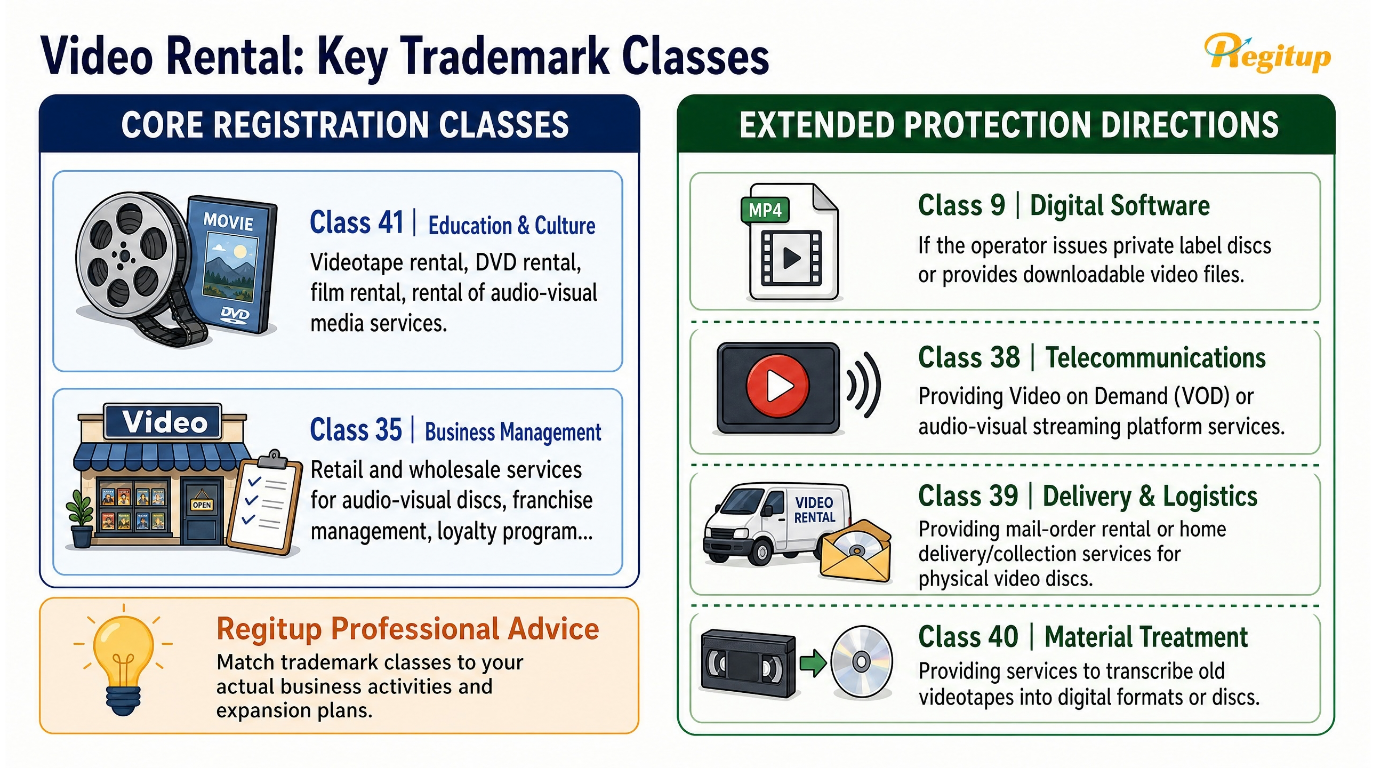
Class 41 | Core Entertainment Services: The most direct service category for the video rental industry, covering all forms of film rental activities. | Videotape rental, DVD rental, film rental, rental of audio-visual media services. |
Class 35 | Brand Management and Retail: Involved in retail management, franchising, and membership systems when operating physical stores or chain brands. | Retail and wholesale services for audio-visual discs, franchise management, loyalty program management, advertising and promotion. |
Under the Nice Classification framework, Class 41 protects the "nature of the service," which is providing entertainment content for rental; Class 35 protects the "act of operation," which is how services and goods are brought to consumers. For most video rental brands, these two classes form the core protection of brand rights. It should be noted that rental services in Class 41 usually refer to "physical media" borrowing; if the business shifts entirely to online subscriptions, the boundaries will change.
Extension Classes Based on Business Models
With the evolution of audio-visual technology, the video rental industry often develops diverse auxiliary services. Operators should selectively extend their registration to the following classes based on actual business plans:
Class | Application Scenario | Scope of Services to Consider |
Class 9 | Private Label Media Products︰ If the operator issues private label discs or provides downloadable video files. | Videotapes, optical discs, downloadable films. |
Class 38 | Digital Transformation Services︰ Providing Video on Demand (VOD) or audio-visual streaming platform services. | Video-on-demand transmission services, audio-visual streaming. |
Class 39 | Logistics and Delivery Services︰ Providing mail-order rental or home delivery/collection services for physical video discs. | Parcel delivery services for physical video discs. |
Class 40 | Value-added Processing Services︰ Providing services to transcribe old videotapes into digital formats or discs. | Videotape transcription, audio-visual format conversion. |
Class 42 | Technical Platform Hosting︰ Developing or hosting dedicated rental management systems, Apps, or SaaS platforms. | Hosting of audio-visual rental management systems, Software as a Service (SaaS). |
The choice of extension classes must be linked to specific business activities. For example, if your video rental store only offers in-store pickup, Class 39 is not necessary; however, if you launch a subscription model with "online reservation and home delivery," the relevance of Class 39 and Class 38 will increase significantly.
Conclusion
In summary, the trademark layout for the video rental industry should be centered on Class 41 and Class 35 to ensure that both rental services and brand operations receive legal protection. For digitalization needs, Class 38 and Class 42 should be included as appropriate; for value-added services such as logistics or transcription, Class 39 and Class 40 can be considered.
The actual designated goods or services, class arrangements, and final scope of rights for trademark registration will still vary depending on the requirements of the filing jurisdiction and specific business operations. It is recommended to consult a professional before formal application to ensure precise classification planning.
Complete Your Trademark Application with Regitup
The choice of trademark classification directly affects a brand's future legal defense and business expansion space. The Regitup team has extensive experience in cross-border trademark practice and can help you verify Nice Classification data, accurately select classes that match your current business situation, and complete the tedious submission process on your behalf, allowing you to focus on the growth of your core business.
Start Your Trademark Registration
Frequently Asked Questions
Q1 : I only operate a small video store; do I still need to register Class 35?
Yes. Class 35 primarily protects the right to use your "store name" as a business entity. When you use your brand name on signs or receipts to provide retail management services, Class 35 provides more direct brand protection than Class 41.
Q2 : If my store also sells second-hand video discs, does this fall under Class 41?
No. Class 41 specifically refers to "rental" services. Selling second-hand video discs belongs to "retail services" and should be classified under Class 35. If you have brand discs produced by yourself, it may involve Class 9 goods.
Q3 : If I want to move my rental business online in the future, what should I register now?
It is recommended to plan ahead for Class 38 (telecommunications streaming) and Class 42 (software platform services). This ensures that when the brand transitions from physical stores to an online platform, the brand name remains protected in the digital environment.
Q4 : After trademark registration, are all audio-visual related classes automatically covered?
Not at all. The scope of trademark protection is limited to the classes selected at the time of application. If only Class 41 is registered, others may still use similar names in Class 9 goods or Class 38 services.
Q5 : Which class does the "membership card" system for the video rental industry belong to?
The management of membership systems is classified under Class 35. This is extremely important for the video rental industry, as ensuring the brand has trademark rights when managing membership services is key to long-term operation.