
Key Point | Details |
Intended Audience | Operators of Pet Food and businesses planning related goods, services or brand development. |
Primary Classes | Class 31, Class 35 |
Extension Classes | Class 5, Class 31, Class 35, Class 39, Class 40, Class 44 |
Analysis Premise
The core business model for "Pet Food" discussed in this article focuses on the research and development, branded production, and multi-channel sales of food for various pets (such as cats and dogs). This covers common dry food, canned food, treats, and dental chews. Beyond physical product manufacturing, it also includes retail operations through official websites or e-commerce platforms, as well as brand marketing and franchise management. When planning a trademark strategy, one must simultaneously consider the identification rights of the products and the brand defense within the distribution channels.
Primary Classes
For pet food brands, the strategy should primarily target two core classes: the product entity and business operations.
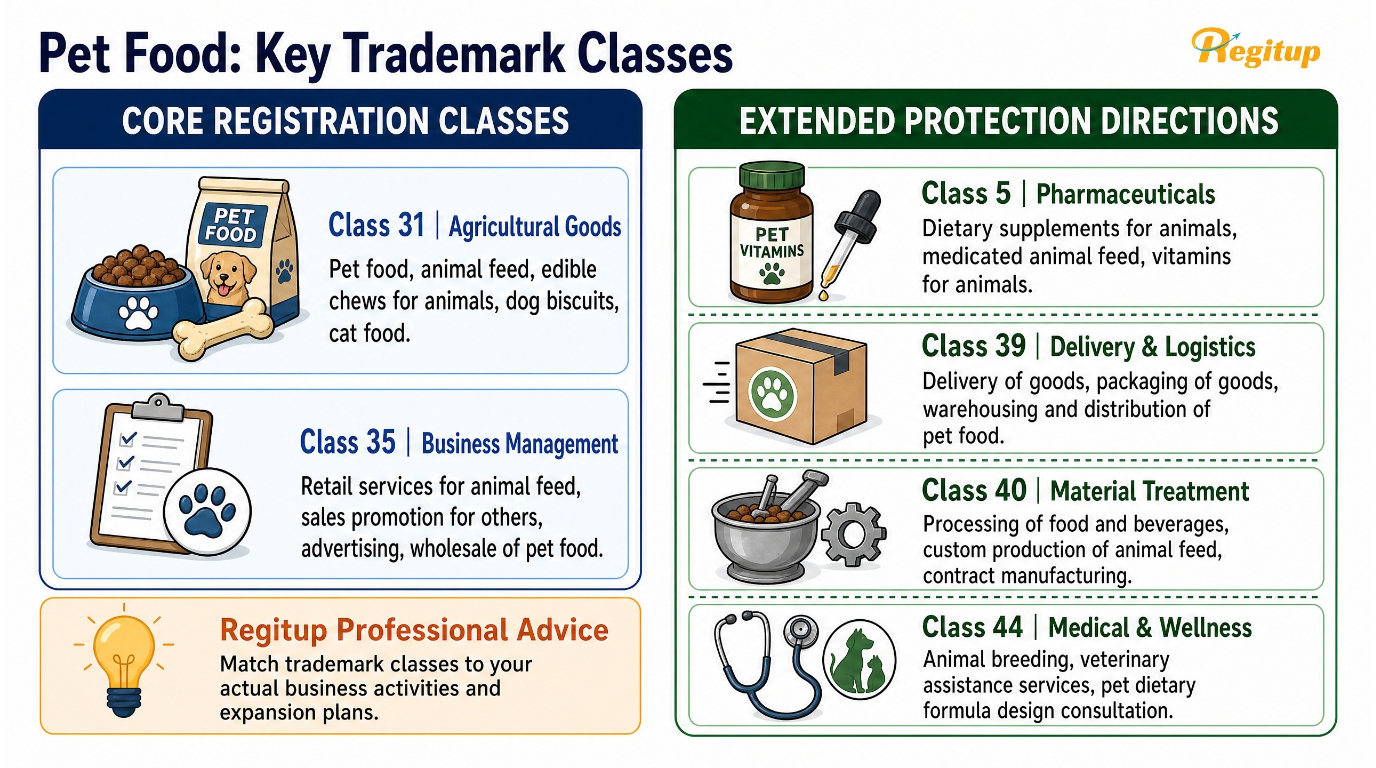
Class | Application Scenario / | Examples of Goods/Service Descriptions |
Class 31 | This is the primary class for pet food, covering all non-medical animal foodstuffs. | Pet food, animal feed, edible chews for animals, dog biscuits, cat food, edible chews for pets. |
Class 35 | Protects brand identification at the distribution level, covering retail, wholesale, and marketing services. | Retail services for animal feed, sales promotion for others, advertising, wholesale of pet supplies, franchise management. |
Class Boundary Clarification
Class 31 is the lifeline of the brand, protecting products from being counterfeited or produced by others under the same name. However, relying solely on product classes is insufficient to handle channel competition. Class 35 protects retail and marketing rights, preventing competitors from opening stores with the same name or using the brand name on e-commerce platforms. If a brand operates a membership system or conducts large-scale advertising, Class 35 becomes an indispensable defensive shield.
Extension Classes Based on Business Models
As business operations diversify, brands should extend their protection to the following classes based on specific activities:
Class | Application Scenario | Scope of Services to Consider |
Class 5 | Production of supplements with medical effects or functional nutrition | Dietary supplements for animals, medicated animal feed, vitamins for animals, functional pet nutrition products. |
Class 39 | Providing self-operated logistics delivery or courier services | Delivery of goods, packaging of goods, warehousing and distribution of pet food. |
Class 40 | Providing OEM production or customized processing services for pet food | Processing of food and beverages, custom production of animal feed, contract manufacturing of pet food. |
Class 44 | Involving pet health consultation or nutritional formula advice | Animal breeding, veterinary assistance services, pet dietary formula design consultation. |
Extension classes should follow a "conditional" strategy. For example, if the product line includes medical prescription diets, Class 5 is essential; if the brand owns production lines and accepts contract manufacturing, Class 40 is required to protect the processing service brand.
Conclusion
In summary, the trademark strategy for a pet food brand should center on Class 31 and Class 35, with extensions into medical nutrition (Class 5), production and processing (Class 40), logistics (Class 39), or professional consultation (Class 44) based on actual business operations.
Trademark registration is a dynamic management of legal assets. Please note that the specific items, class arrangements, and scope of rights during actual application will vary depending on local regulations and specific business models. It is recommended to seek a professional assessment before submitting an application to ensure comprehensive brand protection.
Assistance from Regitup for Trademark Applications
Trademark classification is highly professional, and minor oversights can lead to significant legal risks. The Regitup team has extensive practical experience and can assist you in accurately verifying data, preparing documents, and submitting applications on your behalf. We are committed to simplifying the process so you can focus on your products and the market.
Start Your Trademark Registration
Frequently Asked Questions
Q1 : Does the packaging design of pet food need to be registered as a trademark?
Trademarks primarily protect brand names and logos. Unique packaging visuals can be considered for design patent or copyright protection, but core brand identification should prioritize registration in the Class 31 product category.
Q2 : Is Class 35 registration necessary if I only sell treats online?
Yes. Class 35 covers e-commerce retail services. Operating brand image, order management, and digital marketing on online shopping platforms all fall within the protection of Class 35, effectively preventing others from operating stores under your name.
Q3 : What is the difference in classification between prescription diets and general natural food?
General natural food belongs to Class 31; however, prescription diets or medicated feeds with specific medical claims usually need to be registered in Class 5. To ensure complete protection, it is recommended that brands secure both classes.
Q4 : Does a brand that outsources production to an OEM need to register Class 40?
If you are the brand owner and not the actual processor, you usually do not need to register Class 40. Class 40 is intended to protect manufacturers who provide processing services. Brand owners should prioritize protecting product rights in Class 31 and sales rights in Class 35.
Q5 : Is a pet food trademark registration valid forever?
Trademark registration is not permanent. In most countries, the validity period of trademark rights is 10 years, and renewal is required before expiration. Additionally, if a trademark is not used for a continuous period (usually 3 to 5 years) after registration, it may face the risk of being revoked by others. Therefore, brand owners should ensure that the trademark is continuously used in the registered classes.