
Key Point | Details |
Intended Audience | Operators of Gas Station and businesses planning related goods, services or brand development. |
Primary Classes | Class 37, Class 4, Class 35 |
Extension Classes | Class 4, Class 35, Class 37, Class 39, Class 43 |
Analysis Premise
In the scope of trademark practice and industry classification, the "Gas Station" discussed in this article refers to a commercial entity with a physical location specializing in the retail of various power fuels and related ancillary services. Its core business model focuses on providing refueling services such as gasoline and diesel for vehicles, usually accompanied by basic daily vehicle inspections and simple maintenance.
The gas station defined here does not include upstream energy exploration, large-scale industrial energy wholesale transport, or pure energy trading software development. Our focus is on retail terminals directly facing end consumers, where operational priorities include the physical service quality of the brand, stable supply of fuel products, and multi-functional site management. Before applying for a trademark, a company must clarify whether it only provides refueling services or also owns its own fuel brand, as this will directly affect the depth of classification choice.
Primary Classes
The operation of a gas station involves an intersection of physical goods and on-site services; therefore, primary classes must cover both the products themselves and the sales process. The following are the most prioritized Nice classification recommendations for gas station operators:
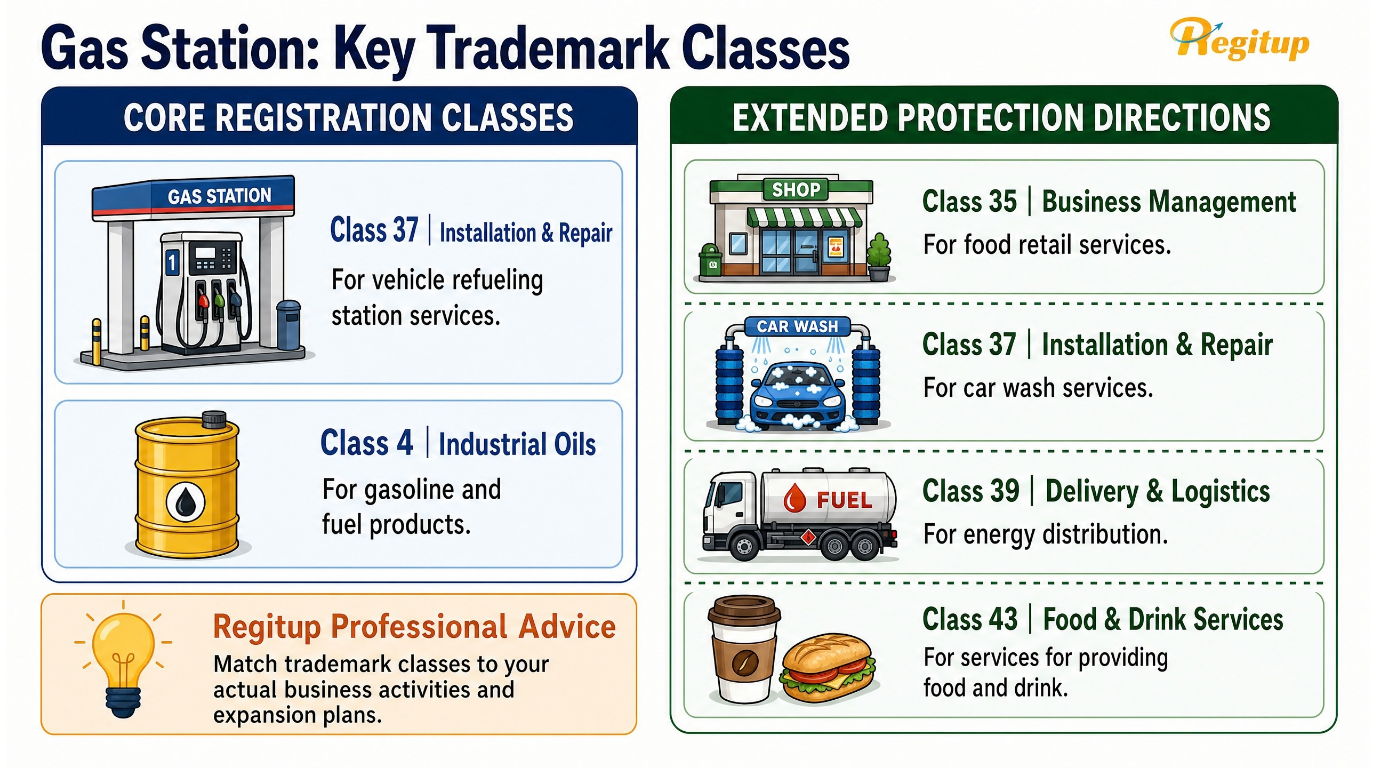
Class | Application Scenario / | Examples of Goods/Service Descriptions |
Class 37 | The service core for providing on-site refueling, gas filling, and vehicle maintenance. | Vehicle refueling station services; vehicle refueling and maintenance; car maintenance. |
Class 4 | If the gas station has its own brand of fuel products, the goods themselves must be protected. | Gasoline; diesel; fuel; industrial oils; non-chemical fuel additives. |
Class 35 | Covers fuel retail management, franchise operations, and chain brand management. | Fuel retail services; gas station business management; franchise operation consultancy. |
The legal protection boundaries for gas stations are typically defined by Class 37 and Class 4. Class 37 protects "service acts," namely the labor process of staff refueling or repairing vehicles; Class 4 protects the "physical goods," the substance that consumers ultimately purchase and pump into their tanks. For most gas station brands with chain operations, the retail services in Class 35 are equally indispensable, as they protect the brand's exclusivity in commercial operations and retail channels, preventing competitors from using similar brand marks in similar retail scenarios.
Extension Classes Based on Business Models
As modern gas stations transform into multi-functional service centers, simple refueling services are no longer sufficient to cover all commercial activities. Depending on specific business expansion directions, companies should consider the following extension classes to ensure complete rights:
Class | Application Scenario | Potential Scope of Services |
Class 35 | On-site convenience stores selling general consumer goods or food. | Food retail services; department store retail services; convenience store operation. |
Class 37 | Providing automatic or manual car wash services, or adding electric vehicle charging facilities. | Car wash services; electric vehicle charging station services; vehicle cleaning. |
Class 39 | Involving the distribution and transport of energy, or providing fuel delivery to specified locations. | Energy distribution; fuel transport; electricity supply distribution. |
Class 43 | On-site cafes, fast food outlets, or providing ready-to-eat catering services. | Services for providing food and drink; cafes; restaurant services. |
When considering extension classes, gas station operators should adopt a condition-based assessment. For example, if a gas station only resells pre-packaged food from other brands on a very small scale, the retail services in Class 35 may be sufficient. However, if it owns an independent convenience store brand or catering brand, independent applications for Class 35 and Class 43 become crucial. Especially amidst the wave of energy transition, electric vehicle charging station services in Class 37 have become a must-have for many gas stations' upgrades, which differs in detailed description from traditional liquid fuel refueling services and requires extra precise notation.
Conclusion
The trademark layout for gas stations should be anchored by Class 37, Class 4, and Class 35 as core pillars, with timely extensions to Class 43 or Class 39 depending on whether specific businesses like car washing, charging, catering, or convenience store retail are provided. This structured application strategy effectively prevents brands from encountering infringement risks during diversified operations.
It should be noted that the specific designated goods or service items, class arrangements, and the final scope of rights for a trademark will still vary depending on the legal practices of the filing jurisdiction and specific business details. The classification recommendations provided in this article are intended as a reference for preliminary planning. Before formally submitting an application, companies should conduct deeper legal searches and evaluations tailored to their unique business models to ensure the legal stability of their trademark assets.
Get Assistance from Regitup for Your Trademark Application
The precision of trademark classification directly determines the strength of brand protection, especially for the complex gas station industry. The Regitup team has extensive experience in cross-border trademark practice and can help you verify industry data, accurately screen goods and service descriptions in the Nice Classification, and complete the tedious application submission process on your behalf. Through professional pre-assessment, we can help you avoid potential registration obstacles and ensure your brand develops steadily in the energy market.
Start Your Trademark Registration
Frequently Asked Questions
Q1 : If a gas station adds EV charging piles, does it need to register an additional class?
Yes. Although traditional refueling services fall under Class 37, "electric vehicle charging station services" is an item with a specific technical description. To ensure brand rights in the new energy market, it is recommended to explicitly include this service description within Class 37 to meet the business needs of future energy transitions.
Q2 : I only sell other people's fuel; do I still need to register Class 4 for fuel products?
If you are only a station providing refueling services and do not own your own fuel brand (for example, only using the supplier's brand as a distributor), then service trademark protection in Class 37 is most critical. However, if you plan to launch your own brand of fuel or additives, Class 4 registration for goods is an indispensable legal line of defense.
Q3 : How should trademark protection be arranged for a convenience store attached to a gas station?
This depends on the brand name of the convenience store. If the convenience store uses the same brand as the gas station, it is recommended to add items related to "food and general merchandise retail services" in Class 35. If the convenience store is an independent brand, a separate application for Class 35 should be made for that brand, and even Class 30 or Class 31 for goods categories should be considered depending on the scale of operation.
Q4 : Why do gas station trademark applications often involve Class 35?
Class 35 primarily protects business operations and retail management. For chain gas stations, brand value is often reflected in their management systems, member services, and the exclusivity of retail channels. Registering Class 35 can effectively prevent others from using your brand name in non-refueling retail scenarios (such as e-commerce or general stores), expanding the protective umbrella.
Q5 : If I provide car wash services, is it already covered by Class 37?
Class 37 does cover vehicle maintenance services, but "car wash" and "vehicle refueling" are separate sub-items in the Nice Classification. To obtain the most secure protection, it is recommended to explicitly list "car wash services" or "vehicle cleaning" in the Class 37 application list to avoid unclear definitions of the scope of rights in the event of a dispute.