
Key Point | Details |
Intended Audience | Operators of Long-term Care Facility and businesses planning related goods, services or brand development. |
Primary Classes | Class 44, Class 43, Class 45 |
Extension Classes | Class 9, Class 35, Class 39, Class 41, Class 42, Class 43 |
What is a Long-term Care Facility in this Context?
A Long-term Care Facility refers to a professional organization that provides integrated services for individuals requiring care. Its core model combines professional medical nursing with long-term accommodation and boarding. These facilities provide not only daily physiological care but also medical-grade "nursing care" and "residential care" to ensure quality of life.
Specifically, this covers everything from full-time nursing homes and sanatoriums to community centers providing day care. Because these services span the three major fields of medical care, catering/accommodation, and social welfare, they are highly complex in terms of trademark classification. Clearly defining the scope of services is key to ensuring complete brand rights and avoiding legal gaps when expanding business in the future.
Primary Classes
The brand rights foundation for a long-term care facility is built upon three core categories: medical care, accommodation, and personal care. The following table summarizes the most critical application items:
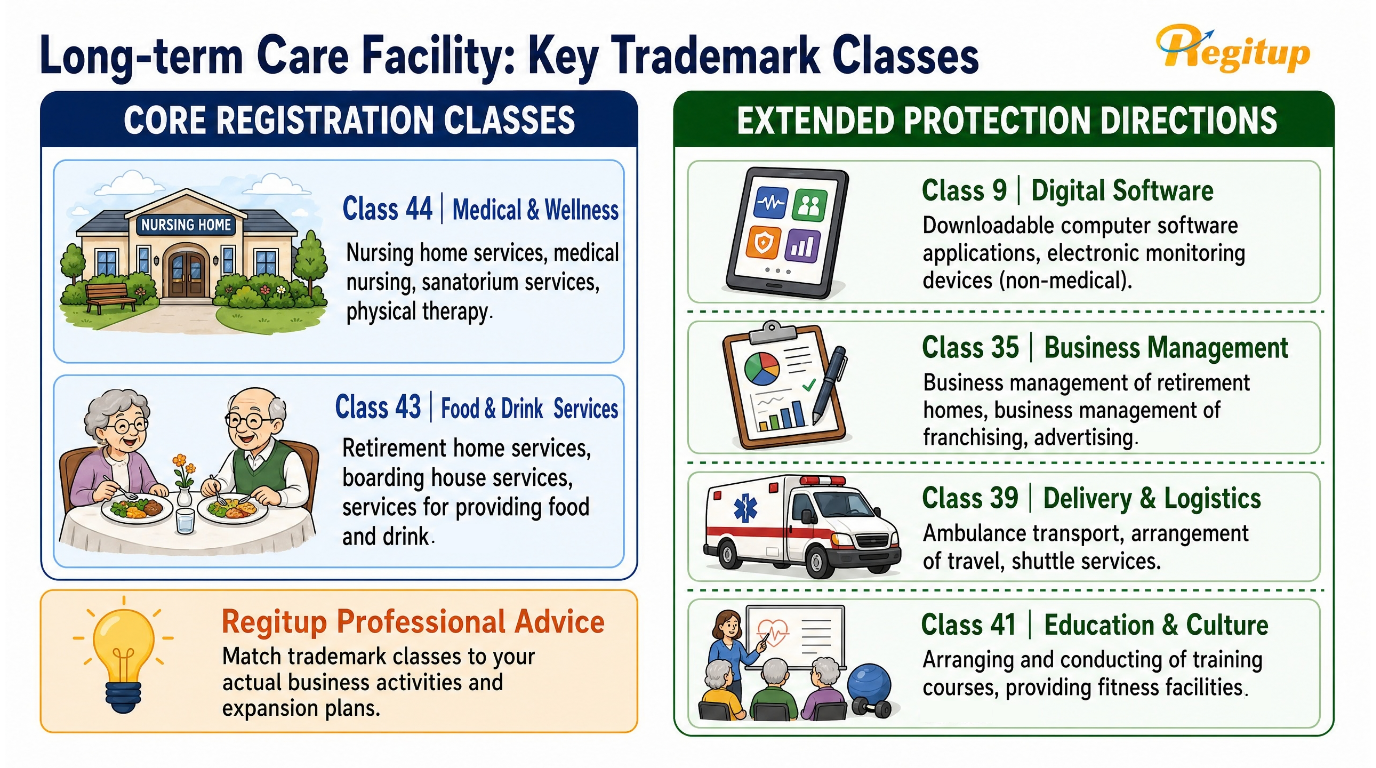
Class | Applicable Scenarios / | Examples of Goods/Services |
Class 44 | Providing professional licensed medical nursing, sanatorium, and rehabilitation services is the core value of the facility. | Nursing home services, medical nursing, sanatorium services, physical therapy, rehabilitation services. |
Class 43 | The facility provides residents with long-term living space, daily meals, and a living environment. | Retirement home services, boarding house services, services for providing food and drink to residents. |
Class 45 | Involves non-medical personal care, social accompaniment, and social welfare support in daily life. | Social work services, social accompaniment services, personal background investigations (if applicable). |
Class 44 and Class 43 are the "dual cores" of a long-term care facility. Class 44 protects nursing activities involving medical expertise, while Class 43 protects the brand's exclusive rights for accommodation services. Class 45 complements these with non-medical personal care and social welfare support, which is particularly important for brands emphasizing community care.
Extension Classes Based on Business Models
With technological progress and the trend toward chain operations, the business of modern long-term care facilities often extends beyond simple care. Depending on different operating strategies, the following extension classes should be considered:
Class | Applicable Scenarios | Scope of Services |
Class 9 | Developing proprietary smart care apps, health monitoring software, or wearable device interfaces. | Downloadable computer software applications, electronic monitoring devices (non-medical). |
Class 35 | Involving franchise operations, administrative management of retirement homes, or business consulting. | Business management of retirement homes, business management of franchising, advertising and marketing. |
Class 39 | Providing dedicated transportation services, such as transporting residents to and from hospitals or community activities. | Ambulance transport, arrangement of travel, shuttle services. |
Class 41 | Organizing training courses for long-term care personnel, or arranging recreational activities and health education for residents. | Arranging and conducting of training courses, providing fitness facilities, cultural activities. |
Class 42 | Providing cloud management platforms (SaaS) for family members to check status or for internal management. | Software as a Service [SaaS], information technology consulting services. |
These extension classes depend on the scale of operations. For example, if franchising is involved, Class 35 will affect the legality of licensing. If smart management is emphasized, Classes 9 and 42 are key protections to prevent competitors from launching apps or platforms with the same name.
Conclusion
The trademark layout for a long-term care facility should adopt a "core first, conditional extension" strategy. Use Classes 44, 43, and 45 as the foundation of the brand's moat, and flexibly add protection for Classes 35, 39, 41, 9, or 42 based on whether the business involves franchise management, transportation, education/training, or smart system development.
It should be noted that the specific designation of goods or services during the actual application, the priority order of classes, and the final scope of rights protection may vary depending on the regulations of the filing jurisdiction and the details of the specific business model. It is recommended to conduct an in-depth legal review of the brand's medium- and long-term development plans before officially submitting an application.
Trademark Registration Assistance from Regitup
Trademark registration is a strategic investment for a brand. The professional team at Regitup can help long-term care facilities accurately verify business details, from core medical nursing to extended smart care technology, creating a rigorous classification list tailored for you. We provide full application agency services to ensure your brand grows steadily under legal protection.
Start Your Trademark Registration
Frequently Asked Questions
Q1 : If we only provide day care and no accommodation, do we still need to register Class 43?
While the core of Class 43 is accommodation, it also includes "providing food and drink to residents." If your day care center includes meal services, or if you have plans to expand into residential facilities in the future, pre-registering Class 43 is still a prudent move to prevent others from occupying the brand name in the accommodation and care sector first.
Q2 : We developed an app for families to see how their elderly relatives are doing. Which class does this belong to?
This usually involves two classes: Class 9 (downloadable application software) and Class 42 (cloud platform services where the software runs). To ensure the brand's exclusive rights in the digital application market, it is recommended to include these two classes in your protection scope to prevent other software developers from launching related tools with similar names.
Q3 : What is the difference between administrative management and general business management for a long-term care facility?
In trademark classification, Class 35 covers the "business management of retirement homes." This is crucial for facilities planning to develop chain brands or provide management output services. If you want to brand your facility's successful operating model and license it to other operators, Class 35 is the core class for protecting your business reputation.
Q4 : Why are physical therapy and rehabilitation placed in Class 44 instead of Class 41 (Education)?
Class 41 is usually for the "imparting of knowledge" or "physical training," while physical therapy and rehabilitation are "medical acts" aimed at improving a patient's physiological functions. Therefore, in the Nice Classification, these professional services of a medical nature are clearly classified in Class 44.
Q5 : Does registering social work services in Class 45 cover all care activities?
No. Class 45 is primarily for non-medical personal care and social welfare. If your services involve professional nursing (such as dressing wounds, suctioning phlegm, or other medical acts), you must rely on the protection of Class 44. Registration in a single class cannot provide all-around legal protection; a multi-class layout is the correct strategy to reduce risk.