
Key Point | Details |
Intended Audience | Operators of Photography Course and businesses planning related goods, services or brand development. |
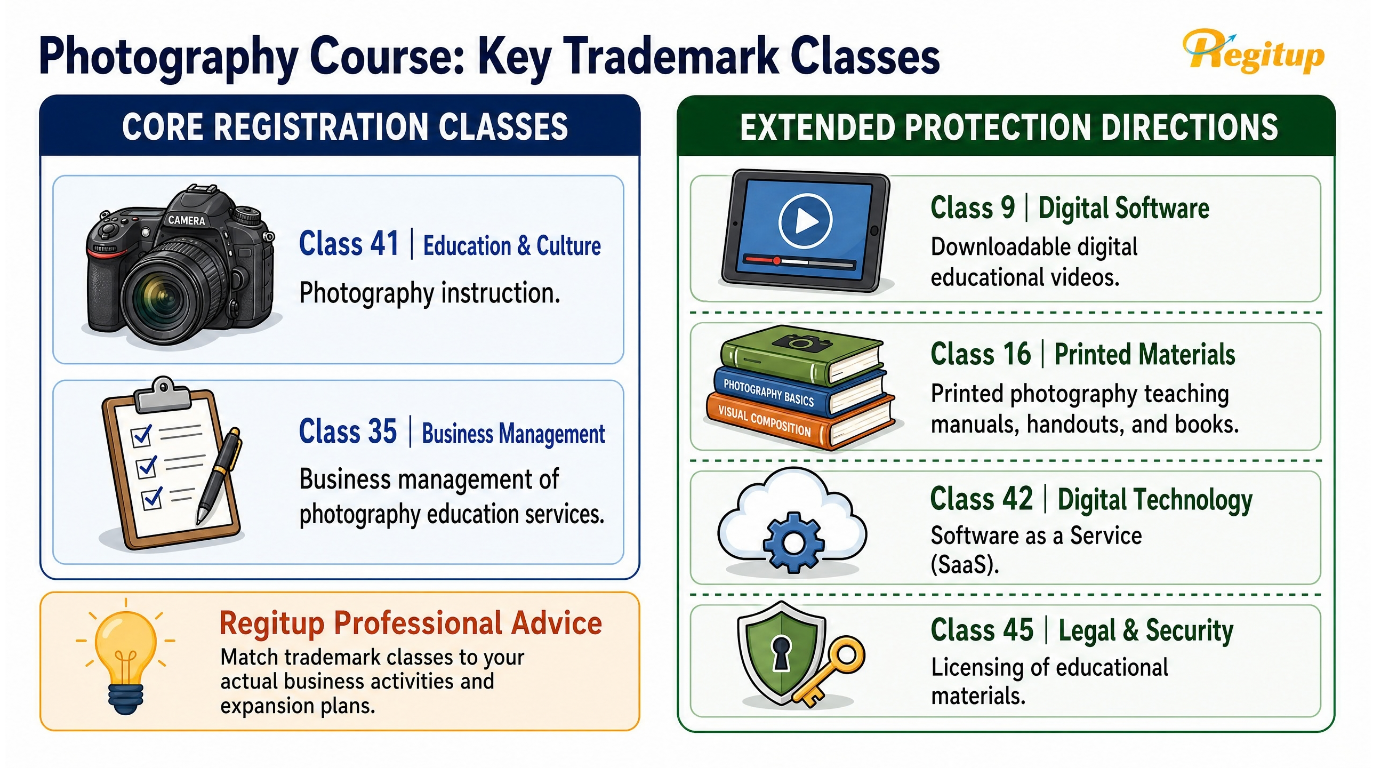
Primary Classes | Class 41, Class 35 |
Extension Classes | Class 9, Class 16, Class 35, Class 41, Class 42, Class 45 |
Analysis Premise
This article focuses on the core business model of a "Photography Course": providing professional photography techniques training and teaching services. This includes physical photography workshops, online video tutorials, and practical guidance on shooting techniques and post-production image processing. The primary objective is to enhance students' practical photography skills rather than simply selling equipment or providing commercial photography services. When a brand's main source of revenue is "teaching others how to take photos," trademark protection should prioritize categories related to knowledge transfer.
Primary Classes
For photography education brands, trademark registration should prioritize the following two classes to ensure legal defense in both teaching and business operations.
Class | Application Scenarios / | Examples of Goods/Service Descriptions |
Class 41 | The core teaching category, covering all forms of teaching, training, and knowledge dissemination activities. | Photography instruction; arranging and conducting photography workshops; providing online non-downloadable educational videos. |
Class 35 | Used to protect brand promotion, franchise management, or business operations acting as an agent for other instructors. | Business management of photography education services; marketing and promotion of photography courses for others. |
Class Boundary Discussion
The protection focus of Class 41 is on the "act of teaching." Whether it is a physical classroom lecture or streaming video on a website, as long as the essence is education, it belongs to this class. Although this class also includes photography services, educators should emphasize "training" related terminology to distinguish themselves from general commercial photography.
Class 35 protects the "business operations" of the brand. When a brand collaborates with other instructors or places course advertisements on social media platforms, registering in this class prevents competitors from using similar trademarks in promotional services, ensuring exclusivity in marketing.
Extension Classes Based on Business Models
In addition to core teaching, if the business involves course material distribution, software services, or copyright operations, the following extension classes should be considered:
Class | Application Scenarios | Potential Scope of Services |
Class 9 | Providing students with downloadable e-books, teaching apps, or pre-recorded digital teaching files. | Downloadable digital educational videos; electronic teaching manuals; educational software applications. |
Class 16 | Providing or selling printed photography course materials, handouts, or photo collections. | Printed photography teaching manuals, handouts, and books. |
Class 42 | Developing and operating a proprietary Learning Management System (LMS) or cloud-based photo editing tools. | Software as a Service (SaaS); technical support for photography teaching platforms. |
Class 45 | Licensing original photography course materials or curriculum systems to other institutions. | Licensing of educational materials; intellectual property licensing management. |
Conclusion
The trademark layout for photography courses centers on Class 41 (Education and Training), with Class 35 (Business Management) serving as brand protection. As teaching mediums diversify, operators should flexibly add protection for Class 9, Class 42, or Class 16 depending on whether they provide downloadable files, operate software platforms, or publish printed materials.
Choosing trademark classifications is not a one-time task, and the description of goods and the scope of rights during the actual application will vary based on local regulations and business details. It is recommended to consult a professional advisor before formal submission to ensure a rigorous classification strategy.
Assistance from Regitup for Trademark Applications
The trademark registration process is complex and full of legal details; a slight oversight could lead to the rejection of the application. The Regitup team has extensive practical experience in cross-border trademarks and can provide precise class verification, application document preparation, and representative submission services for your photography education brand. We are committed to simplifying the process so you can focus on course creation while leaving the legal protection to the professionals.
Start Your Trademark Registration
Frequently Asked Questions
Q1 : I only teach photography on social media platforms; do I still need to register a trademark?
Yes. As long as you teach under a specific brand name and accumulate a reputation, it has protective value. Registering a trademark prevents others from opening similar courses under your name, protecting your brand's credibility and student traffic.
Q2 : If my course includes photo editing instruction, do I need to add Class 40?
Usually not. The essence of photo editing instruction is still education, which belongs to Class 41. Class 40 is primarily for "labor services" of editing photos for clients. Unless you also provide photo editing services for clients, focusing on Class 41 is sufficient.
Q3 : What is the difference between watching videos online and downloading them in terms of classification?
In practice, providing non-downloadable online videos is a Class 41 service; downloadable videos are considered Class 9 goods. If your platform supports both modes, it is recommended to register in both classes.
Q4 : Does registering in Class 41 mean others cannot use my name to sell cameras?
Not necessarily. Class 41 protects educational services, while selling cameras belongs to Class 35 or Class 9. If you wish to be protected in the equipment sales field as well, you need to register across classes, which is why trademark planning should consider future scalability.
Q5 : Is registration guaranteed if I follow this classification guide?
No. Trademark acceptability, class strategy, and scope may vary by filing jurisdiction and actual business operations. This guide is for informational purposes only and does not imply global automatic protection or guaranteed registration.