
Key Point | Details |
Intended Audience | Operators of Sports Venue and businesses planning related goods, services or brand development. |
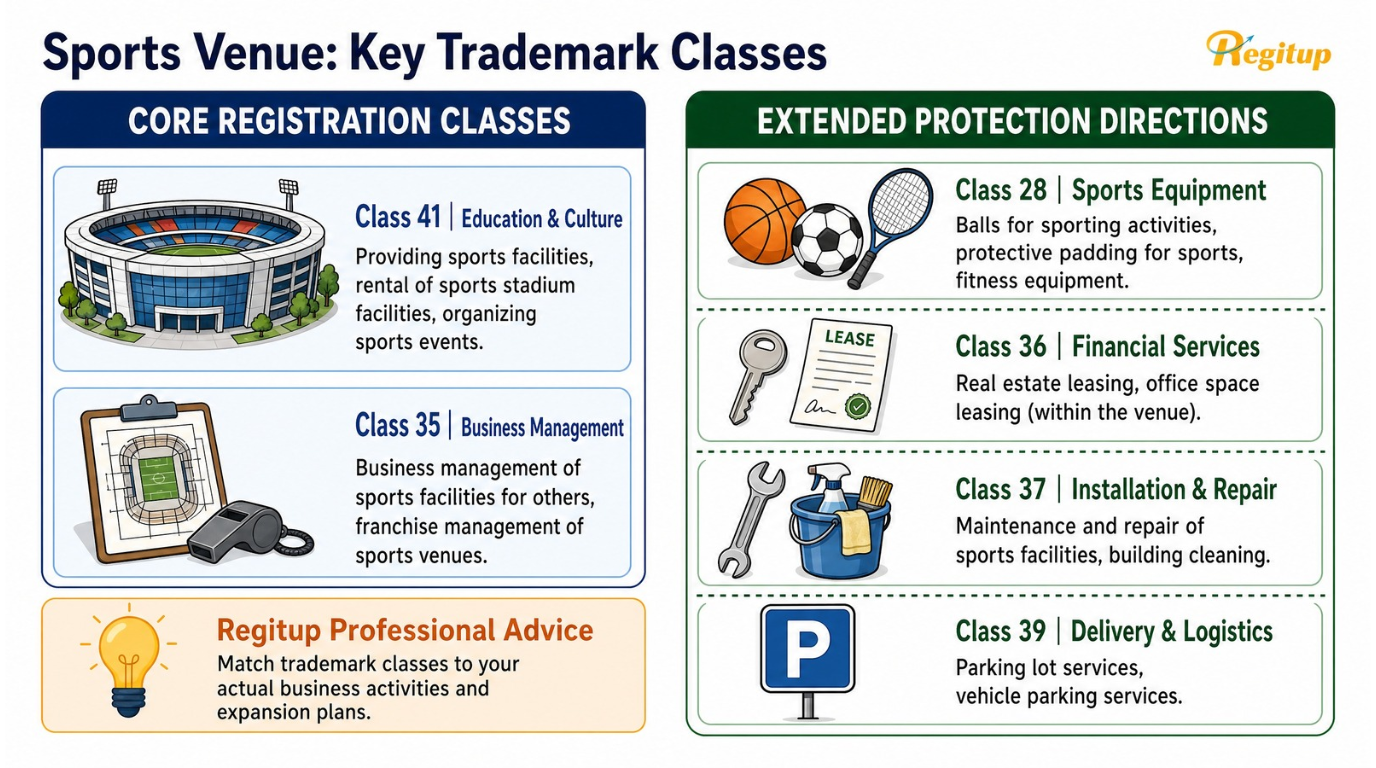
Primary Classes | Class 41, Class 35 |
Extension Classes | Class 28, Class 35, Class 36, Class 37, Class 39, Class 41 |
Analysis Premise
In this discussion, a "Sports Venue" refers to a business model that provides physical spaces and facility services for sports activities, competitions, or training. This covers the operation of various types of courts, gyms, and large multi-purpose stadiums. The core business includes venue leasing, provision of sports equipment, and the organization and hosting of sporting events. The focus is on ensuring consumers correctly associate the quality of service in that space with the brand logo.
Primary Classes
When operating a sports venue, the core value of the brand lies in the provision of venue services and the professionalism of business operations. The following two classes are the top priorities for all venue operators.
Class | Application Scenario / Why it is a Primary Class | Examples of Goods/Service Descriptions |
Class 41 | Core venue services, providing sports spaces for public or professional use. | Providing sports facilities, rental of sports stadium facilities, organizing sports competitions, sports training services. |
Class 35 | Brand management and operation, involving franchising or managing venues on behalf of others. | Business management of sports facilities for others, franchise management of sports venues, venue marketing. |
Class Boundary Discussion
Class 41 covers all substantive activities that "allow consumers to enter the venue for exercise," making it the cornerstone of brand defense. Class 35, on the other hand, focuses on "business operations," which is crucial for companies planning to develop franchise systems or engage in commissioned venue management. Combining these two classes prevents competitors from causing brand confusion at either the service or management levels.
Extension Classes Based on Business Models
As business models diversify, venues may involve other ancillary operations. The following extension classes are recommended based on specific activities.
Class | Application Scenario | Potential Scope of Services |
Class 28 | The venue sells its own brand of sports equipment. | Balls for sporting activities, protective padding for sports, fitness equipment. |
Class 36 | Long-term real estate leasing of venue space. | Real estate leasing, office space leasing (within the venue). |
Class 37 | Provision of maintenance and cleaning services for sports facilities. | Maintenance and repair of sports facilities, building cleaning. |
Class 39 | Operation of a paid parking lot attached to the venue. | Parking lot services, vehicle parking services. |
Class 43 | The venue features a restaurant or snack bar providing food and drinks. | Catering services for food and beverages, cafes, restaurants. |
Extended layouts should focus on activities that carry brand recognition. For instance, if operating a self-managed restaurant, Class 43 is indispensable.
Conclusion
Trademark planning for sports venues should take Class 41 as the defensive core, supplemented by Class 35 to secure operational rights. For diversified venues involving catering, equipment sales, or leasing, extensions should be made to Classes 28, 36, or 43 according to the actual business weight.
Please note that the actual scope of protection varies by jurisdiction. A comprehensive review of your business plan is recommended before submitting an application to ensure the trademark layout provides long-term protection.
Complete Your Trademark Application with Regitup
Trademark registration is a precise layout of legal boundaries and commercial strategies. The Regitup professional team can assist you in verifying classification data, preparing professional documents, and submitting applications on your behalf, ensuring your brand receives full protection in the market.
Start Your Trademark Registration
FAQ
Q1 : If I only provide the venue without coaches, do I still need to register in Class 41?
Yes. The core of Class 41 is the "provision of facilities." As long as you provide a physical sports space, whether or not instruction is included, Class 41 is the most important protective class.
Q2 : If the venue snack bar sells water, do I need an additional class?
If it is merely an ancillary service and you are not selling water under your own brand, registration can be deferred. However, if you plan to launch branded bottled water, it is recommended to register in the Class 32 goods category.
Q3 : Which class does it fall under if I lease venue space long-term to a clinic?
This involves real estate leasing in Class 36. If your brand name appears on the signage or contracts for that space, registering in this class can prevent brand confusion.
Q4 : Does organizing a road race fall under the venue category?
Yes, organizing sports events and competitions also falls under Class 41. If your venue frequently hosts events, relevant descriptions should be included in your application.
Q5 : Why must chain venues register in Class 35?
Class 35 covers business operation authorization and management. This protects the brand when recruiting franchisees and providing operational guidance, preventing others from using your name to engage in investment activities.