
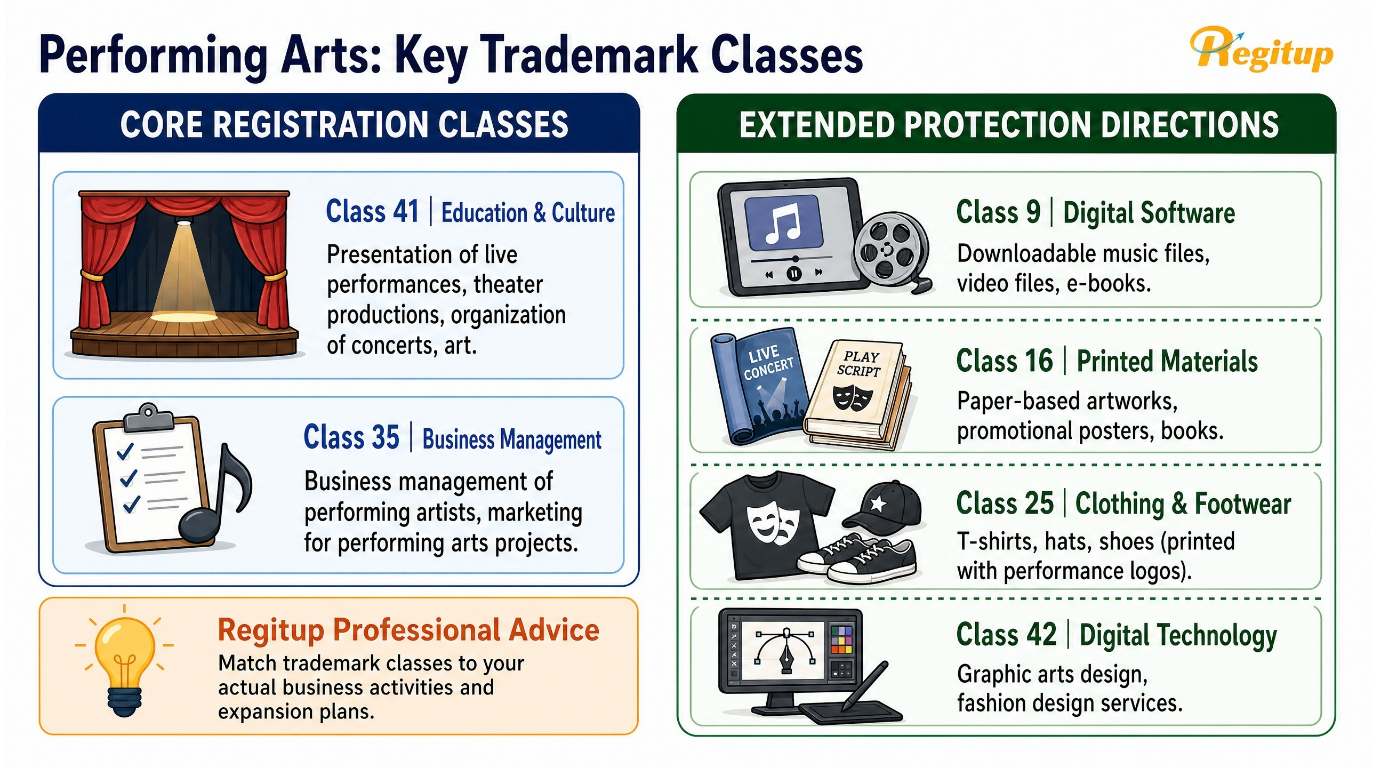
Key Point | Details |
Intended Audience | Operators of Performing Arts and businesses planning related goods, services or brand development. |
Primary Classes | Class 41, Class 35 |
Extension Classes | Class 9, Class 16, Class 25, Class 35, Class 41, Class 42 |
Analysis Premise
In trademark legal practice, Performing Arts refers to a business model centered on live performance production, stage shows, artistic creation, and talent management, generating revenue through ticket sales, licensing, royalties, or sponsorships. This industry is a cultural and creative sector characterized by a high degree of integration between labor and creative output. The scope of this article focuses on brand protection for performing entities and their commercial operations, excluding pure hardware rental services.
Primary Classes
Ensuring registration in core service classes is the first step in preventing brand infringement. The following are the two most critical primary classes for the performing arts industry:
Class | Applicable Scenario / | Examples of Goods/Service Descriptions |
Class 41 | Live performance production and artistic presentation services, which are the core value of performing arts. | Presentation of live performances, theater productions, organization of concerts, art exhibitions. |
Class 35 | Entertainment agency, performance marketing, and business management, involving artist management and promotion. | Business management of performing artists, marketing for performing arts projects. |
Class 41 protects the "act of performance" itself; whether it is a stage play or a concert name, it should be protected under this class. Class 35 focuses on "commercial operations," particularly the management and promotion of artists by agencies, effectively preventing others from using the same name in business management services.
Extension Classes Based on Business Models
As businesses diversify, many performing arts entities extend into digital content or merchandise development. The following extension classes are recommended for consideration:
Class | Applicable Scenario | Scope of Services to Consider |
Class 9 | Providing downloadable digital artworks, music, or audio-visual works | Downloadable music files, video files, e-books. |
Class 16 | Publishing physical artworks, art albums, or literary creations | Paper-based artworks, promotional posters, books. |
Class 25 | Selling performance-related merchandise | T-shirts, hats, shoes (printed with performance logos). |
Class 42 | Providing artistic creation and design services or operating digital art platforms | Graphic arts design, fashion design services. |
Class 45 | Managing intellectual property licensing for performing arts works | Intellectual property licensing, copyright management. |
The choice of these classes should depend on actual operations. For example, distributing digital albums of live recordings requires Class 9; if you own a large number of original scripts and conduct licensing business, Class 45 is key to maintaining intellectual property rights.
Conclusion
The performing arts industry should center its strategy on Class 41 and Class 35, adding Classes 9, 16, 25, and 45 depending on the needs for digital content, physical goods, or copyright management. Comprehensive brand protection not only prevents malicious squatting but also serves as an important legal foundation for future cross-border collaborations.
The actual designated items and scope of rights for a trademark vary according to the laws of different regions and business models. Before formal submission, a detailed search and evaluation should be conducted to ensure that the trademark strategy aligns with long-term development goals.
Complete Your Trademark Application with Regitup
Trademark registration involves precise class selection and risk assessment. The Regitup team has extensive practical experience and can provide professional verification services for performing arts professionals, assisting in the preparation of application materials and submitting them on behalf of clients. Through professional guidance, you can avoid application rejection due to classification errors and ensure that your artistic creativity is fully protected by law.
Start Your Trademark Registration
Frequently Asked Questions
Q1 : Is registering an arts group's name in Class 41 enough?
If the group operates social media platforms, sells souvenirs, or licenses scripts, registering in Class 41 alone is insufficient. It is recommended to evaluate whether classes such as Class 35 (agency management) or Class 25 (merchandise) are needed based on actual revenue sources.
Q2 : In which class should digital artworks be registered?
Downloadable digital artworks are typically classified under Class 9. If artistic creation and design services are involved, they belong to Class 42. Classification depends on the specific technical carrier and the content of the rights.
Q3 : Should individual performers apply in their own name or a company name?
This depends on the ownership of rights. A company name is beneficial for tax planning, while an individual name ensures the artist retains control over their stage name even if they change agencies. In either case, agency protection under Class 35 is indispensable.
Q4 : Does trademark protection for performing arts have automatic global effect?
Trademark rights are territorial. A trademark registered in one jurisdiction is only protected in that jurisdiction. If you plan to go on overseas tours or distribute works on international platforms, you should plan for each target market separately to ensure global brand security.