
Key Point | Details |
Intended Audience | Operators of Software Development and IT Consulting and businesses planning related goods, services or brand development. |
Primary Classes | Class 42, Class 9, Class 35 |
Extension Classes | Class 9, Class 35, Class 38, Class 41, Class 42, Class 45 |
Analysis Premise
Under the framework of trademark practice and the Nice Classification, the Software Development and IT Consulting industry discussed in this article is defined by a core business model of providing professional services such as custom software programming, system design and development, and professional information technology (IT) system planning and architectural consultancy for third-party clients. These enterprises typically do not merely sell packaged software; rather, they focus on architectural design, source code writing, and system integration based on the specific needs of their clients. This "technology output" core determines that their trademark strategy must span both the "goods" and "services" domains to effectively prevent competitors from creating brand confusion in related technical fields.
Primary Classes
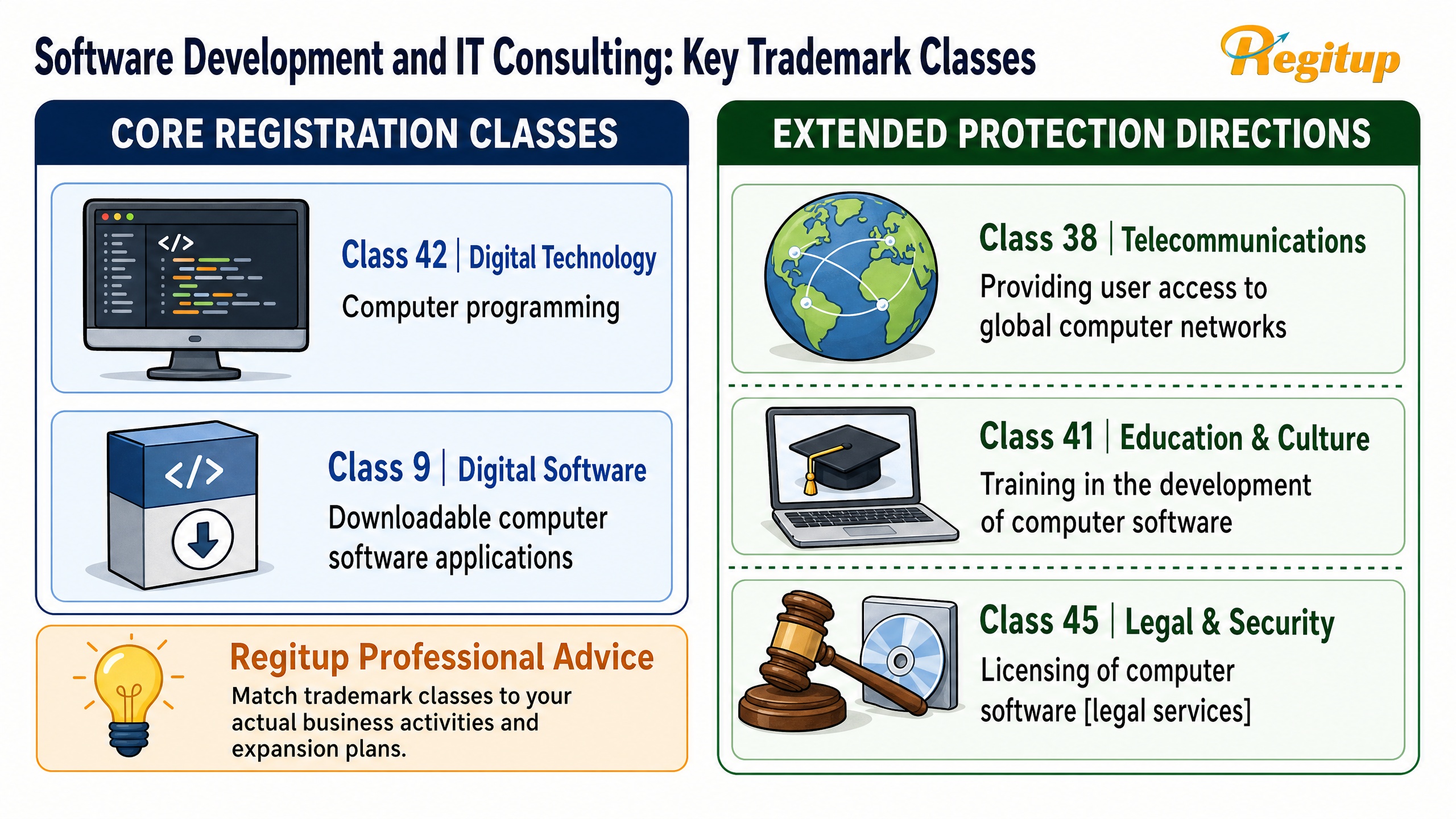
For most software developers and IT consultants, protecting the integrity of their core business requires filing in multiple classes. The following table organizes the most critical categories to help businesses establish a solid brand defense line.
Class | Scenario / | Examples of Goods or Service Descriptions |
Class 42 | Core technical R&D services, covering custom programming and technical consultancy. | Computer programming; computer software design; information technology [IT] consultancy; computer system design; software as a service [SaaS]. |
Class 9 | Software products and apps, when software is provided in downloadable form or on storage media. | Downloadable computer software applications; computer software, recorded; computer operating software; mobile applications. |
Class 35 | Business management and retail, involving software sales channels or project management processes. | Business management of information technology projects; retail services for computer software; wholesale services for software. |
Class Boundary Notes
Class 42 is the core category for software developers, protecting technical output. Once technology is transformed into a downloadable app, it takes on the characteristics of a commodity and needs to be reinforced through Class 9. Many companies overlook Class 35, but when large-scale IT project management or proprietary sales platforms are involved, Class 35 effectively prevents others from misappropriating the brand at the business operation level.
Extension Classes Based on Business Models
As businesses diversify, they often touch upon communication, education, or even legal licensing fields. Depending on specific activities, enterprises should consider extension applications in the following classes.
Class | Applicable Scenario | Examples of Service Scope |
Class 38 | Providing network access services or data transmission platforms. | Providing user access to global computer networks; streaming of data. |
Class 41 | Providing technical training for development tools or specific systems. | Training in the development of computer software; organizing technical seminars. |
Class 45 | Legal licensing business involving software intellectual property. | Licensing of computer software [legal services]; copyright management. |
A principle of precision should be adopted for extension strategies. For example, if a company's operations require the continuous provision of a communication platform for real-time data streaming, Class 38 becomes indispensable. If corporate revenue includes legal arrangements for software licensing fees, the legal licensing services in Class 45 will provide deeper protection.
Conclusion
For the software development and IT consulting industry, establishing a strategy centered on Class 42 and Class 9, supplemented by Class 35 for business management, is currently the most robust path. Enterprises with communication, training, or complex licensing businesses should extend to Classes 38, 41, or 45 as needed.
The arrangement of trademark classes directly affects the breadth of rights. During actual application, adjustments must be made based on the guidelines of the filing jurisdiction and business details. As an enterprise expands, regularly reviewing and supplementing protection in relevant classes is the only way to remain invincible in the highly competitive technology market. The actual designation of goods or services, class arrangements, and scope of rights still vary depending on the filing jurisdiction and specific business operations.
Complete Your Trademark Application with Regitup
Trademark registration involves legal expertise, and incorrect classification choices can lead to a brand losing its protection. The Regitup team has extensive experience in cross-border applications and can provide professional verification services for software development and IT consulting enterprises. We will help you accurately define your business scope, prepare documents, and submit applications on your behalf, ensuring your brand has a strong legal foundation.
Start Your Trademark Registration
Frequently Asked Questions
Q1 : Is it enough for a software development company to register only in Class 42?
Usually, no. Class 42 protects the process of technical output. If the software is available for download and installation, the rights to that name for "software goods" must be protected through Class 9; otherwise, competitors might exploit legal loopholes with identical products.
Q2 : Which class should SaaS (Software as a Service) fall under?
SaaS is typically categorized under Class 42, as it is viewed as an online technical service. However, for defensive purposes, many operators still file in Class 9 to prevent others from using the same name on downloadable software with similar functions.
Q3 : What is the difference between IT consulting and general business consulting?
IT consulting (Class 42) focuses on technical advice, such as system architecture optimization, while business consulting (Class 35) focuses on business strategy or administrative efficiency. If a service includes both, it is recommended to apply for both classes simultaneously.
Q4 : Must a name on the App Store be registered in Class 9?
It is strongly recommended. Applications are considered downloadable software, which belongs to Class 9. In a highly competitive market, holding Class 9 trademark rights is a vital legal basis for protecting an app's name and handling infringement complaints.