
Key Point | Details |
Intended Audience | Operators of Coffee Shop and businesses planning related goods, services or brand development. |
Primary Classes | Class 43, Class 35, Class 30 |
Extension Classes | Class 9, Class 11, Class 21, Class 30, Class 35, Class 40 |
Analysis Premise
The "Coffee Shop" discussed in this article refers to a business model centered on physical store operations, providing on-site brewed coffee, various beverages, and light meals for customer consumption. This type of business typically emphasizes the spatial experience, social environment, and the provision of ready-to-drink products. The scope of analysis also covers common business models involving the retail of private-label coffee beans, the sale of packaged coffee products, and the expansion of brand influence through chain franchising. Simple vending machine services or home-based small shops without brand-operating characteristics are not within the core discussion of this article.
Primary Classes
The operation of a coffee shop involves dual attributes of services and goods. Therefore, when planning trademark registration, both the service categories for providing food and drinks and the physical product categories for sales must be considered. Below are the core Nice Classification recommendations for coffee shops:
Class | Applicable Scenarios / | Examples of Goods/Service Descriptions |
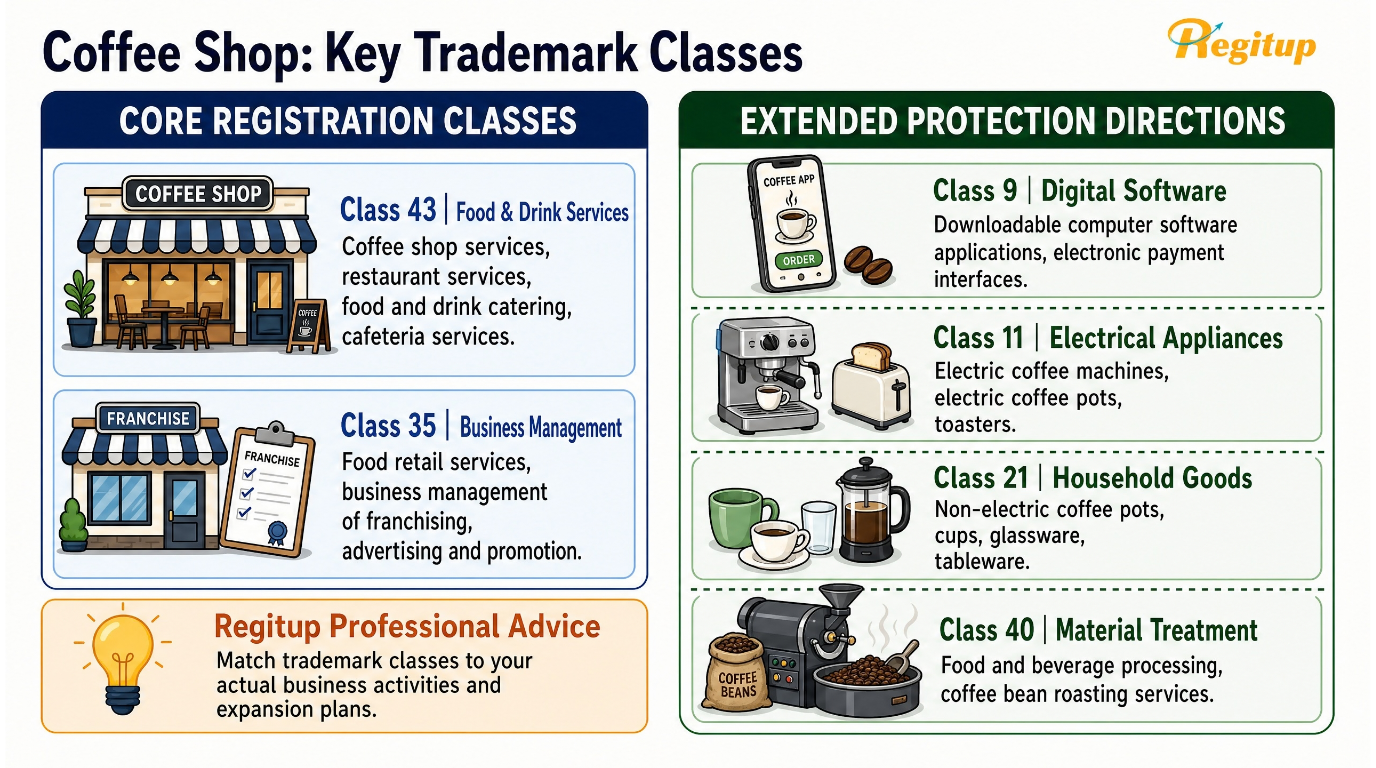
Class 43 | This is the most core service category for coffee shop operations, covering all acts of on-site beverage preparation and meal provision. | Coffee shop services, restaurant services, food and drink catering, cafeteria services. |
Class 35 | Involves store retail operations, brand franchise management, loyalty point systems, and commercial marketing activities. Especially important for chain brands. | Food retail services, business management of franchising, advertising and promotion, business management for others. |
Class 30 | Must be registered if the brand involves selling private-label roasted coffee beans, drip bags, or pre-packaged coffee drinks. | Coffee, coffee beans, roasted coffee beans, coffee-based beverages, coffee-based drinks. |
Class 43 protects the core food and beverage service experience; Class 30 targets physical goods such as private-label coffee beans or packaged beverages. With the trend of digital transformation, Class 35 has become a key category for protecting brand business operations, loyalty marketing, and retail management.
Extension Classes Based on Business Models
In addition to core catering and product sales, many coffee shops develop more diverse businesses based on their brand positioning. In such cases, protection in extension categories needs to be considered:
Class | Applicable Scenarios | Potential Scope of Services |
Class 9 | Developing dedicated mobile applications for online ordering, point accumulation, or delivery services. | Downloadable computer software applications, electronic payment interfaces. |
Class 11 | Selling or developing brand-specific electric coffee machines, grinders, or roasting equipment. | Electric coffee machines, electric coffee pots, toasters. |
Class 21 | Selling coffee mugs, pour-over kettles, or non-electric French presses with the brand logo. | Non-electric coffee pots, cups, glassware, tableware. |
Class 40 | Providing custom coffee bean roasting processing services rather than direct sales. | Food and beverage processing, coffee bean roasting services. |
Class 41 | Providing coffee brewing instruction, latte art courses, or tasting workshops. | Arranging and organizing workshops, providing training services, coffee knowledge lectures. |
Class 42 | Operating independent coffee industry technology platforms or providing SaaS software system services. | Software as a Service (SaaS), website design and hosting. |
Extension categories should be selected based on actual expansion plans. For example, if you plan to launch peripheral mugs, Class 21 is required; if developing a dedicated ordering app, Class 9 should be considered. Making conservative judgments can save initial costs.
Why Can't You Choose Categories Based Only on Industry Names?
Many people mistakenly believe that registering under "Coffee Shop" provides comprehensive protection. However, the same name represents different rights in different categories. While registering Class 43 can protect store operations, it cannot prevent others from selling packaged coffee beans under the same name in supermarkets (which belongs to Class 30). If franchising is involved, the business management in Class 35 is the legal basis for brand licensing. Therefore, registration should be planned according to actual revenue sources rather than just looking at the industry name.
Conclusion
In summary, a standard coffee shop should use Class 43 as the cornerstone of protection and include Class 35 (retail and franchising) and Class 30 (product sales) depending on brand management needs. If education, peripheral goods, or digital tool development are involved, protection should be selectively extended to Classes 41, 21, or 9.
It should be noted that the actual designated goods or services for trademark applications, the priority of category arrangements, and the final scope of rights obtained will vary due to trademark examination practices and specific business details in different countries or regions. Before formally submitting an application, it is recommended to consult a professional advisor to ensure that the application content meets local legal requirements and practical norms.
Assistance with Trademark Applications by Regitup
Trademark registration is a rigorous legal process. From the precise selection of categories to the professional drafting of application documents, every step concerns the future legal security of the brand. The Regitup team has extensive experience in cross-border trademarks and can assist you in verifying industry classification data, preparing professional application documents, and submitting them on your behalf, ensuring that your brand receives the most comprehensive protection during its expansion.
Start Your Trademark Registration
Frequently Asked Questions
Q1 : Do I need to register Class 30 if I only sell freshly brewed coffee?
If it is limited to in-store consumption or takeout of freshly prepared coffee, Class 43 is sufficient. However, if you want to sell packaged coffee beans or drip bags with your brand, you must register Class 30 to protect the physical goods.
Q2 : Do I need to register additional categories for providing light meals?
Class 43 already covers on-site catering services. Unless you produce light meals as pre-packaged food (such as branded desserts) for distribution and sale in other channels, you would then need to consider Class 30 (pastries) or Class 29.
Q3 : Is Class 35 mandatory for operating a chain brand?
Yes. Class 35 protects "business management of franchising," which is the legal basis for opening franchises, managing chain systems, and unifying brand marketing, ensuring the legality of brand licensing.
Q4 : Do I need to register Class 38 for providing free Wi-Fi?
No. Wi-Fi is merely an additional facility for catering services and not a core source of revenue. Registration should focus on primary business activities to avoid unnecessary administrative fee expenditures.