
Key Point | Details |
Intended Audience | Operators of Supermarkets and Convenience Stores and businesses planning related goods, services or brand development. |
Primary Classes | Class 35 |
Extension Classes | Class 9, Class 30, Class 35, Class 36, Class 39, Class 43 |
Analysis Premise
In trademark practice, the supermarket and convenience store industry refers to a business model that operates physical or online stores to aggregate and sell various consumer goods such as food, beverages, and daily necessities to the general public. This type of business typically includes chain operations, franchise management, and membership systems. Its legal essence lies in providing "shopping convenience" retail services to consumers, rather than mere product manufacturing. Clearly defining this premise helps distinguish the core differences in trademark strategy between retailers and manufacturers.
Primary Classes
For supermarket and convenience store operators, the core scope of protection is concentrated in service categories. The following are the most indispensable primary classes for this industry:
Class | Applicable Scenario / | Examples of Goods/Service Descriptions |
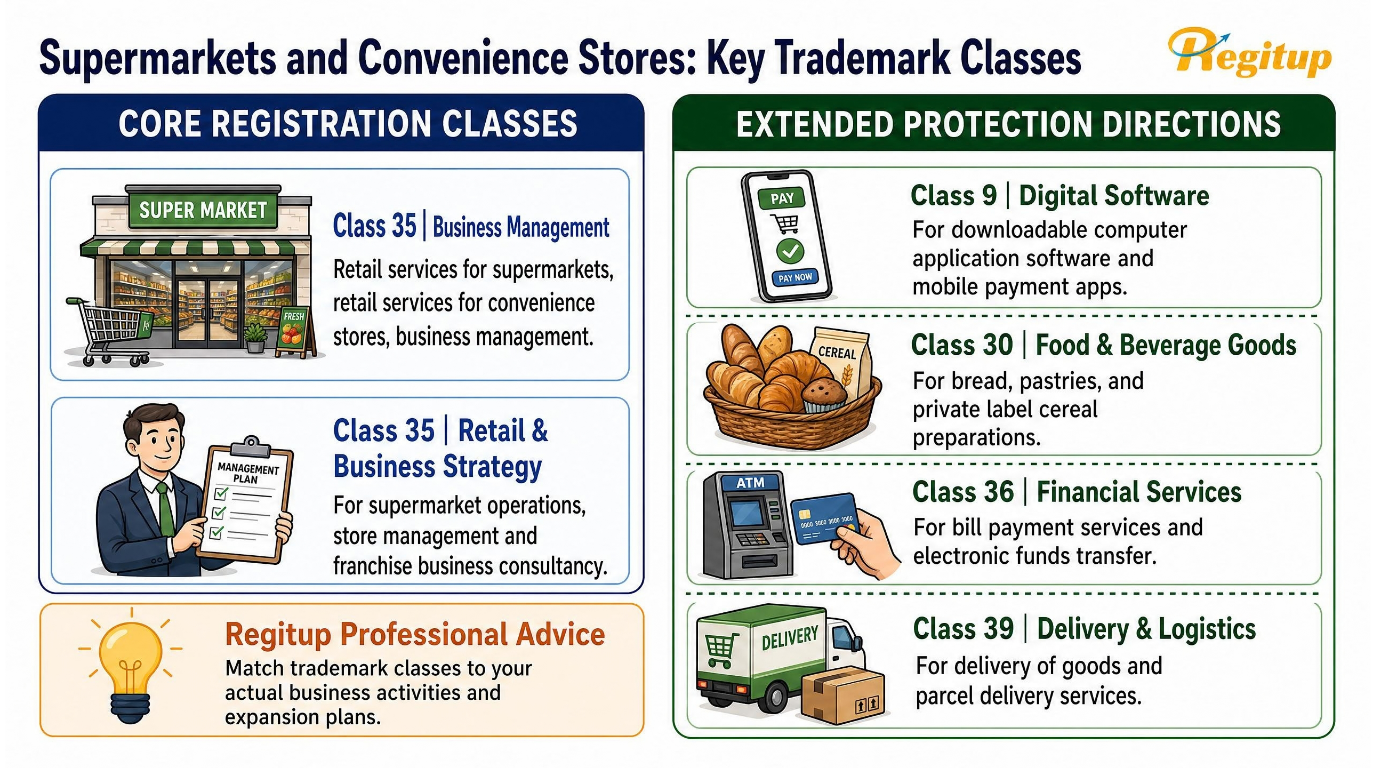
Class 35 | Core Retail and Business Management: Covers store operation, retail aggregation of goods, and franchise management. | Retail services for supermarkets, retail services for convenience stores, business management of franchise businesses, advertising. |
Class 35 is the cornerstone for all retailers. Legally, this class protects the right to "operate a store." For example, when a supermarket uses its brand name on a sign, registration in Class 35 prevents competitors from opening retail stores with the same name. Additionally, modern supermarkets often involve franchising; "franchise management" in this class ensures legal control over the brand during expansion.
Extension Classes Based on Business Models
As the retail industry tends to diversify, supermarkets and convenience stores often provide value-added services. Depending on the specific model, the following extension classes should be considered:
Class | Applicable Scenario | Potential Service Scope |
Class 9 | Providing membership shopping apps or software | Downloadable computer application software, mobile payment apps. |
Class 30 | Selling private label packaged foods | Bread, pastries, cereal preparations (private label). |
Class 36 | Providing bill collection or payment services | Bill payment services, electronic funds transfer. |
Class 39 | Providing product delivery or home delivery services | Delivery of goods, parcel delivery. |
Class 43 | Providing ready-to-eat prepared food or on-site dining | Services for providing food and drink, cafeterias. |
Conditional Extension Analysis:
If the store has a dining area and sells freshly made coffee or prepared food, Class 43 becomes a defensive priority. If home delivery services are provided, Class 39 is needed to protect the logistics chain. Many convenience stores act as community financial hubs, handling bill payments, which falls under Class 36. If developing "private label" goods (such as supermarket-branded rice or noodles), registration must be done for the attributes of the goods themselves (such as Class 30). Finally, for shopping apps developed for digital transformation, software protection under Class 9 should be considered.
Conclusion
The trademark layout for the supermarket and convenience store industry should center on Class 35 retail services, and a protective network should be built based on whether it involves catering supply (Class 43), logistics delivery (Class 39), financial collection (Class 36), or private label goods (Class 30, etc.).
Please note that during the actual application process, specific goods and service descriptions and the scope of rights protection will vary depending on the laws of the filing jurisdiction and the specific business model. The information in this article is for reference only and does not represent any guarantee of successful registration.
Complete Your Trademark Application with Regitup
Trademark registration involves tedious class checking and legal risk assessment. The Regitup team has extensive practical experience and can provide precise class selection advice for supermarket and convenience store operators, assisting in data verification, document preparation, and representing the submission of applications to ensure your brand assets are firmly protected.
Start Your Trademark Registration
Frequently Asked Questions
Q1 : Do online supermarkets also need to register in Class 35?
Yes. As long as it involves the retail act of "aggregating goods for selection," Class 35 is a core class. The brand names of online supermarkets are highly recognizable in search engines, and registering this class effectively prevents others from operating competitive platforms with similar names.
Q2 : Why add Class 43 for selling prepared food?
Class 35 protects retail acts, while Class 43 protects "services for providing food and drink." If the store provides freshly made meals or has a seating area, it is legally closer to catering services. If Class 43 is not registered, it may be difficult to assert your rights when others open a restaurant with the same name.
Q3 : Do private label products have to be registered separately?
Strongly recommended. If you sell products with your own trademark, you are also a "brand owner." Class 35 cannot protect the packaging labels of specific goods; you must register independently for each major private label product category to ensure exclusivity for the product line.
Q4 : Is the bill collection service in convenience stores also related to trademarks?
Yes. If the brand name is linked to financial services, registering Class 36 can protect your rights in bill payment services. This is crucial for building consumer trust and preventing counterfeiting in the fintech sector.
Q5 : Can I register all classes?
In practice, blind registration is not recommended. Trademark law requires the fact of actual use after registration; otherwise, there is a risk of cancellation. The professional approach is to prioritize the core classes and then gradually complete the extension classes as the business expands.