
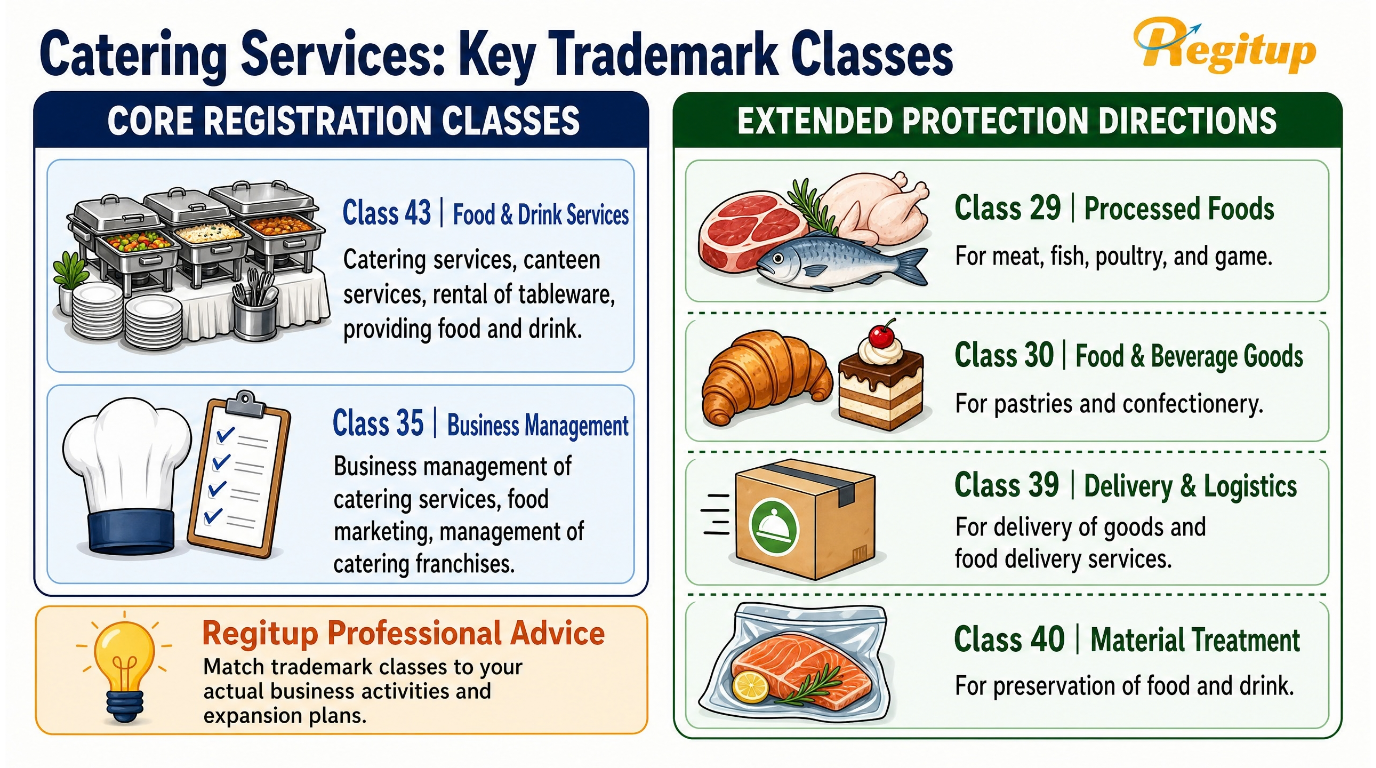
Key Point | Details |
Intended Audience | Operators of Catering Services and businesses planning related goods, services or brand development. |
Primary Classes | Class 43, Class 35 |
Extension Classes | Class 29, Class 30, Class 35, Class 39, Class 40, Class 41 |
Analysis Premise
In this article, "Catering Services" refers to the professional food service provider model, where the primary business involves being commissioned to provide meal preparation, on-site service, and related equipment rental for specific events (such as weddings, parties, and conferences) or specific institutions (such as schools and factories). This model centers on "on-site service" and does not include traditional retail restaurants operating at a fixed location.
Primary Classes
Brand protection for catering services should prioritize core service categories. The following are the two primary classes that operators must prioritize:
Class | Application Scenario / | Examples of Goods/Service Descriptions |
Class 43 | Core services for providing food and drink, which is the foundation of a catering business. | Catering services, canteen services, rental of tableware, providing food and drink for events. |
Class 35 | Involves commercial management of catering brands, franchise operations, marketing promotion, and food retail channel management. | Business management of catering services, food marketing, management of catering franchises. |
Class 43 is the heart of a catering business, defining the essence of the service as "preparing food for others for consumption." Class 35 plays a defensive role for the brand, especially when operators intend to open franchises, conduct large-scale brand marketing, or manage across multiple channels. Registering in this class effectively prevents others from operating related business management services under a similar name.
Extension Classes Based on Business Models
As business operations diversify, operators should selectively add the following extension classes based on their actual scope of operation:
Class | Application Scenario | Scope of Services to Consider |
Class 29 | Production and sale of private-label meat, seafood, canned vegetables, or processed foods. | Meat, fish, poultry, and game; processed fruits and vegetables. |
Class 30 | Production and sale of private-label bread, pastries, seasonings, or deli sauces. | Pastries and confectionery; seasonings; cereal-based snacks. |
Class 39 | Operators with their own logistics fleet providing meal delivery and distribution services. | Delivery of goods, food delivery services. |
Class 40 | Involves large-scale food processing, smoking, freezing, or special food preservation treatments. | Preservation of food and drink; food processing. |
Class 41 | Integrated entertainment services combining catering with performances and party planning. | Party planning [entertainment]; event coordination. |
Class 42 | Development and maintenance of proprietary online ordering platforms, apps, or SaaS management systems. | Software as a Service [SaaS]; computer software design and maintenance. |
Extension classes should follow a "specific activity-oriented" strategy. For example, if a company has its own branded delivery fleet, Class 39 is crucial. If there are plans to commercialize and sell specialty sauces, protection in Class 30 will serve as the cornerstone for brand monetization.
Conclusion
A trademark strategy should center on Class 43, with layouts in Class 35 and related goods categories (such as Classes 29 and 30) depending on the scale. For operators with logistics advantages or digital needs, Class 39 and Class 42 are important extension options.
Please note that the suggestions in this article are for informational purposes only. In actual applications, specific descriptions, class order, and scope of rights may vary depending on the laws of the filing jurisdiction and business details. It is recommended to consult a professional advisor before submitting an application to ensure complete protection.
Complete Your Trademark Application with Assistance from Regitup
Trademark registration is a precise legal layout. The Regitup team has cross-border trademark practice experience and can assist catering operators in verifying information, preparing professional documents, and submitting applications on their behalf. We are committed to simplifying administrative processes, allowing you to focus on your catering services while leaving the legal protection of your brand to a professional team.
Start Your Trademark Registration
Frequently Asked Questions
Q1 : Must a catering service register in Class 35?
While Class 43 is the core, Class 35 is vital for "brand management." If your catering business involves franchise operations, opening franchises, or conducting large-scale advertising and marketing, registering in Class 35 ensures your brand receives complete protection at the business operation and marketing levels, preventing others from misleading consumers.
Q2 : If I only take orders online, do I need to register in Class 42?
This depends on your technical investment. If you simply use general communication software or existing social platforms to take orders, Class 42 is usually not necessary. However, if you invest funds to develop a proprietary ordering system, a member app, or provide catering management software to other operators, then "Software as a Service" protection in Class 42 is very necessary.
Q3 : Is there a difference in trademark classification between institutional catering and general catering?
In terms of core classification, both belong to Class 43. However, institutional catering providers (such as those supplying schools or factories) often involve larger-scale food processing and preservation. Therefore, in terms of extension classes, "preservation of food and drink" in Class 40 may hold more protective value for institutional caterers than for general small-party catering.
Q4 : Can Class 43 protect the sale of frozen meal kits bundled with catering?
No. Class 43 protects "services," while frozen meal kits are "physical goods." Depending on the contents, you need to register in Class 29 (such as processed meat and vegetables) or Class 30 (such as noodles and pastries). If these goods classes are missed, your brand's protection in the retail market will be significantly compromised.
Q5 : Why should my catering brand consider Class 39?
If your catering business highlights "on-time delivery" or "nationwide distribution" and owns its own logistics fleet, registration in Class 39 can protect your brand rights in "transportation services." This prevents other logistics companies from using similar names, which could cause consumer confusion regarding the source of delivery.