
Key Point | Details |
Intended Audience | Operators of Apparel, Shoes, and Bags Store and businesses planning related goods, services or brand development. |
Primary Classes | Class 35, Class 25, Class 18 |
Extension Classes | Class 9, Class 18, Class 25, Class 35, Class 36, Class 37 |
Analysis Premise
In this guide, an "Apparel, Shoes, and Bags Store" refers to a business centered around physical storefronts or e-commerce platforms engaged in the retail and brand management of ready-to-wear clothing, footwear, and leather accessories. The core of this business lies in product distribution and brand presentation, whether operating as a multi-brand boutique or a private label. Some businesses may also extend into app development, custom alterations, or after-sales repair services.
Primary Classes
For any apparel, shoes, and bags store, the following three classes are the cornerstones of a brand's defensive network. Lacking any of these could leave significant gaps in a brand's market rights.
Class | Scenario / | Examples of Goods/Services Descriptions |
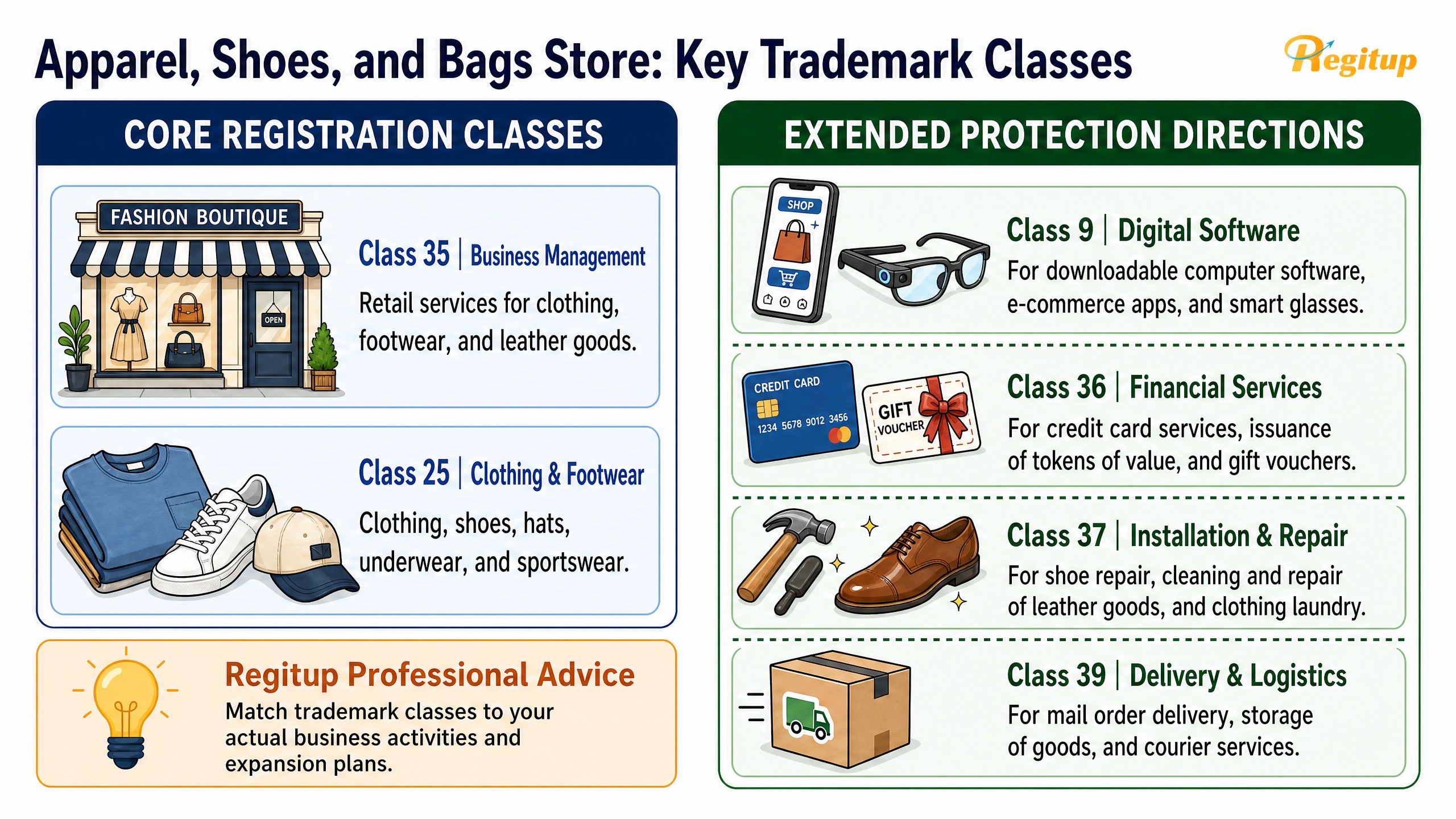
Class 35 | Retail and Business Management: Protects the store name and the right to provide services for "bringing together a variety of goods for consumers to view and purchase." | Retail services for clothing, retail services for footwear, retail services for leather goods, online shopping services. |
Class 25 | Clothing and Footwear Products: Prevents others from producing counterfeit clothing or footwear under the same name, protecting the brand's physical goods. | Clothing, shoes, hats, underwear, sportswear. |
Class 18 | Leather and Bag Products: Targeted protection for leather accessories like bags and wallets, serving as a foundation for brand extension. | Leather and imitations of leather, handbags, wallets, trunks. |
In-Depth Analysis of Class Boundaries
Class 35 protects "retail services," which applies to your store name and signage. Without registration in this class, others could open a store with the same name in the same region to sell similar products. Class 25 and Class 18 protect the "products themselves." Even if you currently only act as an agent or distributor, these two classes are essential identity markers if you plan to launch private-label clothing or bags in the future. In the fashion industry, expanding from apparel into accessories is a common growth path, making a simultaneous layout in these three classes a forward-looking strategy.
Extension Classes Based on Business Models
When a brand stabilizes and begins to diversify, relying solely on primary classes may not cover all service touchpoints. The following classes are recommended extensions based on specific business activities:
Class | Applicable Scenario | Scope of Services |
Class 9 | Developing independent e-commerce apps or smart wearable technology. | Downloadable computer software, e-commerce applications, smart glasses. |
Class 36 | Issuing brand-specific co-branded credit cards or gift voucher payment services. | Credit card services, issuance of tokens of value, issuance of gift vouchers. |
Class 37 | Providing after-sales repair, cleaning, or maintenance services. | Shoe repair, cleaning and repair of leather goods, clothing laundry. |
Class 39 | Operating an independent logistics delivery system or warehousing services. | Delivery of goods by mail order, storage of goods, courier services. |
Class 40 | Providing custom alterations or leather processing services. | Clothing alteration, leather working, dressmaking, cloth dyeing. |
Class 41 | Organizing fashion shows, styling workshops, or operating a fashion blog. | Arranging and conducting of fashion shows, providing online electronic publications. |
Class 42 | Providing technical maintenance or SaaS services for online platforms. | Software as a Service (SaaS), hosting computer websites, clothing design. |
Class 45 | Providing clothing rental services or personal styling consultation. | Clothing rental, evening dress rental, personal background investigations. |
Strategic Considerations for Extension Classes
Extension classes should be selected based on specific business activities. If you provide professional alterations or leather care, Class 40 and Class 37 are vital. For brands with a dedicated shopping app, Class 9 prevents malicious software with the same name from misleading consumers. If the business shifts toward a platform model providing technical services, Class 42 should be considered. Companies should plan their layout by selecting the most relevant classes based on their expansion plans for the next 1-3 years.
Conclusion
The trademark layout for an apparel, shoes, and bags store should center on Classes 35, 25, and 18, with extensions into repair, alteration, or technical platforms depending on specific operations. A complete strategy reserves legal space for future cross-industry expansion. Please note that the choice of terminology and the scope of protection during actual application are still subject to local laws and business details. A professional search is recommended before submission.
Assist Your Trademark Application with Regitup
Trademark registration involves professional legal judgment. The Regitup team has extensive practical experience and can assist in verifying information, preparing documents, and submitting applications on your behalf. We are committed to simplifying the process, allowing entrepreneurs to focus on brand design and market development while our professional team manages legal risks.
Start Your Trademark Registration
Frequently Asked Questions
Q1 : I only sell clothes online. Do I still need to register Class 35?
Yes. Whether physical or e-commerce, as long as you operate a business that "brings together goods for consumers to view and purchase," Class 35 is a core protection target. It prevents others from opening an online store with the same name.
Q2 : If my bags are not made of leather, do I still need to register Class 18?
Yes. Class 18 covers the vast majority of handbags, wallets, and backpacks, regardless of whether the material is canvas, fiber, or synthetic leather.
Q3 : Does registering Class 25 for clothing products automatically protect Class 35 retail services?
No. Class 25 protects "goods," while Class 35 protects "services." To prevent others from opening a store with the same name in a commercial area, you must hold the trademark rights for Class 35.
Q4 : Which class does clothing alteration service belong to?
Clothing alteration is considered the processing and treatment of objects and belongs to Class 40. If you provide custom tailoring or garment remodeling, it is recommended to include this class.
Q5 : Does a brand need to register in all classes?
It is not recommended. You should prioritize securing core Classes 35, 25, and 18, and then select highly relevant extension classes based on your 1-3 year plan to balance cost and risk.