
Key Point | Details |
Intended Audience | Operators of Private Investigator and businesses planning related goods, services or brand development. |
Primary Classes | Class 45, Class 35 |
Extension Classes | Class 9, Class 35, Class 36, Class 37, Class 38, Class 41 |
Analysis Premise
In this article, a "Private Investigator" refers to a service provider whose core business model involves professional investigation, surveillance, information gathering, and evidence collection. Their clients range from individuals (e.g., background checks, missing persons, evidence gathering) to corporations (e.g., business due diligence, anti-fraud, and infringement investigations). The core value lies in obtaining critical information and substantive evidence through legal means, rather than providing simple legal advice or general on-site security services.
Primary Classes
When registering a trademark, private investigators must prioritize the classes directly related to their core investigative operations:
Class | Application Scenario / | Examples of Goods/Service Descriptions |
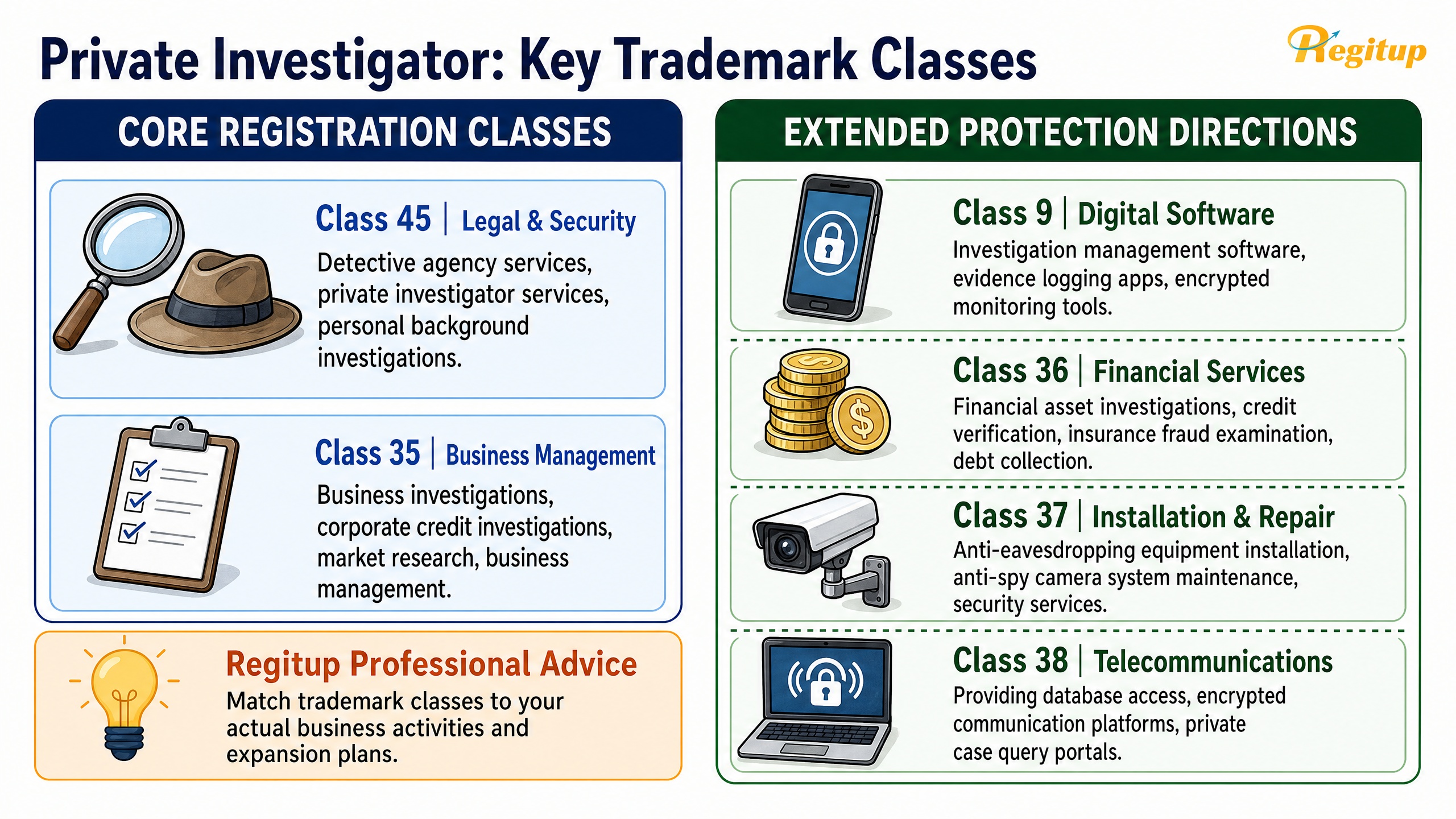
Class 45 | Core Investigation and Security Surveillance. | Detective agency services, private investigator services, personal background investigations, tracking and surveillance, missing person investigations, evidence collection. |
Class 35 | Commercial and Corporate Investigations. | Business investigations, corporate credit investigations, market research, business management consultancy, employee integrity investigations. |
Class Boundary Discussion
Class 45 protects traditional detective agency operations, namely monitoring and data collection regarding an individual's movements, background, or specific events. In contrast, investigative activities targeting legal entities—such as pre-merger due diligence or internal corporate fraud investigations—often fall under Class 35. While Class 35 focuses on the efficiency and integrity management of business operations, Class 45 leans toward personal rights and physical security. Professional investigative agencies typically need to secure both classes to ensure comprehensive protection in both the personal and commercial markets.
Extension Classes Based on Business Models
Beyond core investigative services, private investigators may consider the following extension classes based on their technical expertise or service breadth:
Class | Application Scenario | Potential Service Scope |
Class 9 | When possessing proprietary branded software tools or applications. | Investigation management software, evidence logging apps, encrypted monitoring tools. |
Class 36 | When involving financial crime investigations or asset tracking. | Financial asset investigations, credit verification, insurance fraud examination, debt recovery-related investigations. |
Class 37 | When providing installation or maintenance services for hardware equipment. | Anti-eavesdropping equipment installation, anti-spy camera system maintenance, security hardware repair. |
Class 38 | When providing exclusive encrypted communication channels for clients. | Providing database access, encrypted communication platforms, private case query portals. |
Class 41 | When offering professional skill training or seminars. | Detective practice training courses, legal evidence collection teaching, investigation practice seminars. |
Class 42 | When involving digital evidence extraction and scientific forensic identification. | Digital forensics analysis, computer forensics services, DNA identification, laboratory scientific evidence collection. |
Conclusion
The trademark strategy for a private investigator should be built on the dual pillars of Class 45 and Class 35. On this foundation, operators should review their technical thresholds and specialized service items, such as digital forensics (Class 42) or security system services (Class 37), for targeted extension registrations. Please note that the final scope of rights obtained will vary depending on the laws of the filing jurisdiction and the specific business model. Professional assessment is recommended before application.
Assist Your Trademark Application with Regitup
Trademark registration is a strategic deployment for brand defense. The Regitup team possesses extensive experience in cross-border trademark practice and can assist you in accurately verifying data, preparing professional documents, and submitting applications on your behalf. We ensure your brand finds the right positioning within the complex Nice Classification, avoiding protection gaps.
Start Your Trademark Registration
Frequently Asked Questions
Q1 : Does registering for Class 45 services mean I can legally conduct all investigations?
Trademark rights protect the right to use a brand name and are not equivalent to a professional license. The legality of a private investigator's practice depends on local laws. Trademark registration ensures the brand is not misappropriated, but investigative actions must still comply with legal boundaries.
Q2 : What is the difference between business due diligence and general detective services?
Class 45 focuses on individual backgrounds or uncovering the truth of specific events. Class 35 emphasizes corporate operational status, credit ratings, and competitiveness analysis. If your clients are primarily businesses, Class 35 is an essential protective umbrella.
Q3 : I developed my own App for clients to track progress; do I need to register Class 9?
If the App is merely a service tool and not sold separately, the core classes are usually sufficient. However, if you plan to promote the system as a software product, registering Class 9 provides more complete protection.
Q4 : If I provide anti-surveillance services, why should I consider Class 37?
Class 37 covers the installation and maintenance of hardware equipment. If your services include installing anti-surveillance systems or security hardware, you need to correspond with the physical implementation activities of this class.
Q5 : Can a detective agency register Class 42?
Yes, especially when involving digital forensics or laboratory identification. The core of such services lies in the application of science and technology, and registering Class 42 can effectively prevent infringement by technology-oriented competitors.