
Key Point | Details |
Intended Audience | Operators of Home Goods Store and businesses planning related goods, services or brand development. |
Primary Classes | Class 35, Class 21, Class 20 |
Extension Classes | Class 9, Class 11, Class 20, Class 21, Class 24, Class 35 |
Analysis Premise
A "Home Goods Store" refers to an enterprise engaged in the retail and wholesale of household products, providing kitchenware, home decor, small appliances, and general lifestyle sundries to meet home quality needs.
The definition used in this article focuses on "channel management" and "variety sales," excluding large-scale furniture manufacturing or professional construction engineering. Clearly defining the business scope helps in precisely selecting trademark classes, avoiding resource waste, and ensuring that core operations have an effective legal shield.
Primary Classes
Brand value is reflected in channel trust and product recognition. The choice of classes must consider both "service" and "commodity" dimensions.
Class | Application Context / Why it is a Primary Class | Examples of Goods/Service Descriptions |
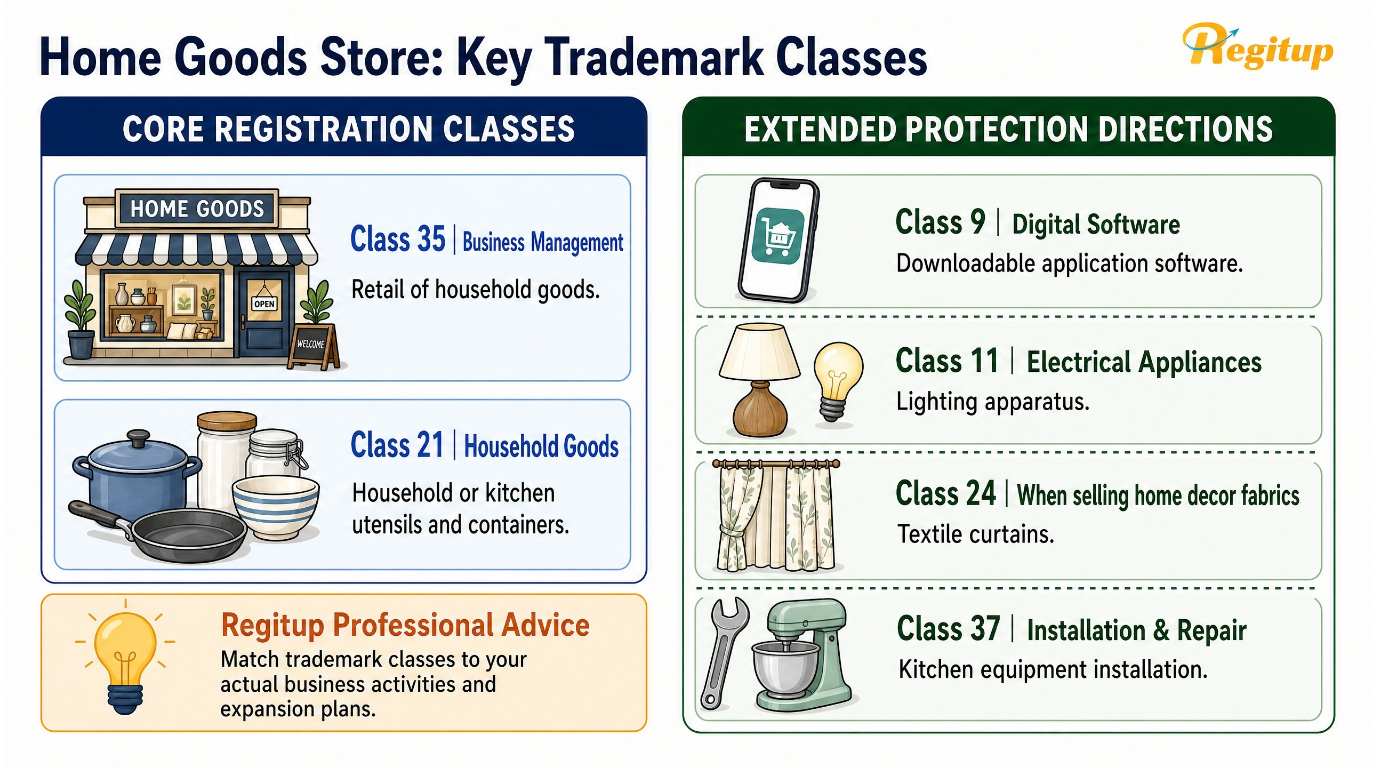
Class 35 | Retail and wholesale services; the foundation for protecting the brand's right to operate. | Retail of household goods; department store retail; online shopping services. |
Class 21 | Core products such as kitchenware, tableware, and household containers. Essential for private label sundries. | Household or kitchen utensils and containers; cleaning tools; glassware. |
Class 20 | Sales of home furnishings, small furniture, or decorative items; key to creating a home atmosphere. | Furniture; mirrors; picture frames; unworked or semi-worked bone, horn. |
Class 35 protects the "right to operate," preventing competitors from opening stores with the same name; Class 21 and Class 20 protect the "product mark," preventing product confusion. This dual-track layout is the standard practice for building a brand moat.
Extension Classes Based on Business Models
Enterprises can consider the following extension classes based on specific activities:
Class | Application Context | Potential Scope of Services |
Class 9 | When providing shopping Apps or electronic catalogs | Downloadable application software; electronic publications. |
Class 11 | When selling small appliances or lighting equipment | Lighting apparatus; cooking apparatus; ventilation apparatus. |
Class 24 | When selling home decor fabrics or bedding | Textile curtains; household linen; quilts and sheets. |
Class 37 | When providing equipment installation or repair services | Kitchen equipment installation; electrical appliance repair; home facility maintenance. |
Class 42 | When providing online home decoration design platforms | Interior design; providing non-downloadable online software. |
A "conditional" judgment is recommended. For example, if you only resell other brands' lighting fixtures, Class 11 is not essential; however, if you provide on-site installation, Class 37 becomes extremely important.
Conclusion
A home goods store should take Classes 35, 21, and 20 as its core and extend to Classes 11, 24, 37, 9, or 42 based on business needs. Trademark classification is professional in nature, and actual application descriptions and scopes vary by jurisdiction. Enterprises should conduct scientific planning based on their stage of development.
Assistance from Regitup for Trademark Applications
Trademark registration is a strategic legal layout. The Regitup team has cross-border practical experience to help accurately verify data, prepare documents, and submit applications on your behalf. Through precise screening and evaluation, we build a solid foundation for your brand.
Start Your Trademark Registration
Frequently Asked Questions
Q1 : Do online home goods sellers also need Class 35?
Yes. Class 35 covers online shopping services and is a core category for e-commerce. As long as you provide a platform for selection and purchase, you can protect the channel brand from being misappropriated.
Q2 : Must I register Class 11 for selling light bulbs in my store?
It depends on your strategy. Pure retail of other brands' light bulbs is protected by Class 35; if you launch private-label light bulbs, it is recommended to register Class 11 to prevent competition from products with the same name.
Q3 : What is the boundary between Class 20 and Class 21?
Class 21 focuses on "utensils" and "containers" (such as cookware); Class 20 focuses on "furniture" and "furnishings" (such as picture frames). It is recommended to register both simultaneously.
Q4 : Where should interior decoration consulting services be placed?
If it is only product suggestions, it is usually included in Class 35; if it involves professional space design consulting, Class 42 (Interior Design) should be considered.