
Key Point | Details |
Intended Audience | Operators of Machinery Maintenance and Installation and businesses planning related goods, services or brand development. |
Primary Classes | Class 37, Class 35 |
Extension Classes | Class 7, Class 9, Class 35, Class 37, Class 39, Class 40 |
Analysis Premise
In practical discussions of trademark classification, "Machinery Maintenance and Installation" as defined in this article refers to providing professional on-site installation, troubleshooting, regular inspection and maintenance, and consumable replacement technical services for various types of machinery and equipment used in industrial production, commercial purposes, or large facilities. The core customer base for this type of business is typically factories, manufacturing operators, and large facility managers.
It is important to note that the analysis here focuses on the role of the "service provider." If your enterprise not only provides maintenance services but also involves designing, manufacturing, and selling machinery under your own brand, or developing specialized equipment monitoring software systems, you will need to configure additional corresponding product categories for protection beyond the basic service categories, based on actual business expansion.
Primary Classes
For enterprises engaged in machinery installation and maintenance, ensuring that the service brand is protected in core technical areas and commercial operations is the top priority. The following are the most critical primary Nice classes for this industry:
Class | Application Scenario / | Examples of Goods/Service Descriptions |
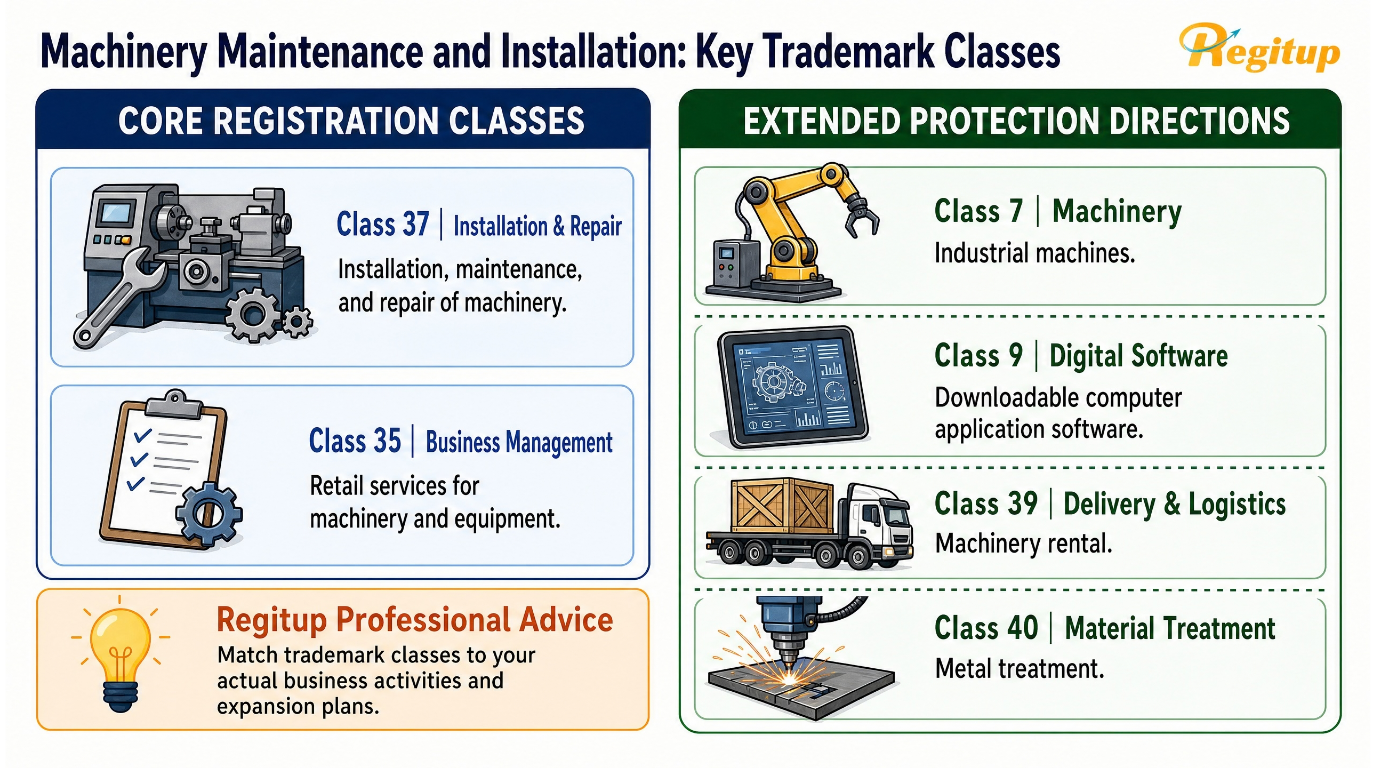
Class 37 | Core Service Protection: This is the most direct category for the maintenance and installation industry, covering all on-site operations that restore machinery functionality or maintain operations. | Installation, maintenance, and repair of machinery; installation and repair of construction machinery; repair or maintenance of pumps. |
Class 35 | Brand Operations and Retail: Used to protect the retail and wholesale services of repair parts, as well as the commercial administrative needs of the enterprise in brand management, chain operations, or franchise promotion. | Retail services for machinery and equipment; wholesale services for maintenance tools; business management and organization consultancy; advertising. |
Class Boundary Explanation
Class 37 is the "protective shield" for the machinery maintenance industry, directly protecting the enterprise's most core technical output—namely, the acts of "hands-on repair" and "on-site installation." However, many operators often overlook the importance of Class 35. In actual business operations, maintenance companies usually sell specific brands of components or consumables. If Class 35 is not registered, when a competitor opens a parts store under the same or a similar name, registration in Class 37 alone may not provide sufficient legal protection. Furthermore, Class 35 also covers the enterprise's administrative management and marketing activities, which are indispensable foundations for long-term brand operation.
Extension Classes Based on Business Models
In addition to the core categories mentioned above, machinery maintenance enterprises often involve the following extended fields due to technological upgrades or business transformation. These categories are not mandatory for every operator but should be evaluated based on specific conditional activities:
Class | Application Scenario | Potential Scope of Services |
Class 7 | Own Brand Manufacturing: If the enterprise involves producing and selling industrial machines or parts labeled with its own trademark. | Industrial machines; machine transmissions; couplings (for machines). |
Class 9 | Digital Management Tools: Providing downloadable equipment remote monitoring systems, fault diagnosis Apps, or maintenance management software. | Downloadable computer application software; remote control devices for industrial use; data processing apparatus. |
Class 39 | Logistics and Leasing Services: Involving the transport and handling of large equipment, or providing machinery rental services. | Machinery rental; transport of goods; warehousing; packaging of goods. |
Class 40 | Customized Processing Services: Involving metal treatment, painting, or processing and modification of specific materials for parts provided by customers. | Metal treatment; material treatment information; metal plating; welding services. |
Class 42 | Technical R&D and Testing: Providing equipment performance testing, engineering design, technical research, or professional mechanical engineering consultancy services. | Mechanical engineering; technical research; product quality testing; engineering drawing. |
Conclusion
In summary, the trademark layout for the machinery maintenance and installation industry should use Class 37 (installation and maintenance) and Class 35 (brand management and retail) as the basic defensive line. On this basis, operators should review whether they involve own-brand production (Class 7), engineering design consultancy (Class 42), part processing (Class 40), digital management tools (Class 9), or equipment rental (Class 39) to build a comprehensive brand protection network.
It is important to note that the choice of trademark classification must be closely integrated with actual business activities. In the actual application, the acceptability of specific designated product or service names, the detailed arrangement of categories, and the final scope of rights protection will still vary depending on the legal regulations of the application location and specific business details. Before officially submitting an application, it is recommended to consult a professional institution to ensure the rigor of the plan.
Assistance from Regitup for Trademark Applications
Trademark registration is not just about filling out forms; it is a strategic layout for the enterprise's future assets. The Regitup team has extensive experience in cross-border and local trademark practices, assisting you in precisely verifying business data, preparing professional application documents, and completing tedious submission procedures on behalf of the enterprise, ensuring your technical brand receives the most comprehensive legal protection in the competitive machinery market.
Start Your Trademark Registration
Frequently Asked Questions
Q1 : If I only do repairs and don't sell parts, do I still need to register Class 35?
Although your core revenue comes from maintenance services (Class 37), Class 35 covers "advertising" and "business management." In the process of brand promotion, any promotional behavior or possible future franchise expansion is closely related to Class 35. Additionally, registering Class 35 can prevent others from opening related consultancy or parts management services under the same name, which is an important complement to protecting brand integrity.
Q2 : Where should "remote fault diagnosis" be classified?
This depends on how the diagnosis is implemented. If you send personnel to conduct technical analysis and provide suggestions via the network, this usually belongs to Class 42 (technical research and consultancy); if you provide a software tool for customers to download and diagnose themselves, Class 9 (downloadable software) must be considered. If both are involved, it is recommended to layout both.
Q3 : Are the categories for machinery installation and construction the same?
Yes, in the Nice Classification, the title of Class 37 is "Construction; installation and repair services." Therefore, whether it is the installation of large industrial machinery or the construction and repair of buildings, it falls under the scope of Class 37. However, when describing specific service items, it is still necessary to precisely specify "machinery installation" to match the actual business scope.
Q4 : If I customize parts for customers, does it count as maintenance?
Simply replacing standard parts belongs to maintenance (Class 37), but if it involves processing raw materials (such as metal blocks) into parts of a specific shape, or performing special surface treatments on parts (such as electroplating or hardening), this is classified under Class 40 (material treatment). For maintenance plants with precision processing capabilities, Class 40 is an important direction for extended protection.
Q5 : I allow customers to book repairs on my own website; do I need to register Class 42?
If the website serves only as a booking tool or a display of company information, it is seen as an extension of general business operations and usually does not require registering Class 42 for the website itself. The threshold for Class 42 registration lies in whether you provide "software technology" or "platform development" as an independent service to the outside world, or if the platform possesses a complex technical computing core.
Q6 : After registering Class 37, is the maintenance business protected globally?
Trademark rights are territorial. Registration under the Nice Classification framework only means that the category division in the application location (such as Taiwan, the US, or the EU) complies with international standards. To obtain protection globally, applications must be filed separately in each target market. It is recommended to plan global layouts through professional platforms such as Regitup.