
Key Point | Details |
Intended Audience | Operators of Educational Institution and businesses planning related goods, services or brand development. |
Primary Classes | Class 41, Class 35, Class 43 |
Extension Classes | Class 9, Class 16, Class 25, Class 35, Class 41, Class 42 |
Analysis Premise
In the context of trademark registration, the "educational institution" discussed in this article refers to entities based on physical campuses or online learning systems that provide formal educational services, ranging from early childhood education to advanced academic research. Beyond the transmission of knowledge, the core operation also encompasses administrative management, brand franchise operations, admissions marketing, and student accommodation and catering services provided by the institution.
These institutions possess high brand recognition, and the scope of trademark protection must extend from simple "teaching activities" to overall "brand operation" and "campus life." Whether it is a private school, an international school, or an online university, the core lies in establishing a long-term and stable educational service system.
Primary Classes
For educational institutions, trademark registration cannot be limited to teaching alone. To ensure exclusive rights to the school name and emblem, a layout must be created for teaching, management, and supporting services. The following are the three most core Nice classes for educational institutions:
Class | Application Scenario / | Examples of Goods/Service Descriptions |
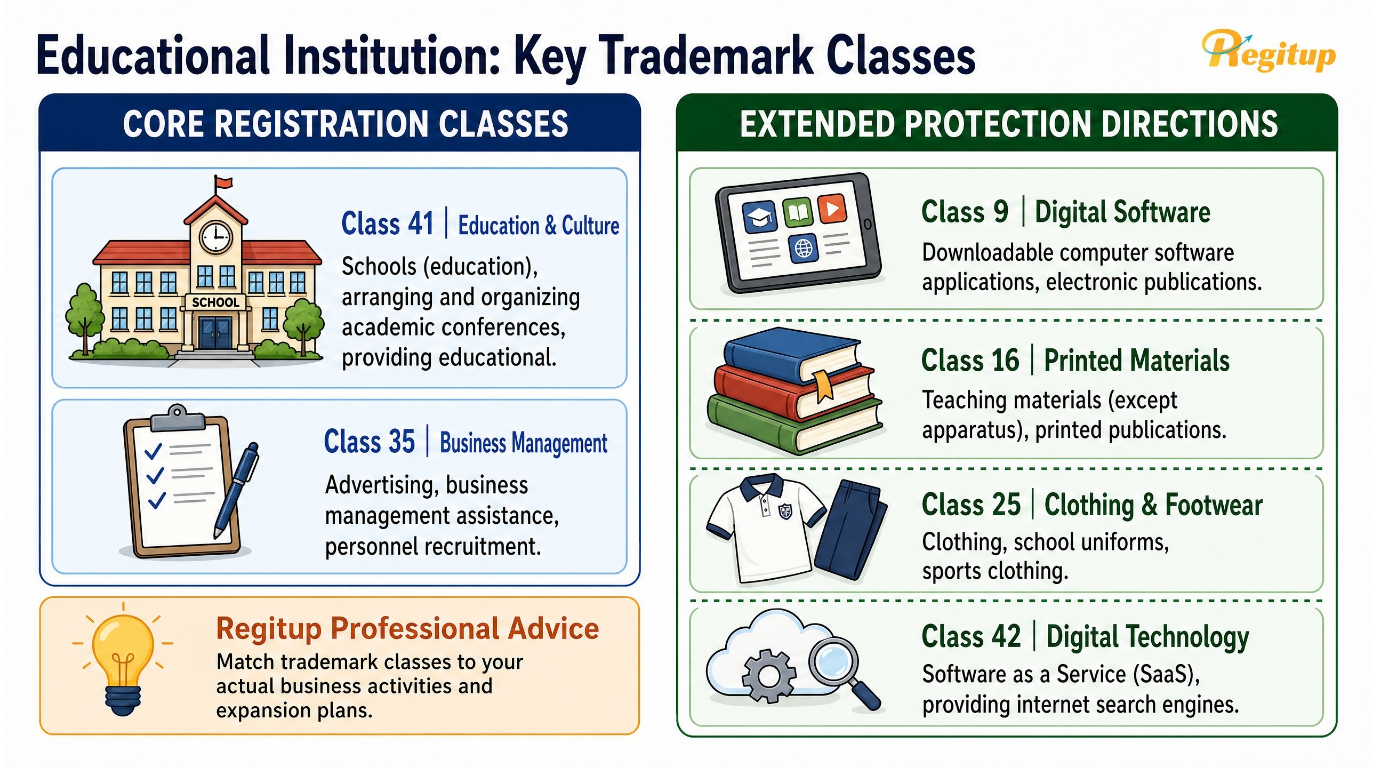
Class 41 | Core education and training services, covering all forms of teaching activities. | Schools (education), arranging and organizing academic conferences, providing educational information. |
Class 35 | School brand management, admissions marketing, and franchise operations, protecting administrative and recruitment interests. | Advertising, business management assistance, personnel recruitment. |
Class 43 | Student accommodation and catering services, ensuring brand rights for campus life facilities. | Boarding house services, providing food and drink. |
Class Boundary Discussion
Class 41 is the foundation for educational institutions, protecting the act of teaching itself. Whether it is early childhood enlightenment or university lecturing, it falls under this category. Without registration, competitors might use similar names to offer courses, causing public confusion.
Class 35 focuses on operations. Educational institutions involve a large amount of admissions advertising and school administrative management. Registering in this class prevents others from misappropriating the school name for recruitment activities or management consulting.
Class 43 is crucial for institutions equipped with dormitories or cafeterias. These services are an important part of the campus brand experience. Without this layout, the institution will face difficulties in protecting its rights when restaurants or dormitories with the same name appear around the campus.
Extension Classes Based on Business Models
In addition to the core classes, educational institutions can selectively extend their registration to the following classes based on their degree of digitalization, peripheral products, or professional services:
Class | Application Scenario | Potential Scope of Service |
Class 9 | Providing educational apps or downloadable software | Downloadable computer software applications, electronic publications. |
Class 16 | Publishing school journals, textbooks, handouts, and stationery | Teaching materials (except apparatus), printed publications. |
Class 25 | Providing school uniforms, sportswear, or commemorative clothing | Clothing, school uniforms, sports clothing. |
Class 42 | Independently operated online learning platforms or SaaS | Software as a Service (SaaS), providing internet search engines. |
Class 44 | Providing campus medical clinics and psychological counseling services | Medical clinic services, psychological counseling. |
Strategic Considerations for Extension Classes
Under the trend of digitalization, Class 9 and Class 42 are becoming increasingly important. If a learning management system or app is developed for download, Class 9 is essential protection; if the platform operates as a cloud subscription (SaaS), Class 42 more accurately covers its technical nature.
Furthermore, Class 16 and Class 25 are related to the campus peripheral economy. Well-known institutions often issue stationery or school uniforms printed with the school emblem, and these two classes are needed to prevent counterfeit goods. For institutions with school clinics or those providing psychological counseling, Class 44 ensures the brand compliance of medical services.
Conclusion
Trademark registration for educational institutions should center on Class 41, and include Class 35 and Class 43 for primary protection depending on the scale. Institutions that develop teaching materials, issue school uniforms, or operate online platforms should expand to Class 16, Class 25, and Class 9/Class 42.
The selection of trademark classes should be combined with actual business operations. Specific descriptions and the scope of rights may vary depending on the regulations of the filing jurisdiction. It is recommended to conduct a thorough search and risk assessment before submitting an application.
Assistance from Regitup for Trademark Applications
Trademark registration is a professional and tedious process. For educational institutions with diverse businesses, accurately defining service descriptions is the key to success. The Regitup team has extensive practical experience and can provide professional data verification, document preparation, and representative submission services to ensure your educational brand is fully protected.
Start Your Trademark Registration
Frequently Asked Questions
Q1 : Is registering only Class 41 enough for an educational institution?
For institutions with a school name and administrative system, it is usually insufficient. A lack of protection for admissions management in Class 35 or accommodation and catering services in Class 43 exposes the brand to the risk of misappropriation at the operational level.
Q2 : Does providing online courses require registration in Class 9 or Class 42?
It depends on the delivery method. Providing downloadable apps or textbook files should fall under Class 9; providing a cloud platform (SaaS) falls under Class 42. It is recommended to register both for complete protection.
Q3 : Do school uniforms and souvenirs need to be registered separately?
Yes. School uniforms belong to Class 25, while stationery or teaching materials belong to Class 16. If the institution sells or distributes peripheral products printed with the school emblem, registering these classes can prevent counterfeit goods from damaging the institution's image.
Q4 : Why is admissions marketing classified under Class 35?
Class 35 covers advertising and business management. Promotional activities and administrative processes for recruiting students fall within the scope of business operations in the classification logic, and exclusive rights to recruitment activities must be protected through this class.
Q5 : Is a trademark protected globally after registration?
No. Trademark protection follows the principle of territoriality; a trademark registered in a specific country is only valid in that location. International institutions should create layouts for each of their major markets respectively.