
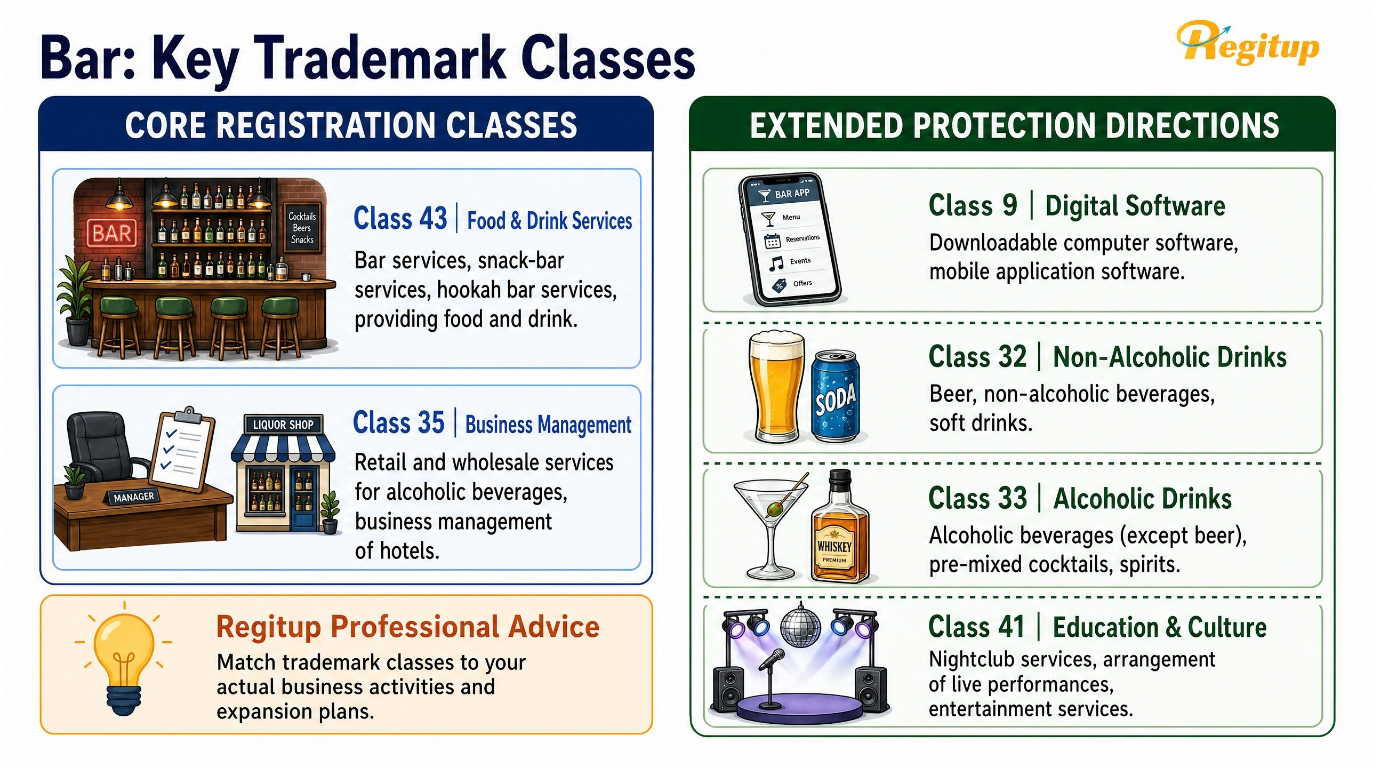
Key Point | Details |
Intended Audience | Operators of Bar and businesses planning related goods, services or brand development. |
Primary Classes | Class 43, Class 35 |
Extension Classes | Class 9, Class 32, Class 33, Class 35, Class 41, Class 42 |
Analysis Premise
In trademark practice, the "bar" discussed in this article refers to a social space with a physical place of business that primarily provides alcoholic and non-alcoholic beverages for customers to consume on-site. This includes models such as sports bars, craft beer bars, cocktail lounges, and hookah bars. The core characteristics of such enterprises are "spatial operation" and "immediate supply of drinks," which may include elements like branded operations, bartending performances, or live music.
Primary Classes
For most bar operators, Class 43 is the core category, defining the essence of "food and drink services," while Class 35 protects the rights of brand expansion and business operations.
Class | Application Scenario / | Examples of Service/Product Descriptions |
Class 43 | The core operational category, covering all services providing food and drink for on-site consumption. It is the foundation of storefront operation. | Bar services, snack-bar services, hookah bar services, providing food and drink. |
Class 35 | Involves franchising, brand licensing, or retail and wholesale of liquor products, protecting business management rights. | Retail and wholesale services for alcoholic beverages, business management of hotels, franchising management for bars, advertising and business mediation. |
Class 43 protects the "provision of services," which is the process of customer consumption at the store. If the brand begins selling merchandise or recruiting franchisees, Class 35 provides more comprehensive protection for business operations, preventing others from causing confusion at the management level.
Extension Classes Based on Business Models
Bar operations often involve entertainment or product development. The following are recommended extension classes based on specific conditional activities:
Class | Application Scenario | Scope of Services to Consider |
Class 9 | Developing a dedicated app for customers to book, order, or manage membership points. | Downloadable computer software, mobile application software. |
Class 32 | The operator independently produces or sells private-label beer or non-alcoholic beverages. | Beer, non-alcoholic beverages, soft drinks. |
Class 33 | The operator independently develops, brews, or sells private-label spirits, wines, or pre-mixed cocktails. | Alcoholic beverages (except beer), pre-mixed cocktails, spirits. |
Class 41 | Providing live music, DJ performances, nightclubs, or social activities with specific entertainment qualities. | Nightclub services, arrangement of live performances, entertainment services. |
Class 42 | Providing an independent online booking technology platform or related software technical support. | Software as a service (SaaS), computer software design. |
Extension classes should be judged conservatively. If you only use a third-party platform for bookings without developing your own technology, Class 42 is not necessary. If you only sell commercially available brands rather than private-label products, the necessity of Class 33 and 32 is lower.
Conclusion
A bar's trademark layout should take Class 43 as the defensive core and include Class 35 depending on the scale. If it involves private products, large-scale entertainment, or digital tool development, targeted selections should be made from Class 33, 32, 41, or 9. The scope of trademark rights varies according to examination practice and business details. The suggestions in this article are for reference only, and actual applications should be professionally adjusted according to the brand's development blueprint to ensure core interests.
Assistance from Regitup for Trademark Application
Trademark registration is a precise legal layout. The Regitup team has extensive experience and can provide in-depth verification services tailored to your business model. From search analysis and category recommendations to representative submission, we provide full support to reduce the risk of rejection and ensure your brand remains invincible in market competition.
Start Your Trademark Registration
Frequently Asked Questions
Q1 : Is additional registration required for providing light meals?
Usually not. Class 43 already includes food and drink services, covering the supply of meals in-store. Unless you plan to turn light meals into pre-packaged food for sale in supermarkets, Class 43 is sufficient.
Q2 : Should a small bar also register in Class 35?
If there are no franchising plans or retail business, Class 43 is the top priority. However, if you wish to prevent others from misusing the brand in the franchising market or have retail plans in the future, laying out Class 35 in advance is more stable.
Q3 : Should Class 41 be registered for hosting bartending competitions?
If these activities are core to the business and you wish to establish brand authority, it is recommended to register in Class 41 to prevent others from using the trademark to host similar performance activities.
Q4 : Is registration in Class 43 protected globally?
No. Trademark rights are territorial. Registration in one jurisdiction only provides protection within that jurisdiction. If you plan to open stores overseas, you must apply separately in each location and consult professional advisors.
Q5 : Is Class 42 registration necessary for developing an ordering webpage?
Class 42 protects software research and development services. For most bars, a webpage is just a tool, not a product. Unless the system is licensed for others to use, it can be seen as an extension of food and drink services.