
Key Point | Details |
Intended Audience | Operators of Banking and businesses planning related goods, services or brand development. |
Primary Classes | Class 36, Class 35, Class 09 |
Extension Classes | Class 09, Class 16, Class 35, Class 36, Class 38, Class 41 |
Analysis Premise
In the context of trademark strategy, the "Banking" industry discussed in this article centers on the business models of traditional banks and digital financial institutions. These institutions primarily provide financial services such as deposit-taking, various lending operations, foreign exchange transactions, currency exchange, and payment settlements. Modern banking is highly dependent on digital platforms; therefore, its scope of operation also covers brand management and customer relationship maintenance through physical branches, online banking interfaces, and mobile applications (Apps). Trademark registration aims to ensure service distinctiveness and prevent others from misleading consumers.
Primary Classes
Securing registration in core service classes is the foundation of a trademark strategy, establishing a solid legal fortress for the brand.
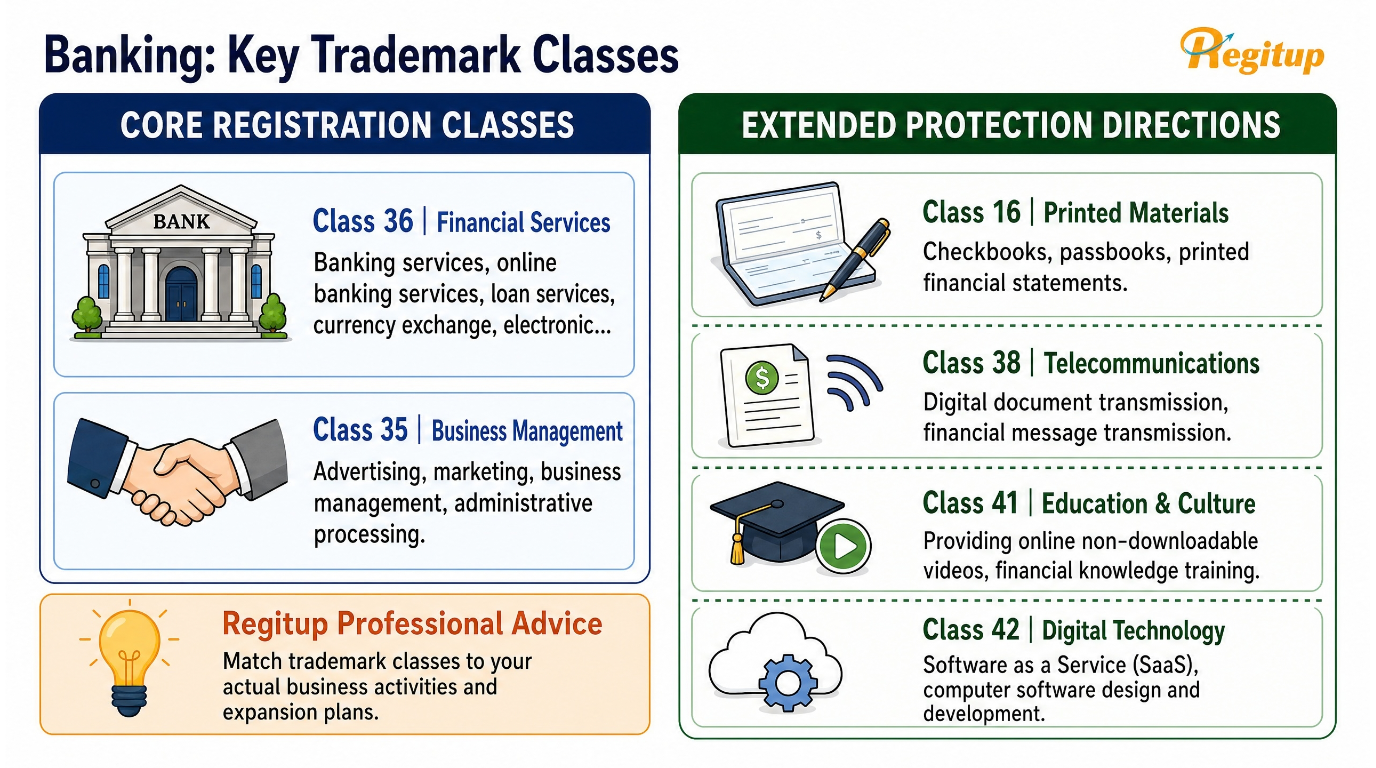
Class | Application Scenario / | Examples of Goods/Services Descriptions |
Class 36 | Core Financial Services: Covers all fund flows and currency management services, the cornerstone of a bank's business. | Banking services, online banking services, loan services, currency exchange, electronic funds transfer. |
Class 35 | Brand Operations and Management: Protects the bank's distinctiveness in advertising, customer data management, and business operations. | Advertising, marketing, business management, administrative processing. |
Class 09 | Digital Mobile Tools: Protects mobile banking apps and encryption software products, serving as a defense line for modern digital finance. | Downloadable computer software applications, software for mobile banking. |
Class 36 is the core; a lack of protection here poses significant risks. With technological advancements, Class 09 has become essential for consumers to identify apps. Class 35 ensures the bank's trademark security during marketing and management activities.
Extension Classes Based on Business Models
Beyond core services, banks may selectively register in other classes based on specific product lines. The following are common extension classes:
Class | Application Scenario | Potential Scope of Services |
Class 16 | Providing physical checkbooks or printed financial statements | Checkbooks, passbooks, printed financial statements. |
Class 38 | Providing exclusive secure financial message transmission channels | Digital document transmission, financial message transmission. |
Class 41 | Hosting investment seminars or providing wealth management education services | Providing online non-downloadable videos, financial knowledge training. |
Class 42 | Providing independent fintech platforms or technology exports | Software as a Service (SaaS), computer software design and development. |
Class 45 | Involving strict regulatory compliance and identity verification | Legal compliance auditing, identity verification services. |
Extension strategies should be based on precise judgment. If a bank only uses software developed by others, Class 42 may not be necessary; however, if technology licensing is involved, Class 42 becomes crucial. Similarly, Class 45 applies to institutions providing professional risk control consulting, while Class 16 targets traditional banks that still have a high demand for physical instruments.
Conclusion
The trademark strategy for the banking industry should center on Class 36, supplemented by Class 35 and Class 9. For institutions with fintech attributes or diversified services, Classes 42, 41, or 45 should be selected based on actual circumstances.
Please note that this article serves as a general industry guide. The descriptions of goods and the scope of rights in actual applications may vary depending on local laws. It is recommended to conduct thorough searches and evaluations before submitting an application.
Get Assistance from Regitup for Your Trademark Application
Trademark registration is a professional decision for brand defense. The Regitup team has extensive practical experience and can assist you in verifying classification data, optimizing product descriptions, and preparing application documents to submit to the relevant authorities on your behalf. Through professional guidance, you can avoid gaps in rights caused by incorrect class selection and ensure your financial brand receives the most comprehensive legal protection.
Start Your Trademark Registration
Frequently Asked Questions
Q1 : Does a bank always need to register in Class 9?
Most modern banks provide app services. Class 9 protects software products. If not registered, others launching financial apps with similar names could cause confusion; therefore, banks with a high degree of digitalization should include this in their strategy.
Q2 : Which class should be registered for providing wealth management courses?
If wealth management courses are independently charged or constitute large-scale training, Class 41 should be registered. If they are merely incidental investment advice, financial consultancy services in Class 36 usually cover them.
Q3 : What is the significance of Class 35 for the banking industry?
Class 35 covers advertising, marketing, and business management. When a bank promotes its brand, manages customer loyalty programs, or handles administrative affairs, this class ensures the brand is not infringed upon during business operations.
Q4 : What are the classification differences between digital banks and traditional banks?
The core for both is Class 36. Digital banks rely more on Class 9 (software) and Class 42 (technological platforms), while traditional banks may still require protection for physical documents like checks and passbooks in Class 16.
Q5 : Which class does credit card business belong to?
Credit card services belong to Class 36 financial services, including credit issuance and payment settlement. If it involves the management of loyalty point redemptions, it may involve business management in Class 35.