
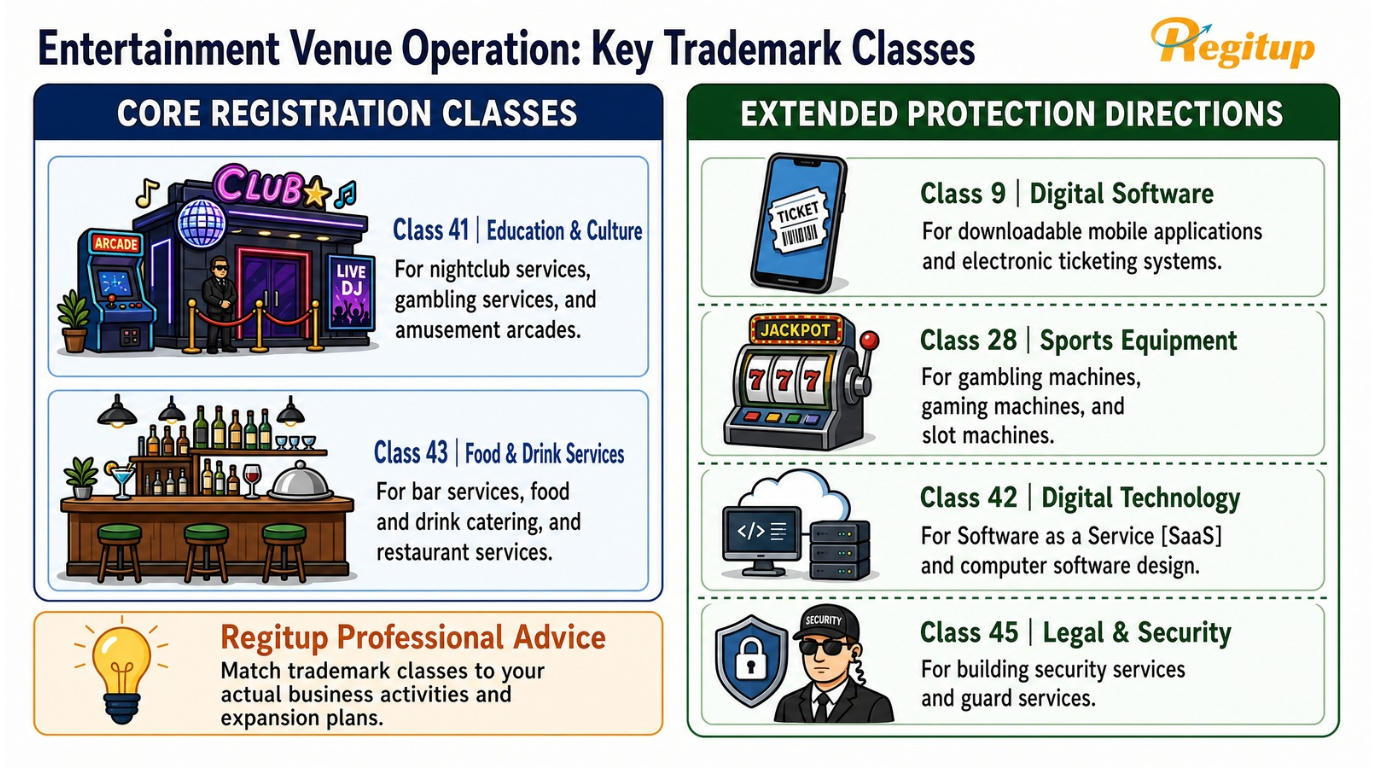
Key Point | Details |
Intended Audience | Operators of Entertainment Venue Operation and businesses planning related goods, services or brand development. |
Primary Classes | Class 41, Class 43, Class 35 |
Extension Classes | Class 9, Class 28, Class 35, Class 41, Class 42, Class 43 |
Analysis Premise
In this context, Entertainment Venue Operation refers to the management of physical integrated leisure spaces where the core business provides services such as gambling, music performances, dancing, karaoke, and electronic games. These venues are typically highly integrated, often incorporating catering supplies and branded management alongside their core entertainment offerings. The scope of trademark protection must cover the specific services provided by the venue to ensure the brand receives comprehensive legal protection in a competitive market and to prevent third parties from misleading consumers.
Primary Classes
For most enterprises operating physical entertainment spaces, the following three classes constitute the legal foundation of trademark protection.
Class | Applicable Scenarios / Strategic Importance | Examples of Service Descriptions |
Class 41 | The core category for entertainment venues, covering gambling and leisure entertainment services. | Nightclub services [entertainment], gambling services, providing amusement arcade services. |
Class 43 | Entertainment venues are often accompanied by catering; this protects brand rights in food and beverage supply. | Bar services, food and drink catering services, restaurant services. |
Class 35 | Used for brand management, franchise operations, and the commercial operation of the venue. | Business management of entertainment venues, business management of franchising. |
Within Class 41, special attention should be paid to the definitions of nightclub services and gambling services. If the venue provides live performances and dance spaces, Class 41 is indispensable. Registration in Class 43 prevents others from operating restaurants under the same name, thereby avoiding brand dilution. Class 35 serves as the legal basis for corporate expansion and licensing, ensuring brand exclusivity at the business operation level.
Extension Classes Based on Business Models
Beyond core services, modern entertainment venues often involve technical integration or hardware development. The following classes should be selected based on the specific needs of the business.
Class | Applicable Scenarios | Potential Scope of Services |
Class 9 | Developing and providing proprietary branded apps or digital membership systems. | Downloadable mobile applications, electronic ticketing systems. |
Class 28 | Producing or selling proprietary branded gambling machines or gaming equipment. | Gambling machines, gaming machines, slot machines. |
Class 42 | Operating independent online gaming platforms or providing technical support for booking systems. | Software as a Service [SaaS], computer software design. |
Class 45 | Involving physical security protection or dispatching security personnel for the venue. | Building security services, guard services. |
If an enterprise plans to launch a mobile application for customer bookings, Class 9 is critical for protecting the software name. If customized production of gambling equipment is involved, Class 28 provides essential product protection. Class 42 applies to enterprises that platformize their technology and provide it to other operators.
Why Industry Name Alone is Insufficient for Classification
Many operators mistakenly believe that registering in "entertainment-related" classes provides comprehensive protection, which is a significant misconception. First, there is a clear legal boundary between services (Class 41) and goods (Class 28). Operating an amusement arcade is a service, whereas producing gaming machines is a product. If a brand only registers in Class 41, it may be difficult to assert rights if a third party produces equipment under the same name.
Secondly, the independence of catering services is often overlooked. Many venues generate significant revenue from catering; without a presence in Class 43, the brand's recognition in the catering sector will exist in a legal vacuum. Furthermore, business management (Class 35) and specific entertainment execution (Class 41) represent different levels of rights. The former protects the interests of operating the brand, while the latter protects the customer's entertainment experience. A lack of protection in Class 35 will put the enterprise at a disadvantage during chain expansion or franchise licensing.
Conclusion
Trademark registration for Entertainment Venue Operation should center on Class 41, with simultaneous positioning in Class 43 and Class 35. For enterprises with technical research and development or proprietary equipment production capabilities, Class 9, Class 28, and Class 42 should also be included. It is important to note that the actual designated service items, class arrangements, and scope of rights will vary depending on the laws of the filing jurisdiction and the specific business model. A thorough trademark search and risk assessment are recommended before proceeding with an application.
Professional Assistance from Regitup
The trademark registration process is complex, and even minor oversights can lead to application rejection. The Regitup team possesses extensive practical experience and can provide entertainment venue operators with professional class verification, document preparation, and representative submission services. We assist enterprises in precisely defining their scope of protection and reducing legal risks, ensuring their brands develop steadily in the market.
Start Your Trademark Registration
Frequently Asked Questions
Q1 : If the venue only provides performances and not gambling, is Class 41 registration still necessary?
Yes. Class 41 covers all forms of entertainment activities, including live performances. As long as the core business is providing an entertainment experience, Class 41 remains the primary protection category.
Q2 : What is the strategic reason for registering in Class 35?
Class 35 includes "business management." If you plan to open multiple branches, conduct franchise licensing, or require branded commercial operations for the venue, Class 35 ensures that your business model receives adequate legal protection.
Q3 : Is additional registration required for selling souvenirs within the venue?
If souvenir sales have become an independent business line, it is recommended to register for specific product classes, such as Class 25 for clothing. The primary classes discussed in this article focus on the core services, while product sales are considered an extension of the business.
Q4 : Does registration in Class 41 provide global protection?
No. Trademark protection is territorial, meaning that registration in a specific country is only valid within that jurisdiction. If there are plans for international operations, applications must be filed separately in each target market.
Q5 : Is there a classification difference between operating a karaoke lounge and a gaming arcade?
Both are typically classified under Class 41. However, when drafting the trademark description, it is important to specify "providing karaoke facilities" or "providing amusement arcade services" to ensure the business content is accurately covered.