
Key Point | Details |
Intended Audience | Operators of Bamboo Scaffolding and businesses planning related goods, services or brand development. |
Primary Classes | Class 37, Class 19 |
Extension Classes | Class 19, Class 35, Class 37, Class 39, Class 41, Class 42 |
Analysis Premise
Bamboo scaffolding is a traditional construction technique with strong regional characteristics, widely used in building facade repairs, interior decoration, high-altitude maintenance, and temporary festival structures. The core of the bamboo scaffolding business discussed in this article lies in structural planning and material supply for specific architectural needs, with professional masters performing manual assembly (commonly known as "scaffolding erection") on-site, as well as safe dismantling services after project completion.
This business model primarily focuses on "engineering implementation of high-altitude work platforms" rather than simple bamboo trading. Therefore, the scope of trademark protection must cover both the labor-intensive construction activities and the building materials that form the main body of the scaffold. If a business only registers one of these, it may face gaps in rights protection when competitors offer similar services or launch bamboo products under the same brand.
Primary Classes
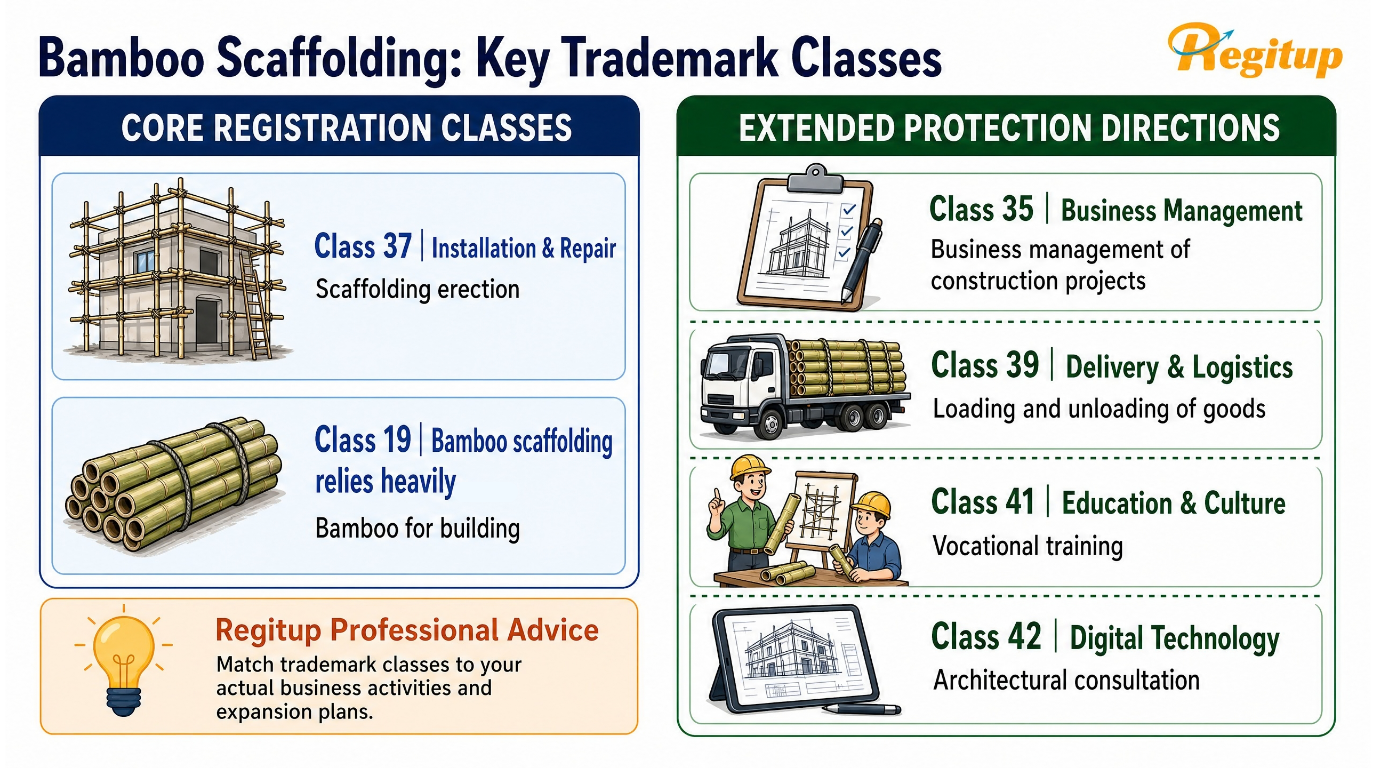
The brand rights for bamboo scaffolding should be prioritized in classes directly related to construction practices and core consumables. The following table summarizes the essential base classes for bamboo scaffolding operators:
Class | Application Scenario / Why it is a Primary Class | Examples of Goods/Service Descriptions |
Class 37 | This is the core class for the industry, covering all on-site construction, assembly, and dismantling labor. | Scaffolding erection; construction services; building maintenance. |
Class 19 | Bamboo scaffolding relies heavily on bamboo materials of specific specifications; this class protects the building materials under the brand. | Bamboo for building; non-metallic scaffolding; non-metallic building materials. |
In Class 37, the focus of protection is the specific act of "scaffolding erection," which is the legal manifestation of the professional skills of bamboo scaffolding masters. The necessity of Class 19 arises because many bamboo scaffolding companies source or process their own bamboo, sometimes even having specific branded specifications. If a competitor sells bamboo materials under the same name and the business has not registered in Class 19, it will be difficult to claim trademark infringement. These two classes together form the most basic protection network for the bamboo scaffolding industry.
Extension Classes Based on Business Models
In addition to core assembly and materials, as bamboo scaffolding enterprises expand, their scope of operations often extends into management, consulting, or training. Operators should selectively add the following extension classes based on their actual operational activities:
Class | Application Scenario | Service Scope to Consider |
Class 35 | Providing business coordination and administrative management for franchise operations or large-scale construction projects. | Business management of construction projects; business management of franchises. |
Class 39 | Owning a fleet to transport large quantities of bamboo materials and accessories to various construction sites. | Loading and unloading of goods; logistics and transportation services; warehousing services. |
Class 41 | Providing safety operation training or technical certification courses for scaffolding practitioners. | Vocational training; providing training courses; organizing educational lectures. |
Class 42 | Involving mechanical calculations, safety assessments, or architectural design consulting for scaffolding structures. | Architectural consultation; engineering drawing; structural engineering research. |
These extension classes are not mandatory for all bamboo scaffolding companies but depend on whether the enterprise treats these activities as independent billable items or brand extension directions. For example, if a company only transports bamboo needed for its own projects, Class 37 already provides a certain level of coverage. However, if the company also provides logistics and transportation services to external parties, Class 39 becomes necessary. Similarly, if the company has a dedicated safety training department, it should protect its teaching brand through Class 41.
Conclusion
The trademark layout for bamboo scaffolding should have Class 37 construction services and Class 19 building materials as its dual core. Depending on whether the enterprise is involved in business management, technical consulting, vocational training, or logistics, Class 35, Class 42, Class 41, or Class 39 should be flexibly added. Through multi-dimensional class coverage, a business can ensure that its technical assets and market reputation are not infringed upon in the competitive construction market.
Please note that the class recommendations provided in this article are for informational purposes only. The specific goods or service names, class combinations, and the final scope of rights designated during the actual application will vary based on the examination standards of different countries and regions and the specific business details of the enterprise.
Assistance from Regitup
The precision of trademark registration directly affects a company's legal defense capabilities. The Regitup professional team has extensive experience in handling cross-border trademarks. We can help you accurately verify Nice classification data, prepare professional application documents, and submit applications to the authorities on behalf of your business, specifically tailored to the unique nature of bamboo scaffolding operations. We are committed to simplifying tedious legal procedures to ensure your brand receives the best legal protection in the engineering field.
Start Your Trademark Registration
Frequently Asked Questions
Q1 : Is it enough to register a bamboo scaffolding trademark in only one class?
Usually not. This is because bamboo scaffolding involves both "construction services" and "building materials." If you only register Class 37, although the scaffolding service is protected, you cannot stop others from selling bamboo materials under the same brand. It is recommended to register at least Class 37 and Class 19 simultaneously for basic brand protection.
Q2 : If my bamboo scaffolding is used for temporary stage construction, will the class change?
While the core still involves Class 37 construction services, if your business focuses on equipment rental for events or performing arts support, you may need to consider Class 41 (entertainment services) or Class 43 (related to equipment rental). However, for the "structural assembly" itself, Class 37 remains the primary class.
Q3 : Can I put "scaffolding master training" in Class 37?
No. Class 37 specifically refers to physical labor such as construction, repair, and installation. If your company provides technical teaching for scaffolding, issues certificates, or conducts safety lectures, these fall under the scope of education and training and must be registered in Class 41; otherwise, your training brand will lack legal protection.
Q4 : After registering a trademark, is it guaranteed that using the name on construction sites is not illegal?
Trademark registration protects the brand name from being misappropriated by others, which is separate from construction permits and safety qualifications on-site. Trademark rights prevent competitors from misleading customers with similar names, but you must still comply with local building regulations and safety standards.
Q5 : What is the difference between steel scaffolding and bamboo scaffolding in trademark classification?
Both are the same in Class 37 for "scaffolding erection" services, but there are significant differences in material classes. The main material for bamboo scaffolding belongs to Class 19 (non-metallic building materials), while steel scaffolding belongs to Class 6 (common metals and their alloys). Therefore, from a material perspective, the trademark layout paths for the two are completely different.