
Key Point | Details |
Intended Audience | Operators of Art Education Center and businesses planning related goods, services or brand development. |
Primary Classes | Class 41, Class 35 |
Extension Classes | Class 9, Class 16, Class 28, Class 35, Class 40, Class 41 |
What is an Art Education Center in this Context?
The "Art Education Center" discussed in this article refers to institutions that provide regular art theory education, painting technique training, and calligraphy guidance to children, adolescents, or adults through physical classrooms or online platforms. The business model of such institutions typically includes regular courses, one-off workshops, art promotion activities, and the display of related artworks. The core value lies in the transmission of knowledge and skill training, rather than simple commodity trading or gallery mediation. Clarifying this "teaching-based" premise helps entrepreneurs accurately target the categories with the highest defensive value.
Primary Classes
For the vast majority of Art Education Centers, Class 41 is the lifeline of the brand, while Class 35 is the cornerstone of commercial expansion.
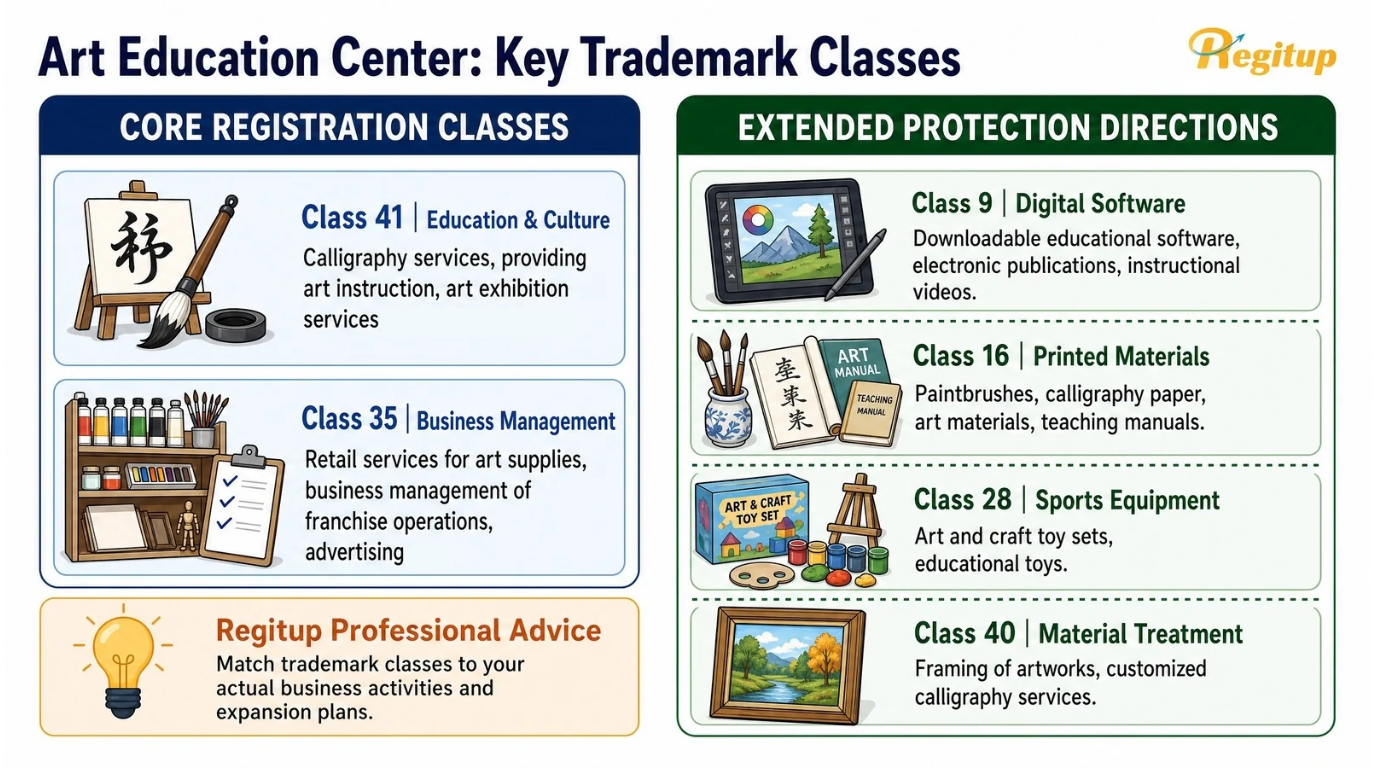
Class | Application Scenario / | Examples of Goods/Service Descriptions |
Class 41 | Providing core teaching services, course arrangements, and artistic and cultural activities. | Calligraphy services, providing art instruction, art exhibition services, arranging and conducting workshops. |
Class 35 | Involving retail of art supplies, brand franchise management, and marketing promotion. | Retail services for art supplies, business management of franchise operations, advertising, retail and wholesale of artworks. |
Class Boundary Analysis
Class 41 protects the "provision of services," which is the act of a teacher instructing students in painting or calligraphy itself. This is the core asset of an Art Education Center and effectively prevents competitors from opening a classroom with the same name in the same area. Class 35 plays a dual role: first, it protects the right to "sell things," such as retail services for brushes and pigments; second, it protects the "business model." For brands planning to open franchises or establish a chain system, the business management and advertising protection provided by Class 35 is indispensable.
Extension Classes Based on Business Models
With digital transformation and product development, it is recommended to consider the following extension classes based on specific business activities:
Class | Application Scenario | Potential Scope of Services |
Class 9 | Providing downloadable digital courses, apps, or electronic publications. | Downloadable educational software, electronic publications, instructional videos. |
Class 16 | Self-developed and branded physical teaching materials or tools. | Paintbrushes, calligraphy paper, art materials, teaching manuals. |
Class 28 | Developing educational art toys or DIY handicraft kits. | Art and craft toy sets, educational toys. |
Class 40 | Providing subsequent processing or highly customized services for artworks. | Framing of artworks, customized calligraphy services. |
Class 42 | Operating a dedicated online teaching platform or providing cloud-based educational tools. | Hosting educational websites, providing online non-downloadable educational software. |
These extension classes should be decided based on whether there are "physical products sold under the brand" or whether "high-tech platform operations" are involved. If the center only uses commercially available art tools for teaching, there is no need to register Class 16; however, if a proprietary branded brush set is launched, Class 16 becomes crucial.
Conclusion
Building an Art Education Center brand requires Class 41 as the core protection, with Class 35 included depending on the scale. If digitalization or peripheral development is involved, planning for Class 9, Class 16, or Class 42 should be undertaken. Please note that the specific goods or services designated, class arrangements, and scope of rights in an actual application will vary depending on the laws of the filing jurisdiction and the specific business model. It is recommended to seek professional evaluation before formal application to ensure that the trademark strategy aligns with the brand development goals.
Complete Your Trademark Application with Regitup
Trademark registration is a professional legal process, and even minor errors can lead to losses in rights protection. The Regitup team has extensive cross-border practical experience and can assist you in accurately verifying data, preparing documents, and submitting on your behalf. We are committed to simplifying the process, allowing art educators to focus on creativity and teaching while leaving the tedious tasks of brand protection to the experts.
Start Your Trademark Registration
Frequently Asked Questions
Q1 : If I only provide free instructional videos online, do I need to register a trademark?
Yes. The primary function of a trademark is to identify the source. Registering a trademark in Class 41 can prevent others from using your name to publish content, protecting your brand reputation and future monetization potential.
Q2 : An Art Education Center wants to sell its own art books; which class should be chosen?
If selling physical art books, Class 16 should be the priority; if publishing in the form of e-books, consider Class 9. Class 41 only protects teaching activities and does not cover the right to sell publications.
Q3 : The center provides art consignment services; does this count as Class 41?
No. Retail or brokerage services for artworks belong to Class 35. Class 41 is for education and exhibition activities. If there are sales activities, it is strongly recommended to add Class 35.
Q4 : Can I register all the mentioned extension classes?
Yes, but it is recommended to prioritize them based on your budget and development plan. Excessive registration increases costs, and if a trademark is not used in a specific class for a long time, it may face the risk of cancellation.
Q5 : Is there a difference between calligraphy teaching and painting teaching in classification?
In the Nice classification, both calligraphy services and art instruction are categorized under Class 41. It is recommended to list both when writing the specific service description to obtain the most precise protection.