
Key Point | Details |
Intended Audience | Operators of Insurance and Asset Management and businesses planning related goods, services or brand development. |
Primary Classes | Class 36, Class 35 |
Extension Classes | Class 9, Class 16, Class 35, Class 36, Class 41, Class 42 |
Analysis Premise
In trademark practice, the Insurance and Asset Management industry is defined as financial institutions providing various types of insurance underwriting, claims consulting, as well as portfolio management and fund planning. Its core business model lies in risk transfer and asset appreciation. The scope discussed in this article focuses on businesses centered on financial protection and wealth management, including life insurance companies, property and casualty insurance companies, and professional asset management platforms, excluding pure software development or general e-commerce activities.
Primary Classes
For insurance or asset management companies, the primary goal is to ensure that core service names are legally protected. The following are the most critical primary classes for this industry.
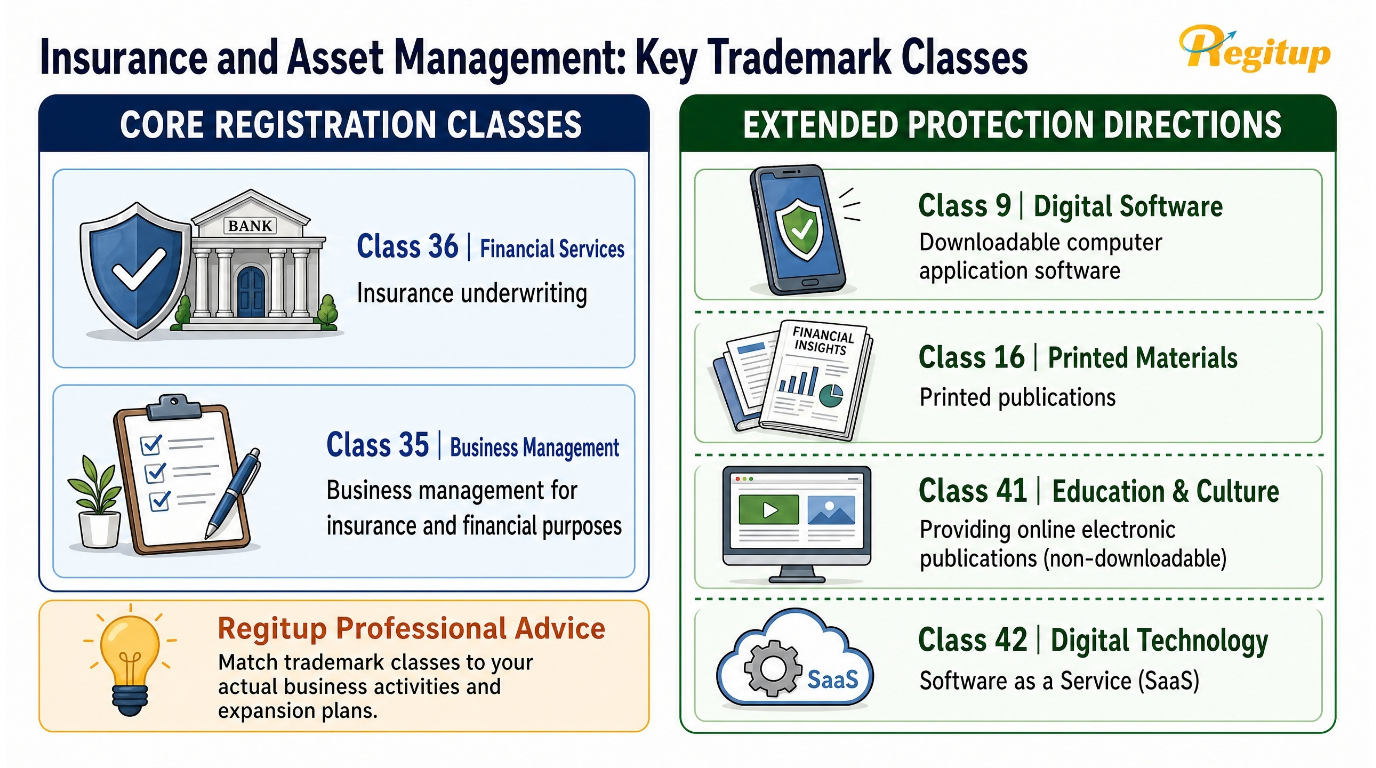
Class | Applicable Scenarios / | Examples of Goods/Service Descriptions |
Class 36 | Covers the signing of insurance contracts, execution of claims, and operation of fund assets. It is the most core class for this industry. | Insurance underwriting; management of investment funds; financial appraisals; claims processing. |
Class 35 | Protects the brand's rights in product promotion, agent management, and financial business operations, preventing competitors from misleading consumers. | Business management for insurance and financial purposes; marketing of insurance products. |
Class 36 is the lifeblood of the insurance and asset management industry. Whether it is life insurance, property insurance, or private equity fund operations, rights must be obtained in this class. Without this class, a brand will not be able to legally provide financial contract services. Class 35 complements the business operation level, especially when managing an agent system or conducting brand marketing, effectively preventing others from infringing at the administrative and advertising levels.
Extension Classes Based on Business Models
With the development of financial technology, the following extension classes should be considered for comprehensive protection based on the degree of digitalization or additional services of the enterprise.
Class | Applicable Scenarios | Potential Scope of Services |
Class 9 | When providing downloadable mobile insurance apps or financial planning software. | Downloadable computer application software; electronic wallet software. |
Class 16 | Issuing printed fund prospectuses or printed financial research reports. | Printed publications; prospectuses; promotional brochures. |
Class 41 | When hosting financial seminars, training, or providing non-downloadable investment commentary reports. | Providing online electronic publications (non-downloadable); financial education and training. |
Class 42 | When providing InsurTech or asset management SaaS platforms. | Software as a Service (SaaS); encrypted processing of financial data. |
Class 45 | Involving insurance compliance consulting, legal review of contracts, or brand licensing services. | Legal consulting; compliance auditing; intellectual property licensing. |
The selection of extension classes must be closely integrated with actual business operations. If positioned as a fintech company, SaaS protection in Class 42 is crucial; if services are primarily provided through an app, Class 9 is the key to defending against infringement. Enterprises should make precise arrangements for specific digital tools or promotional activities.
Conclusion
The trademark strategy for the insurance and asset management industry should have Class 36 and Class 35 as the dual cores, and incorporate extension protections such as Class 9 and Class 42 based on the degree of digitalization. A complete layout not only prevents the brand from being misused but also lays a legal foundation for future diversified operations.
Please note that the suggestions in this article are based on general industry practices. When actually applying, the names of designated goods or services, class combinations, and the scope of rights will vary depending on the laws of the place of application and business details. It is recommended to conduct a thorough search and professional evaluation before formal submission.
Assist with Trademark Applications by Regitup
Trademark registration is a highly professional process, especially in industries involving complex financial regulations. Precise classification is directly related to brand safety. The Regitup team has extensive practical experience and can assist in verifying information, preparing documents, and submitting on your behalf to ensure your brand is fully protected in the competition.
Start Your Trademark Registration
Frequently Asked Questions
Q1 : Why do insurance companies need to register Class 35?
Class 36 covers the core of the business, but Class 35 protects "business management" and "marketing." This prevents competitors from using similar names in business administration or marketing channels, causing consumer confusion.
Q2 : If I only provide online services, do I still need to register Class 16?
If you are fully digitalized and no longer print paper reports, the need is lower. However, if you still issue physical investment publications or brochures, Class 16 remains an important class for ensuring exclusive brand rights for printed materials.
Q3 : Should a financial management app be registered in Class 9 or Class 36?
It is recommended to register both. Class 36 protects the "financial service content," and Class 9 protects the "software product" itself. This makes it easier for you to assert your rights in app stores.
Q4 : Do I need to register a special class for providing investment seminars?
Yes, if you frequently host seminars or provide educational reports, Class 41 can protect the brand's reputation in the field of education and prevent others from opening fake courses in your name.