
Key Point | Details |
Intended Audience | Operators of Publishing Industry and businesses planning related goods, services or brand development. |
Primary Classes | Class 16, Class 41, Class 9 |
Extension Classes | Class 9, Class 16, Class 35, Class 38, Class 40, Class 41 |
Analysis Premise
The "Publishing Industry" referred to in this article centers on the editing, distribution, and sale of content for books, periodicals, and magazines. it encompasses both traditional physical print production and modern digital content supply (such as e-books and online reading platforms). The target audience includes organizations focused on content production and commercialization.
Primary Classes
Class | Application Scenario / | Examples of Goods/Service Descriptions |
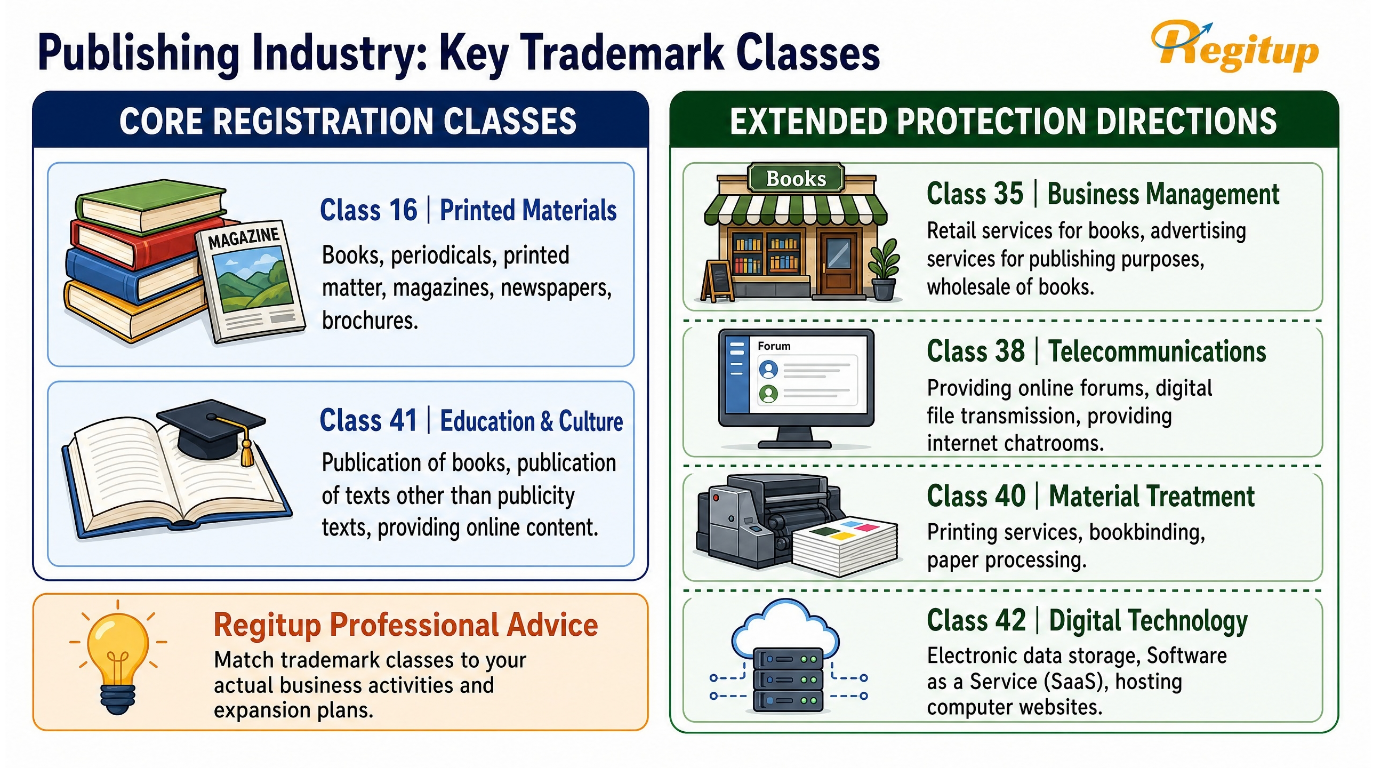
Class 16 | Production of physical printed materials; core physical protection for the publishing industry. | Books, periodicals, printed matter, magazines, newspapers, brochures. |
Class 41 | Publishing and cultural services; professional services for editing and distribution. | Publication of books, publication of texts other than publicity texts, providing online non-downloadable electronic publications. |
Class 9 | Digital publications; protection for downloadable digital content files. | Downloadable electronic books, downloadable electronic journals, downloadable electronic publications. |
In the publishing industry, these three classes form a comprehensive protection system. Class 16 targets physical paper products, the foundation of traditional publishing; Class 41 protects editing and distribution services, covering online reading; Class 9 focuses on the commercial protection of digital files. These three complement each other to ensure the brand holds exclusive rights across different media.
Extension Classes Based on Business Models
Class | Application Scenario | Potential Scope of Services |
Class 35 | Brand Marketing and Channel Retail | Retail services for books, advertising services for publishing purposes, wholesale of books. |
Class 38 | Online Community or Digital Transmission | Providing online forums, digital file transmission, providing internet chatrooms. |
Class 40 | In-house Printing Equipment or Processing | Printing services, bookbinding, paper processing. |
Class 42 | Reading Software or SaaS Platform | Electronic data storage, Software as a Service (SaaS), hosting computer websites. |
Class 45 | Copyright Operation and Licensing Management | Intellectual property licensing, copyright management, book copyright agency services. |
Conclusion
Trademark layout for the publishing industry should emphasize both goods and services. The primary classes should prioritize Classes 16, 9, and 41; if the business involves retail channels, copyrights, or technical platforms, it should extend to Classes 35, 45, or 42. It is important to note that the scope of protection varies depending on the laws of the filing jurisdiction and the specific business operations. The information in this article is for reference only and does not constitute a legal guarantee.
Assistance from Regitup for Trademark Application
The Regitup team has extensive experience and provides precise advice. We help organize terminology to ensure your brand receives comprehensive protection. From verification to submission, Regitup is committed to simplifying the process, allowing you to focus on content creation.
Start Your Trademark Registration
Frequently Asked Questions
Q1 : If I only publish e-books, do I still need to register in Class 16?
It is recommended to consider it. Successful brands often release physical commemorative editions later. Registering in Class 16 reserves space and prevents others from using the same brand name to issue physical copies, which could cause confusion.
Q2 : Which class should I register for a website that provides free online reading?
It is usually classified under Class 41 as "providing online non-downloadable electronic publications." Even if it is free, the core remains a publishing service. If it includes social features, Class 38 should also be considered.
Q3 : How should a publisher choose classifications if they also sell cultural and creative products?
If the cultural products are paper-based (such as notebooks), they are usually already included in Class 16. However, if they involve canvas bags (Class 18) or mugs (Class 21), additional classes must be added based on the nature of the products.
Q4 : Is the classification for a copyright agency the same as for a publisher?
No, they are different. The core of a publisher is content production and distribution, while a copyright agency focuses on rights licensing and management, which falls under Class 45. If you negotiate copyrights on behalf of others, Class 45 is a necessary extension.
Q5 : Why does my e-book reading app need to be registered in Class 42?
If you develop proprietary software or provide cloud storage involving technical platform maintenance, it falls under the category of "Software as a Service (SaaS)." To prevent the brand from being misused, Class 42 is an important category for protecting technical services.