
Key Point | Details |
Intended Audience | Operators of Chinese Herbal Medicine Cultivation and businesses planning related goods, services or brand development. |
Primary Classes | Class 31, Class 44, Class 5 |
Extension Classes | Class 1, Class 3, Class 5, Class 31, Class 35, Class 41 |
Analysis Premise
The Chinese herbal medicine cultivation discussed in this article focuses on the field planting, nurturing, and harvesting of medicinal plants (Chinese herbs) as the core business model. This includes processes from seedling raising and farmland management to harvesting, where the harvested products are sold as raw agricultural products or medicinal raw materials after primary processing such as cleaning and drying. This definition does not involve complex chemical pharmaceuticals or clinical medical services. Clarifying this premise helps operators accurately protect their core assets and avoid investing excessive resources in unrelated categories.
Primary Classes
For the core business of Chinese herbal medicine cultivation, trademark applications should focus on two dimensions: product production and service provision.
Class | Application Scenario / Why it is a Primary Class | Examples of Goods/Service Descriptions |
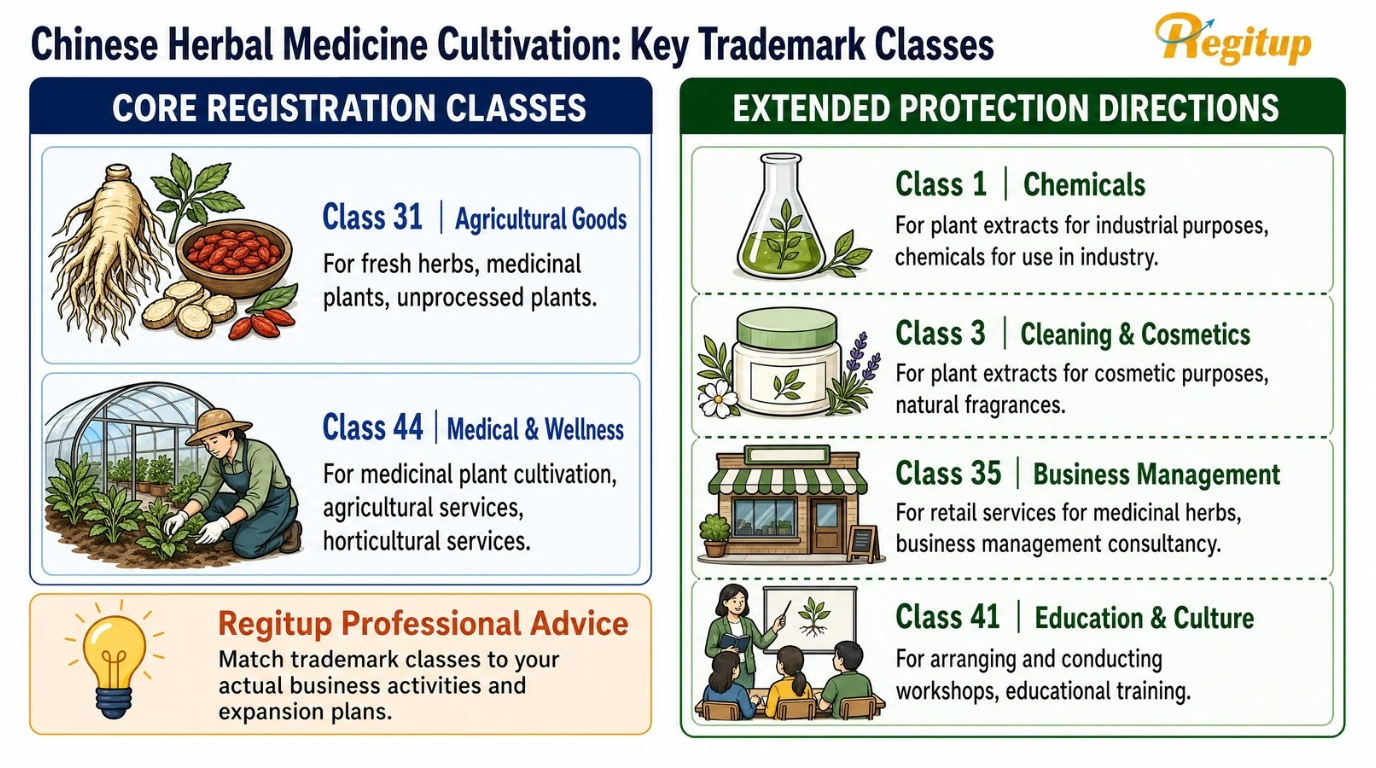
Class 31 | Sales as raw agricultural products, protecting medicinal plants in their fresh state. | Fresh herbs, medicinal plants, unprocessed plants. |
Class 44 | Providing actual cultivation techniques, farmland management, and horticulture-related services. | Medicinal plant cultivation, agricultural services, horticultural services. |
Class 5 | When the harvested products are defined as raw material commodities with medical purposes. | Medicinal herbs, roots of medicinal plants, plants for medical purposes. |
Class 31 primarily protects unprocessed natural products and serves as the identification basis in the agricultural product market. Class 44 targets "service actions," such as contract cultivation or technical guidance. Class 5 covers raw materials with medicinal properties, ensuring that the brand's rights remain intact when supplying to pharmaceutical factories or traditional Chinese medicine stores. These three classes complement each other and are all essential.
Extension Classes Based on Business Models
Beyond core operations, enterprises can extend into the following related fields based on their level of diversification:
Class | Application Scenario | Potential Scope of Services |
Class 1 | Producing extracts for industrial use (non-medical). | Plant extracts for industrial purposes, chemicals for use in industry. |
Class 3 | Processing herbs into plant-based raw materials specifically for cosmetics. | Plant extracts for cosmetic purposes, natural fragrances. |
Class 35 | Operating wholesale or retail of medicinal herbs or establishing a base brand franchise system. | Retail services for medicinal herbs, business management consultancy. |
Class 41 | Organizing technical training for herbal cultivation or popular science education activities. | Arranging and conducting workshops, educational training. |
Class 42 | Investing in research and development of breeding techniques or scientific analysis of plant components. | Scientific research, biological research, research on plant varieties. |
Extension classes are not mandatory; enterprises should review their five-year development plan. For example, if there is a plan to transform from a farm into a biotechnology company with R&D capabilities, Class 42 should be considered; if there is an intention to enter the end-retail market, Class 35 should be added.
Conclusion
The Chinese herbal medicine cultivation industry should use Classes 31, 44, and 5 as its core pillars and flexibly extend to Classes 35, 42, or 1 based on specific business activities such as wholesale/retail, scientific R&D, or industrial raw material production. This article suggests an analysis based on general business models. The actual description of goods and the scope of rights during application may vary depending on local regulations and business details. A thorough review is recommended before submission.
Trademark Application Assistance by Regitup
The accuracy of trademark classification directly affects an enterprise's legal defense capabilities. The Regitup team has extensive industry experience and can assist you in verifying classification data, preparing professional application documents, and submitting them on your behalf. We are committed to simplifying the registration process to ensure your brand receives solid protection in the market.
Start Your Trademark Registration
Frequently Asked Questions
Q1: If I only grow herbs and sell them to wholesalers, do I still need to register in Class 5?
Yes. If the output is explicitly circulated as medicinal raw materials, Class 5 provides targeted protection, preventing competitors from using similar trademarks in the field of medicinal commodities.
Q2: What is the difference between Class 44 and Class 31?
Class 31 protects the "items" sold (fresh plants), while Class 44 protects the "actions" performed (cultivation services). If you are commissioned to manage a herb garden, Class 44 is indispensable.
Q3: Which class does hosting pick-your-own activities at a farm belong to?
Pick-your-own activities combine entertainment and educational nature, involving Class 41. If this activity is a significant source of income, it is recommended to consider adding this category.
Q4: Does developing new herb varieties require additional registration?
Scientific R&D or component analysis involving plant varieties falls under Class 42. This is particularly important for companies whose competitiveness lies in technical leadership.
Q5: Can I register all classes at once?
Technically, yes, but it will result in higher official fees. It is recommended to first secure the core classes (31, 44, 5) and then gradually add others according to your budget and expansion plans.