
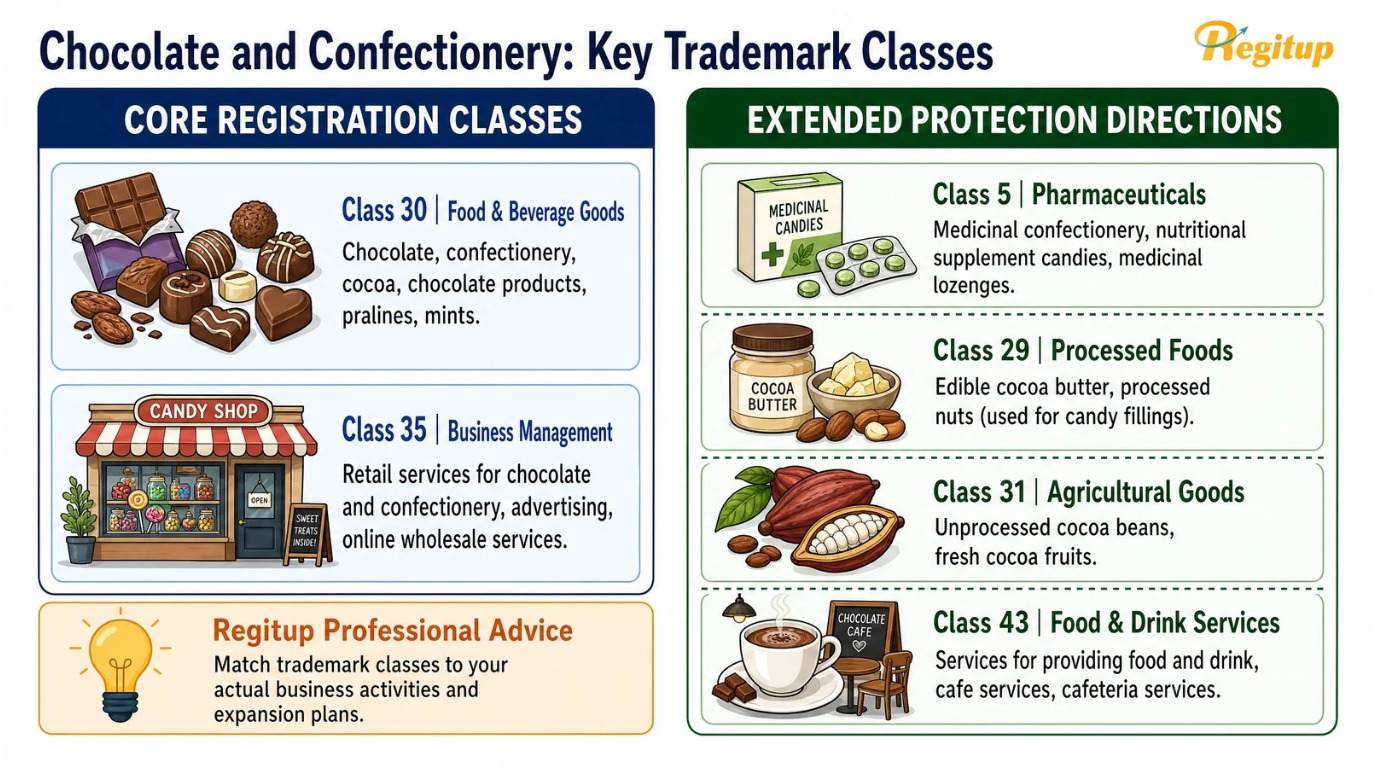
Key Point | Details |
Intended Audience | Operators of Chocolate and Confectionery and businesses planning related goods, services or brand development. |
Primary Classes | Class 30, Class 35 |
Extension Classes | Class 5, Class 29, Class 30, Class 31, Class 35, Class 43 |
Analysis Premise
In trademark practice, the core business model of the Chocolate and Confectionery industry is defined as the production, manufacturing, and brand management of various chocolates, cocoa-related products, and all types of candies. This covers not only the research, development, and packaging of the products themselves but also retail and wholesale activities conducted through physical counters, specialty stores, or e-commerce platforms.
It is important to note that this analysis focuses on the food sector of the mass consumer market. If a business involves medicinal candies for therapeutic purposes or purely wholesale trade of unprocessed agricultural raw materials (such as raw cocoa beans), the classification logic will differ. Clearly defining business boundaries is the first step in selecting trademark classes, ensuring that the brand receives precise and effective legal protection within its core operating scope.
Primary Classes
For most companies engaged in the production and sale of chocolate and confectionery, Class 30 and Class 35 are indispensable basic lines of defense. These two classes protect "the product itself" and "business operating activities," respectively, together forming the two pillars of brand protection.
Class | Applicable Scenarios / Why it is a Primary Class | Examples of Goods/Services Descriptions |
Class 30 | Product Protection: This is the primary category for chocolate and confectionery, protecting the product's identity in the market. | Chocolate, confectionery, cocoa, chocolate products, pralines, mints. |
Class 35 | Channel Protection: Protects the brand's right to operate retail stores, e-commerce platforms, and conduct advertising and promotions. | Retail services for chocolate and confectionery, advertising, online wholesale services, business management. |
In-Depth Analysis of Class Boundaries
Class 30 is the most core category for all chocolate brands. Whether it is exquisite handmade chocolate, cocoa powder, or various gummies and hard candies, they all belong to this class. When applying, it is recommended to cover as many sub-terms related to "cocoa" and "chocolate" as possible to prevent competitors from using similar trademarks on related items.
Class 35 plays the role of a channel escort. Many chocolate brands are not just manufacturers but also operate sophisticated brand boutiques or online malls. Registering in Class 35 ensures that the brand's trademark rights are not infringed upon when providing "retail services." Furthermore, if the brand involves franchising or large-scale advertising promotion, the protective effect of Class 35 becomes particularly important.
Extension Classes Based on Business Models
As business operations diversify, chocolate and confectionery businesses often expand into catering services, raw material processing, or special functional food sectors. The following classes are suggested for extension based on specific business activities:
Class | Applicable Scenarios | Potential Scope of Services |
Class 5 | Developing and selling special candies with medicinal functions, nutritional supplements, or hypoallergenic properties. | Medicinal confectionery, nutritional supplement candies, medicinal lozenges. |
Class 29 | Producing or selling food-grade processed ingredients, such as edible cocoa butter. | Edible cocoa butter, processed nuts (used for candy fillings). |
Class 31 | Involving the trade of unprocessed raw cocoa beans or the supply of agricultural raw materials. | Unprocessed cocoa beans, fresh cocoa fruits. |
Class 43 | Operating brand specialty stores, dessert shops, or attached cafes providing on-site catering services. | Services for providing food and drink, cafe services, cafeteria services. |
When considering extension classes, businesses should exercise conservative and precise judgment. For example, if only producing chocolate, there is no need to register in Class 31; this class is only meaningful if the company actually engages in the raw trade of cocoa beans. Similarly, if a store only provides take-out packaged products, Class 35 may be sufficient; however, if a seating area is provided for customers to enjoy chocolate drinks and desserts, Class 43 must be considered.
Conclusion
For the Chocolate and Confectionery industry, the trademark layout should center on Class 30 goods and Class 35 services to establish a solid brand foundation. On this basis, extension strategies should be flexibly adjusted according to whether physical catering spaces are operated (Class 43), whether functional foods are involved (Class 5), or whether raw material production is part of the business (Classes 29, 31).
It must be emphasized that the actual description of designated goods or services, the arrangement of classes, and the final scope of rights will still vary based on the examination practices of the filing jurisdiction (such as Taiwan, Mainland China, or the European Union) and specific business details. Businesses should conduct thorough searches and professional assessments before submitting an application.
Assistance from Regitup for Trademark Applications
Trademark registration is a highly professional and tedious process. From the precise selection of classes to the preparation of application documents, every step is crucial to the brand's future legal security. The Regitup team has extensive experience in cross-border trademark practice and can provide you with professional data verification, application strategy planning, and representative submission services. Through systematic processes and professional consultant guidance, we are committed to helping businesses build the strongest brand defense system in an ever-changing market.
Start Your Trademark Registration
FAQ
Q1 : I only sell chocolate online; do I still need to register in Class 35?
Yes. Class 35 covers retail services for e-commerce platforms. Even without a physical store, displaying goods online, processing orders, and conducting brand marketing all fall within the scope of protection for Class 35. This prevents others from operating an online chocolate boutique with the same name and confusing consumers.
Q2 : Do chocolate-flavored ice cream or cakes also belong to Class 30?
Yes, chocolate ice cream, cakes, and various pastries also belong to Class 30. However, if your brand focuses on "chocolate," it is recommended to explicitly include these items in the application description to ensure you have exclusive rights in the related dessert fields.
Q3 : If I produce "sugar-free" or "sugar-substitute" candies, will the classification change?
Usually not. As long as the candies are intended for general consumption as food, whether they contain sugar or not, the core classification remains Class 30. Unless the product is assigned a specific medicinal use or serves as a medicinal-grade nutritional supplement, Class 5 would not be involved.
Q4 : Why do some large chocolate brands register in dozens of classes?
Large brands often undertake "all-class" or "multi-class" layouts to prevent others from using the brand's reputation to create malicious associations in unrelated fields (such as clothing or cosmetics). For startups, it is recommended to first secure the core and extension classes mentioned in this article, and then gradually expand the scope of protection as the brand grows.
Q5 : If I want to open handmade chocolate workshops in the future, do I need to add a class?
Yes. Providing educational or entertainment-oriented handmade courses belongs to Class 41. This is a further business extension. If you plan to develop teaching or workshop models in the future, Class 41 should be included in your medium- to long-term trademark planning.