
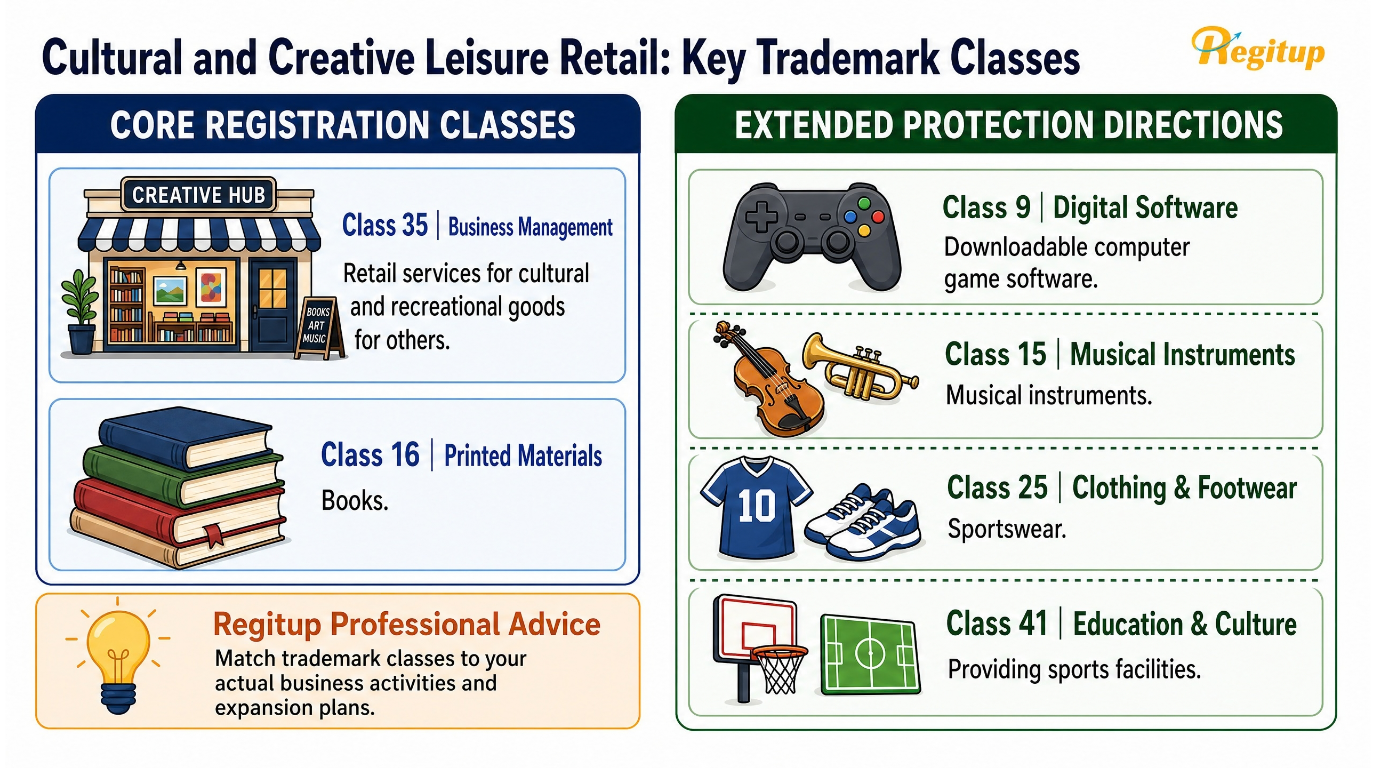
Key Point | Details |
Intended Audience | Operators of Cultural and Creative Leisure Retail and businesses planning related goods, services or brand development. |
Primary Classes | Class 35, Class 16, Class 28 |
Extension Classes | Class 9, Class 15, Class 16, Class 25, Class 28, Class 35 |
Analysis Premise
Cultural and creative leisure retail refers to an integrated retail business model targeting general consumers through physical or online channels for cultural and leisure goods, such as books, stationery, sporting goods, toys, musical instruments, and arts and crafts. This type of business typically combines "channel services" with "branded products." Operators not only need to protect the right to operate under their store name but also must register for specific product categories if they develop their own branded merchandise to establish a complete legal protection network.
Primary Classes
For comprehensive cultural and creative retail enterprises, the first step in brand protection is to secure core service categories and the most important product ranges. Below are the three primary classes that this industry must prioritize:
Class | Applicable Scenario / Why it is a Primary Class | Examples of Goods/Services Descriptions |
Class 35 | Retail Channels and Business Management: Protecting the right to operate the store name, signage, and e-commerce platforms is the foundation of the retail industry. | Retail services for cultural and recreational goods for others; book retail; stationery retail; sporting goods retail. |
Class 16 | Core Goods (Books and Stationery): Covers the most common items in cultural and creative stores, such as books, notebooks, office supplies, and printed materials. | Books; stationery; printed matter; posters; notebooks; office supplies. |
Class 28 | Core Goods (Toys and Sports): Protects educational toys, leisure equipment, and general sporting goods sold in-store. | Toys; sporting goods; games and playthings; educational games; sports balls. |
Operators must distinguish between "services" and "goods." Class 35 protects the store name and operating rights, preventing others from opening stores with the same name. To label a trademark on self-branded notebooks or pens, authorization in Class 16 is required. Class 28 covers most non-electronic games and sporting equipment, serving as an important defense against counterfeit branded merchandise. These three classes constitute the basic protection for cultural and creative retail, covering both operating rights and core products.
Extension Classes Based on Business Models
As business diversifies, cultural and creative retailers often expand into education, professional equipment, or digital technology. Based on research records, the following extension classes are recommended for consideration:
Class | Applicable Scenario | Scope of Services to Consider |
Class 9 | When selling digital games, e-books, or audio-visual media. | Downloadable computer game software; electronic publications (downloadable); audio-visual media. |
Class 15 | When involved in the sale of professional musical instruments such as pianos and violins. | Musical instruments; pianos; violins; accessories for musical instruments. |
Class 25 | When selling specialized sports apparel or footwear. | Sportswear; sports shoes; sports hats; sports socks. |
Class 41 | When providing cultural activities, sports facilities, or arts and crafts courses. | Providing sports facilities; arranging and conducting training classes; cultural and artistic lectures; operating workshops. |
Class 42 | When providing cultural and creative design software platforms or SaaS services. | Providing online non-downloadable software; Software as a Service (SaaS). |
Extension classes should be determined with precision. If only selling third-party e-books, Class 9 registration may not be necessary; however, if developing a proprietary App, Class 9 and Class 42 become critical.
Conclusion
Cultural and creative leisure retail should use Class 35 as its cornerstone, combined with Class 16 and Class 28 to establish core protection. Extension businesses should be allocated based on operational weight. The analysis in this article is for reference only. Actual applications may vary depending on regional examinations. It is recommended to consult a professional advisor before submission to ensure your rights.
Complete Your Trademark Application with Regitup
Trademark classification details are complex. The Regitup team has extensive experience in cross-border trademark practice and can help you accurately verify information, prepare professional application documents, and submit applications to authorities in various countries. Through professional category planning, we are committed to building a solid legal moat for your brand, allowing you to focus on the innovative growth of your business.
Start Your Trademark Registration
Frequently Asked Questions
Q1 : Do online cultural and creative e-commerce businesses also need to register Class 35?
Yes. Class 35 covers the operation of e-commerce platforms, including services that categorize goods to help customers search and purchase. Registering this class prevents others from misappropriating your store name to open similar online shopping platforms.
Q2 : If my store sells clothing, must I add Class 25?
If clothing is only a small amount of branded merchandise, you can decide based on your budget. However, if you plan to develop a full clothing line, Class 25 is an indispensable protective item.
Q3 : Why do books and e-books need to be registered separately?
Physical books are classified under Class 16, while e-books are considered "downloadable digital content" and are classified under Class 9. If you operate in both formats, it is recommended to register both for comprehensive protection.
Q4 : Which class should I register for holding handmade workshops in-store?
Holding training courses or workshops falls under "education and entertainment services" and should be registered in Class 41. This is different from simply selling material kits (Class 16 or Class 28), as it protects the branded service of activity arrangement.
Q5 :Why is it not recommended to register all 45 classes at once?
In addition to high official fees, many countries require proof of actual use after registration. Registering irrelevant classes may face the risk of "cancellation of registration" by others, and overly broad registrations are also more likely to be rejected.